

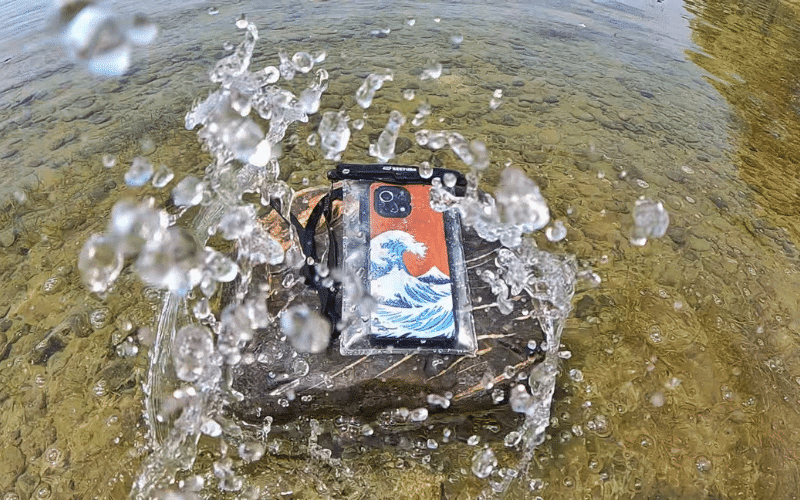
A phone in a pocket on a paddle board is a phone with a countdown on it.
You will fall in eventually, and even if you do not, spray and a wet hand are enough to end an afternoon and a device.
The good news is that this is a solved problem for under ten dollars. The catch is that most pouches do not float, most are rated IPX8 rather than IP68, and quite a few will not close around a large phone with its case on.
We compared ten waterproof phone pouches for paddle boarding, from Pelican’s certified marine case to four dollar family packs, and sorted them by what they actually get right.


The best waterproof phone bags at a glance
| Pouch | Rating | Fits | Standout features |
|---|---|---|---|
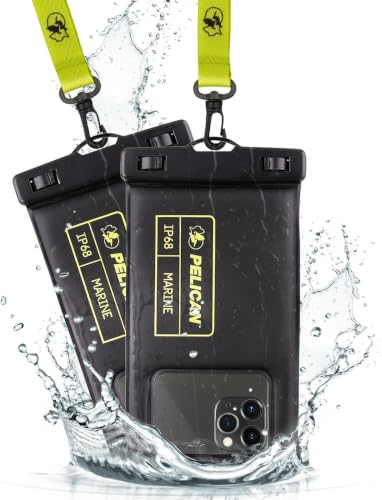
| Pelican Marine Waterproof PouchTop pick | IP68, 1 m | Regular size phones | Floats, side button access, detachable lanyards, 1 year warranty |
| Hiearcool Waterproof PouchBest value | IPX8 | Up to 8.9 in inner space | Fits big phones with case on, dual lock seal, 2 pack |
| ProCase Floating PouchBest floating | IPX8 | Up to 7 in | Floating padding built in, TPU windows, adjustable lanyards |
| JOTO Universal Waterproof CaseThe classic | IPX8, 100 ft | Up to 7 in | Clear front and back, snap and lock, neck strap |
| Lamicall Waterproof PouchEasiest to close | IPX8 | Up to 7 in with case | Curved locking clips, 99 percent light transmittance, 2 pack |
| Rynapac Large Waterproof PouchLargest | IPX8 | Up to 10 in | Two compartments, cards and keys separate from the phone |
| Takfox Floating PouchBest strap options | IPX8, 100 ft | Large phones | Lanyard plus reflective armband, front and back windows |
| ProCase Waterproof Pouch 2 PackBest button access | IPX8, 100 ft | Up to 7 in | Side button cutaway design, clear both sides, lanyards |
| Outdoor Products Watertight CaseRigid alternative | Watertight gasket | Inside 6.75 x 3.75 in | Shatterproof polycarbonate, latch closure, hard shell |
| Newppon 4 Pack Waterproof PouchFamily pack | IPX8, 100 ft | Up to 7.2 in | Four pouches, dual swivel locks, detachable lanyards |
The ten pouches in detail
- RatingIP68 certified, 1 m for 30 minutes
- Floatsyes
- Materialsoft TPU with clear window
- Accessside buttons usable through the case
- Contents2 pouches, 2 detachable lanyards, 1 year warranty
Best for: Anyone who would replace their phone rather than shrug it off
Pelican make hard cases for people who transport expensive equipment, and this pouch is built with the same instinct. The seal is properly engineered, the TPU is thick, and it floats with a phone inside.
Floating is the feature that matters most on a paddle board. A sealed phone that sinks in twelve feet of water is just as gone as an unsealed one.
Thirty five dollars for two pouches feels steep next to eight dollar twin packs. Compare it to the phone instead, and it stops being a difficult decision.
Strengths
- IP68 rather than IPX8, so it is rated against dust as well as water
- Actually floats, which no amount of sealing can substitute for
- Side button access works, so you are not fighting the pouch to take a photo
- Pelican back it with a one year warranty, which nobody else here does
Weaknesses
- Four times the price of the cheap pouches
- Regular size, so the largest phones in thick cases are a squeeze
- RatingIPX8, fully sealed
- Inner space8.9 in
- Sealreinforced dual lock
- Windowsclear touch responsive front
- Contents2 pack
Best for: Large phones that never come out of their protective case
The most common complaint about cheap pouches is that a modern phone in a chunky case will not fit. This one has the space, which is why it is the value pick rather than the cheapest.
The double lock is the other reason. Two clips rather than one is the difference between confidence and checking the seal every ten minutes.
It does not float. On a board that means either a floating strap or clipping it to something that does, which our floating action cam handles comparison covers, since several of those grips include a floating strap.
Strengths
- The 8.9 inch inner space is the roomiest of the cheap pouches
- A big phone goes in with the case on, which is where most pouches fail
- Dual lock seal, more reassuring than a single clip
- Two in the pack for around eight dollars
Weaknesses
- Does not float on its own, budget for a floating strap
- Only the front window is fully usable, the back is smaller
- RatingIPX8 certified
- Floatsbuilt-in floating padding
- Materialtransparent TPU, front and back windows
- Fitsphones up to 7 in
- Contents2 pack with adjustable neck lanyards
Best for: Paddlers who want flotation without paying Pelican money
Flotation is the feature people skip and then regret. This pouch has it built into the padding, so a dropped phone sits at the surface long enough to grab.
The trade is bulk. It is a fatter pouch than a plain sleeve, which matters if you were planning to keep it in a pocket rather than on a lanyard.
For the money, this is the most sensible pouch on the list for a paddle board specifically. Everything above it is better made, nothing below it floats.
Strengths
- Floating padding is built in rather than sold separately
- Under nine dollars for two, which is remarkable for a floating pouch
- Clear TPU on both sides, so the rear camera still works
- Adjustable lanyards included
Weaknesses
- Seven inch limit, so the biggest phones with cases will not fit
- The floating padding makes it bulkier in a pocket

- RatingIPX8 certified to 100 ft
- Fitsup to 7 in diagonal, window 3.2 x 6.37 in
- Windowsclear front and back
- Closuresnap and lock
- Extrasneck strap included
Best for: A first pouch, or a spare for a guest
This is the pouch most people already own without knowing the brand. It has been on the market for years, the seal works, and it costs almost nothing.
Its weakness is size. The window is 3.2 by 6.37 inches, which a large phone in a rugged case will not enter, and forcing it stresses the seam.
Take the case off, fit the phone, and it does the job perfectly. Add a floating strap and it is a proper paddle board setup.
Strengths
- The pouch that has been sold in millions, and the seal is proven
- Clear on both sides, so photos through the back window work
- Snap and lock closure that is simple enough to get right in a hurry
- Around seven dollars
Weaknesses
- Tight on big phones, thick cases have to come off
- No flotation at all
![Lamicall Waterproof Phone Pouch, [Easy Lock] IPX8 Water Proof Phone Case](https://m.media-amazon.com/images/I/51qx4t2JcZL._SL500_.jpg)
- RatingIPX8
- Closureupgraded curved locking clips
- Materialsoft PVC, 99 percent light transmittance
- Fitsup to 7 in with case on
- Contents2 pack
Best for: Cold hands, and anyone who has ever mis-latched a pouch
Every pouch failure story starts the same way: the clip looked closed and was not. Lamicall reshaped the locking clip so it is obvious when it has snapped home, which is worth more than another decimal place on a rating.
The clarity is the other strong point. At 99 percent light transmittance the screen reads properly in bright sun, and the camera is usable.
Press the lock until it clicks, then pull it apart to test it. Doing that once on the beach is a habit worth building.
Strengths
- The curved clip is genuinely easier to lock with wet or cold fingers
- Very clear PVC, so the screen stays readable in sun
- Fits most phones with a slim case on
- Seamless heat pressed seams rather than glued
Weaknesses
- PVC scratches more easily than TPU over a season
- No flotation

- RatingIPX8, three layer lock down
- Sizeup to 10 in
- Layouttwo compartments, inner semi-sealed for cash, ID and keys
- MaterialPVC, face verification works through the window
- Contents2 pack
Best for: Carrying a phone, a card and a key without a separate dry bag
This is the pouch for people who want everything in one place. Phone in the outer compartment, a card and a key in the inner one, and nothing else to carry.
Ten inches means no fit problems ever, including tablets and the largest phones in rugged cases.
On a board, run it on a short lanyard or tuck it under the deck bungee, because a large pouch on a long strap swings when you paddle. For carrying more than that, a waterproof fanny pack is the better tool.
Strengths
- Ten inches of space, so any phone fits with any case
- Second compartment keeps a card and a key away from the screen
- Three layer closure, the most sealing hardware on the list
- Face recognition and photos work through the windows
Weaknesses
- Big enough to flap around on a lanyard
- Bulkier than it needs to be if you only carry a phone
Takfox Floating Waterproof Phone Pouch
Best strap options- RatingIPX8 certified to 100 ft
- Fitslarge phones, including Note and Ultra sizes
- Windowsclear front and back
- Extrasdurable lanyard plus reflective armband
- Closuresnap and lock
Best for: Paddlers who want the phone on an arm rather than swinging on the chest
A lanyard around the neck is fine until you lean forward to paddle hard and the pouch swings into the deck. The armband solves that, and it is the reason to pick this one.
It is cut for large phones, so the Ultra and Pro Max sizes go in without a fight.
Test the flotation in a sink at home. Pouches that float do so on trapped air, and how much air you seal in changes the answer.
Strengths
- Comes with an armband as well as a lanyard, which nothing else here does
- Sized for the large Samsung and iPhone Pro Max bodies
- Reflective armband is useful for the walk back at dusk
- Front and back windows for photos
Weaknesses
- The floating claim depends on trapped air, so test it before trusting it
- Armband is a loose fit over a thick wetsuit sleeve
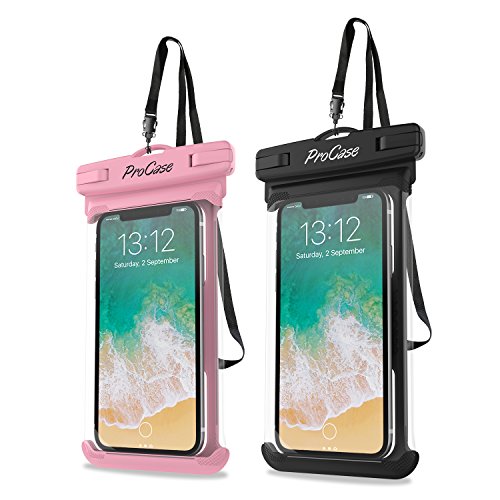
- RatingIPX8 certified to 100 ft
- Fitsup to 7 in diagonal
- Designside cutaway for volume and power buttons
- Windowsclear front and back
- Extraslanyard per pouch
Best for: Anyone who takes photos and hates fighting the case to do it
Being able to press the volume button through the pouch means you can take a photo with the shutter key instead of poking at a touchscreen through plastic. On the water, with wet fingers, that is the difference between getting the shot and dropping the phone.
The rest is a standard, well made IPX8 pouch with a proper lock and a decent lanyard.
Two per pack, in different colours. Small detail, but it stops the argument about whose phone is in which pouch.
Strengths
- Side button access is properly designed rather than an afterthought
- Two colours in the pack, so two people can tell them apart
- Upgraded lock is easy to close and stays closed
- Clear on both sides for the rear camera
Weaknesses
- Seven inch limit, so thick cases must come off
- Does not float

- Typerigid hard case
- Materialultra clear shatterproof polycarbonate
- Sealgasket with latch closure
- Outside7.25 x 4.25 x 0.75 in
- Inside6.75 x 3.75 x 0.5 in
Best for: Rough handling, where a soft pouch would get punctured
Every other product here is a bag. This is a box, and it solves a different problem: the phone is protected against being sat on, crushed under a board or dropped onto rock.
The trade is obvious. The screen is unusable while the phone is inside, so this is storage rather than access.
Consider it if the phone spends the paddle stowed and only comes out on the beach. If you want to shoot photos while you paddle, take one of the pouches.
Strengths
- A hard shell protects against impact as well as water
- Gasket and latch, the same principle as a proper dry box
- Room inside for a phone plus a key or a card
- Clear polycarbonate, so you can see what is inside
Weaknesses
- You cannot use the touchscreen through it
- Rigid, so it does not fold into a pocket

- RatingIPX8 certified to 100 ft, 30 m
- Fitsup to 7.2 in
- Closuredual plastic swivel locks
- Materialtransparent PVC
- Contents4 pouches with detachable lanyards
Best for: Families, groups and rental boards, where one pouch is never enough
Four pouches for seven dollars is the price at which you stop rationing them. One in each dry bag, one in the car, one for whoever came along.
The dual swivel locks are better than the single clips found on other budget pouches, and the lanyards are decent.
Do not expect them to survive several seasons of sun and sand. Treat them as consumables, replace them when the PVC clouds, and keep the good pouch for your own phone.
Strengths
- Four pouches for about seven dollars
- Dual swivel locks rather than a single clip
- Fits up to 7.2 inches, slightly more generous than most cheap pouches
- Detachable lanyards with a rotating head that resists tangling
Weaknesses
- PVC is the thinnest material here and will not last years
- Flotation is not reliable, treat them as sealed only
How to choose a waterproof phone bag
IPX8 is not the same as IP68: The X in IPX8 means the case was never tested against dust. IP68 covers both. For a paddle board that distinction matters less than sand does, but it tells you how thoroughly a manufacturer tested the product. There is a clear explanation of what the digits mean in the IP code reference.
Flotation beats sealing: A sealed phone that sinks is still lost. Either buy a pouch with flotation built in, or add a floating strap, or clip the pouch to something buoyant. On open water this is the single most important decision.
Measure before you buy: Most pouches list a diagonal size, but the inner window is what really decides fit. A large phone in a rugged case usually needs an 8.5 inch or larger pouch. If in doubt, plan to remove the case.
Test it empty, every season: Seal the pouch with a folded paper towel inside and hold it underwater for a minute. Dry towel means you are good. Seams and clips degrade in UV, so do this at the start of each summer rather than assuming last year's result still holds.
Frequently asked questions
Do waterproof phone pouches float?
Only some of them, and only some of the time. Pouches with built-in floating padding, like the ProCase and the Pelican, are designed to. The rest float on whatever air you happen to seal inside, which is not something to rely on. Test yours in a sink before you trust it on open water.Can I use the touchscreen through the pouch?
Yes on every soft pouch here. Fingerprint sensors on the back generally do not work through the plastic, and face recognition usually does. Rigid cases like the Outdoor Products box do not allow any screen use at all.Will my phone overheat inside a sealed pouch?
It can, if it sits in direct sun on a dark deck while recording video or navigating. Keep it under a bungee in shade, stop recording when the phone warns you, and let it cool before opening the pouch in spray.How long do these pouches last?
A season or two of regular saltwater use for the cheap PVC ones, longer for TPU pouches like the Pelican. Rinse in fresh water, dry the seal, store flat and out of the sun, and replace the pouch as soon as the plastic clouds or the clip feels loose.Bottom line
If the phone in your pocket costs more than a paddle, buy the Pelican. It is IP68 certified, it floats, and it comes with a warranty, which is exactly the combination the cheap pouches leave out.
For everyone else, the Hiearcool is the value pick when your phone is large, and the ProCase floating pouch is the one to choose if the water is deep. Whatever you buy, test the seal with a paper towel before the phone goes in, and keep the pouch tethered to you or to the board, the same way the board itself is tethered.


