

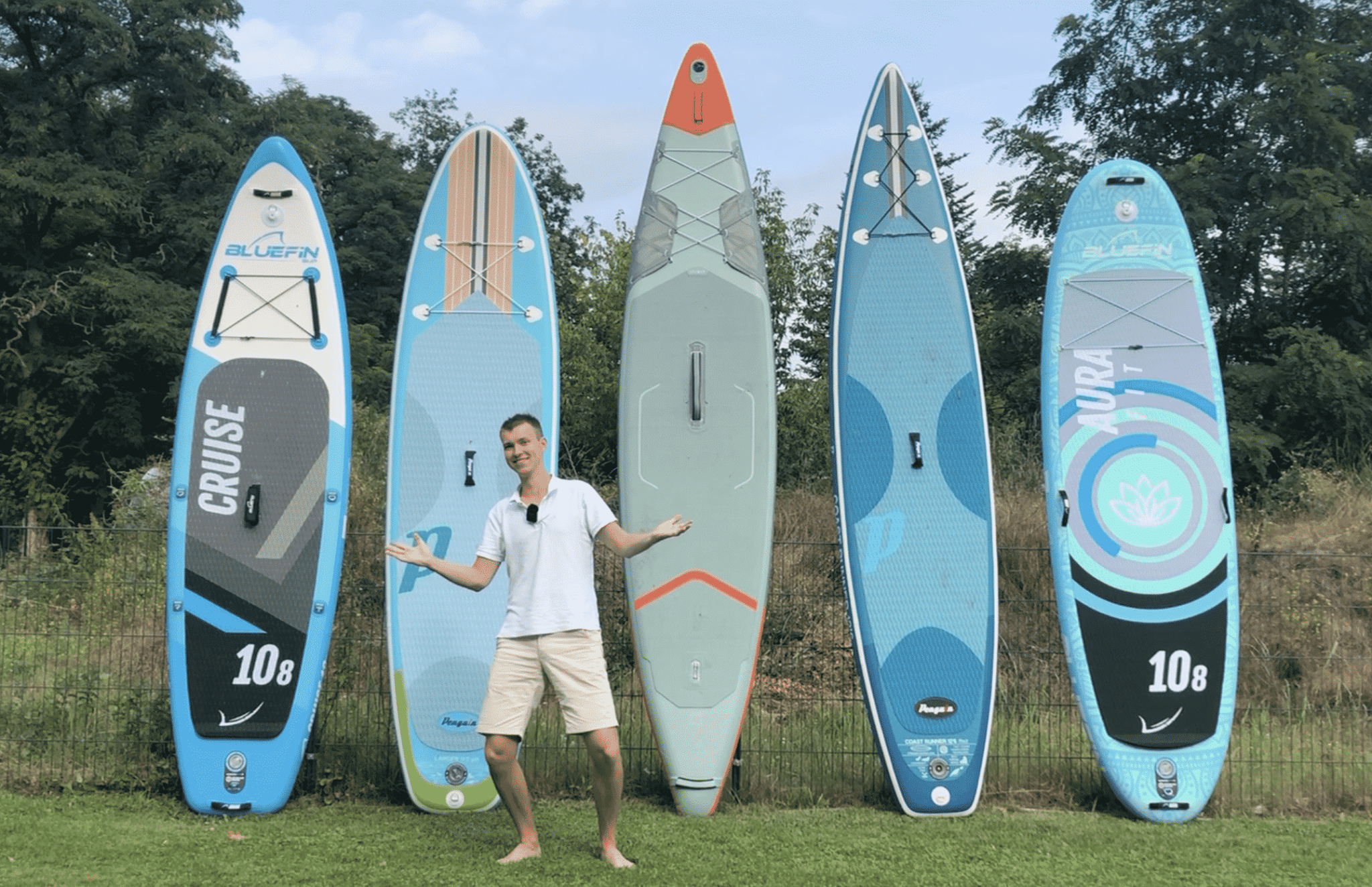
There is no single best paddle board, only the best board for what you do on the water. A touring hull and a fishing platform are barely the same object.
So this list is organised by job rather than by score. Nine boards, each the strongest answer to a different question, from a 700 dollar expedition board to a 140 dollar first board.
The specifications that matter across all of them are the same three: how the core is woven, whether the seams are welded or glued, and how much width sits under your feet.
Everything else on a spec sheet is packaging.


The best paddle boards at a glance
| Board | Size | Best for | Standout feature |
|---|---|---|---|
| NIXY MontereyTop pick | 11 ft 6 x 34 in x 6 in | Expedition and touring | Welded seams with a woven drop stitch core |
| THURSO SURF Expedition 12 ft 6Best touring | 12 ft 6 x 31 in | Distance paddling | 24 lb, heat-welded rails and fusion PVC |
| CETANA Fishing SUPBest for fishing | 11 ft 6 x 35 in x 7 in | Angling | Recessed deck and a two-chamber build |
| DAMA Triple ChamberMost stable | 10 ft 8 x 47 in | Groups and yoga | 47 in wide with three separate chambers |
| Retrospec WeekenderBest all-round | 10 ft 6 x 32 in | Everyday paddling | 17.5 lb with AerGlide-Lite PVC |
| NACATIN 12 ft with SeatBest 2-in-1 | 12 ft x 36 in | Sitting and standing | Kayak seat, rod holder and a fish ruler |
| Niphean Extra LargeBest for families | 11 ft x 33 in x 6 in | Two adults and a child | Over 500 lb capacity at 19 lb board weight |
| SLOOSH Meander 10 ft 6Best budget all-round | 10 ft 6 x 33 in x 6 in | Mixed use | 13 D-rings and a 20 psi maximum |
| Aqua Plus 11 ftBest value | 11 ft x 33 in x 6 in | A first board | 18.5 lb with reinforced rail layers |
The nine paddle boards in detail
- Size11 ft 6 x 34 in x 6 in
- Seamswelded
- Corewoven drop stitch
- Pressureup to 15 psi
- KitG4 Typhoon pump, G4 hybrid paddle, backpack and coiled leash
- Suitstaller and larger paddlers
- Pricearound 699 dollars
Best for: One board for touring, day trips and loaded paddling
A woven drop stitch core is the difference you feel underfoot. The threads are woven rather than knitted, so the deck pulls flatter at the same pressure and the board stops sagging in the middle.
Fifteen psi is the other half. Most budget boards claim it and reach twelve, and every complaint about a soft ride traces back to that gap.
At 11 ft 6 by 34 in it is faster than an all-round board without demanding the balance of a proper touring hull.
Strengths
- Welded seams and a woven core, the two things that actually make a board stiff
- Fifteen psi working pressure, which very few inflatables genuinely hold
- Thirty four inches of width on a touring hull, so it is stable as well as fast
- A hybrid paddle in the package instead of the usual aluminium stick
Weaknesses
- Seven hundred dollars
- Single chamber, so a puncture takes the whole board out
- Size12 ft 6 x 31 in x 6 in
- Weight24 lb
- Corewoven drop stitch with fusion PVC
- Railsheat welded
- D-rings15, with nose and tail bungees
- Kitboard, 3 fins, coiled leash and repair kit
- Pricearound 549 dollars
Best for: Long paddles where speed and glide matter more than stability
Length is what buys glide. A 12 ft 6 hull keeps moving between strokes in a way a 10 ft 6 never will, and on an hour long paddle that is the whole experience.
The narrow width is the price. Thirty one inches is fine once you can paddle, and unforgiving on the first day.
Note that this is a board-only package. That is deliberate on Thurso's part and it lets you spend properly on a carbon paddle rather than inheriting an aluminium one.
Strengths
- Twelve foot six is where a board starts to hold speed between strokes
- Twenty percent lighter than knitted drop stitch boards of the same size
- Fifteen D-rings for camping kit on a multi-day trip
- Heat-welded rails, the seam that fails first on cheaper boards
Weaknesses
- Thirty one inches of width demands some competence
- Sold without a pump or paddle, so budget for both

- Size11 ft 6 x 35 in x 7 in
- Capacity600 lb
- Deckrecessed for a lower centre of gravity
- Chamberstwo
- Fishing kitrod holder and universal mount
- Extrasseat, floating paddle, 5 L dry bag and phone case
- Pricearound 400 dollars
Best for: Anglers, and anyone who wants a platform rather than a boat
Standing to cast is the hard part of SUP fishing, because a strike pulls you sideways at the worst moment.
A recessed deck drops you into the board instead of onto it, and that changes how much force you can take before going in.
The second chamber matters more here than anywhere else on this list. Hooks, knives and rocky launches are what puncture boards.
Strengths
- A recessed deck genuinely lowers your centre of gravity, which no amount of width can copy
- Two chambers, so a puncture leaves you something to paddle home on
- 600 lb capacity for rods, cool box, tackle and you
- A rod holder and mount fitted rather than bolted on later
Weaknesses
- Seven inches of thickness makes it slow
- A specialised board that is dull on a plain cruise

- Size10 ft 8 x 47 in
- Capacity661 lb
- Chambersthree
- Fishingtwo rod holders
- Materialhigh-intensity PVC drop stitch
- Usefishing, yoga, family and groups
- Pricearound 340 dollars
Best for: Yoga, dogs, small children and anyone who refuses to fall in
Beyond about forty inches a board stops being something you paddle and starts being something you stand on, which for yoga and photography is exactly right.
Three separate chambers is the safety argument. Losing one still leaves a floating platform under everyone on board.
Do not buy it as a general purpose board. Buy it because you want a stable island, and keep a narrower board for actually going somewhere.
Strengths
- Forty seven inches is close to twice the width of a touring board
- Three chambers, which is as redundant as an inflatable gets
- 661 lb capacity takes a whole family at once
- Two rod holders included for fishing use
Weaknesses
- At 47 in wide it is a raft, not a paddle board, and paddles like one
- Awkward to carry and slow to inflate

- Size10 ft 6 x 32 in
- Weight17.5 lb
- MaterialAerGlide-Lite PVC
- Deckbrushed EVA pad
- Fins3 removable
- Kitadjustable paddle, dual-action pump, waterproof case and leash
- Pricearound 290 dollars
Best for: The board most people should own if they only own one
The all-round shape exists because most paddling is a couple of hours on flat water with a bag on the nose, and this shape is optimal for exactly that.
Retrospec have got the weight down without going to a premium construction, which is the useful trick at this price.
If you are unsure what kind of paddler you will become, this or a good beginner board is the low-regret choice.
Strengths
- 17.5 lb, light enough that it gets carried without complaint
- A dual-action pump in a package at this price
- 10 ft 6 by 32 in is the shape that does everything acceptably
- The centre handle doubles as a tow point for group paddling
Weaknesses
- Not the stiffest board here, and you feel it above ninety kilos
- A brushed deck pad shows dirt quickly

- Size12 ft x 36 in
- Capacity661 lb
- Seatkayak seat and double-sided paddle included
- Tailwidened tail platform
- Fishingbuilt-in rod holder and fish ruler
- Extrasfoot rest, dry bag and phone case
- Pricearound 285 dollars
Best for: Long days where you want to sit for part of the paddle
Sitting down is the answer to wind, distance and tired legs, and a board that converts properly is worth more than one that merely has D-rings.
The wide tail is the detail that makes it work. A narrow-tailed board sinks at the back the moment you sit on it.
Twelve feet with a seat is close to a fishing kayak in practice, with the advantage that it rolls into a bag.
Strengths
- A proper double-blade paddle included, not a token seat attachment
- The wide tail keeps the board level when you sit at the back
- 661 lb capacity for two people and gear
- A built-in fish ruler, which is a nice touch for catch and release
Weaknesses
- Thirty six inches of width is slow standing up
- A lot of board to inflate before every session

- Size11 ft x 33 in x 6 in
- Weight19 lb
- Capacityover 500 lb
- Fins4 detachable, with a larger centre fin
- Mountstwo multifunctional accessory mounts
- Warranty3 years, 30 day returns
- Pricearound 230 dollars
Best for: Two adults and a child, or one adult and two dogs
Most family boards buy their capacity with width and become unusable solo. This one buys it with volume instead and stays a normal board.
That matters because the family paddle happens twice a summer and the solo paddle happens every other week.
If passengers are the main event rather than the exception, a wider tandem board is the better tool.
Strengths
- Over 500 lb capacity on a board that weighs only 19 lb
- Thirty three inches, so it still paddles properly with one person on it
- Four fins, including a larger centre fin for tracking under load
- A three year guarantee at 230 dollars
Weaknesses
- Two adults on 33 in of width takes some coordination
- Budget accessories throughout the package

- Size10 ft 6 x 33 in x 6 in
- ConstructionFortaFusion with mesh-reinforced sidewalls
- Pressureup to 20 psi
- D-rings13, plus an M8 accessory mount
- Storage6-point front and 4-point rear bungee
- Paddle3-piece aluminium with dual locks
- Pricearound 170 dollars
Best for: Someone who wants the features of a 300 dollar board for half that
Sidewalls are the unglamorous part of an inflatable and the part that decides stiffness, because that is where the board folds under load.
Reinforcing them with mesh at this price is unusual and it is the reason this board sits above the other budget options.
Ignore the 20 psi figure. Anything past fifteen requires an electric pump and no board here needs it.
Strengths
- Mesh-reinforced sidewalls, which is where cheap boards flex first
- Thirteen D-rings and an M8 mount for seats, coolers and cameras
- A pointed nose that tracks better than the usual budget round nose
- A dual-lock paddle, so the sections stop twisting mid-stroke
Weaknesses
- A 20 psi rating that no hand pump will reach in practice
- Aluminium paddle, which is where the savings show
- Size11 ft x 33 in x 6 in
- Weight18.5 lb
- Capacity328 lb
- Railsadditional PVC layer
- Deck5 mm diamond groove traction
- D-rings11 stainless steel with a front bungee
- Kitpaddle, backpack, coiled leash, fin and phone pouch
- Pricearound 140 dollars
Best for: A first board that will not be embarrassing in year three
Rails take every knock, from docks to roof racks to the boot of a car, and an extra layer there is worth more than a thicker deck.
Stainless D-rings are the other quiet sign of a decent build. Plated hardware rusts and stains the deck within two seasons on salt water.
At 140 dollars this is the cheapest board on the list that does not feel like a compromise on the water.
Strengths
- An extra PVC layer on the rails, which is where boards take their knocks
- 18.5 lb, twenty percent under the usual weight for eleven feet
- 316 stainless D-rings rather than the usual plated steel
- A coiled leash included, which most budget packages skip
Weaknesses
- 328 lb capacity is modest for an 11 ft board
- One year warranty on materials only
How to choose a paddle board
Pick the length by the job: Ten to eleven feet is all-round, eleven to twelve feet carries passengers and gear, and twelve feet six is where touring starts. Under ten feet is a surf or river shape and will feel slow and wandering on a lake.
Width is the stability dial: Thirty one inches is quick and demanding, thirty two to thirty three is the sensible middle, thirty four and up is a platform. Every inch of width you add costs you speed, so add only as much as you need.
Construction is what the price buys: Welded seams, fusion PVC and a woven drop stitch core are the three features that separate a board that is still stiff in five years from one that is soft in two. If a listing does not mention them, assume glued seams and a knitted core.
Judge the package, then plan to replace half of it: Almost every board ships with an aluminium paddle and a basic hand pump. Both work, both are the first things you will upgrade, and neither should decide which hull you buy.
Learn the conditions before the technique: Paddle boarding is easy to learn and unforgiving of offshore wind, which pushes a light board out faster than a beginner can paddle back. Check the forecast, wear a leash, and tell someone where you are going.
Frequently asked questions
Inflatable or hard board?
For nearly everyone, inflatable. A well made inflatable at full pressure is stiff enough that the difference only shows in racing or real surf, and it wins outright on transport, storage and taking knocks. Hard boards remain faster and thinner in the rail.How much should I spend?
Around 150 dollars gets a board that works. Around 300 gets a noticeably better one. Above 500 you are buying welded seams and woven cores, which matter if you paddle weekly and are irrelevant if you paddle twice a summer.What size board for my weight?
Leave at least fifty kilos of headroom between your loaded weight and the stated capacity. A board close to its limit sits low, ships water and feels unstable, which is the most common reason people think they have bought the wrong shape.Can one board do everything?
An 11 ft all-round board at 32 to 33 in comes closest. It will tour slowly, surf badly and carry a passenger at a push. Every specialised board on this list beats it at one thing and loses to it at the rest.Bottom line
The NIXY Monterey is the overall pick because it combines the two construction features that decide how a board ages, welded seams and a woven core, with enough width to still be relaxing on a long day.
If you are covering distance, the Thurso Expedition 12 ft 6 is the faster tool. If you are fishing, the recessed deck on the CETANA does something no amount of width can. And at 140 dollars the Aqua Plus is a genuinely decent board rather than a cheap one.


