

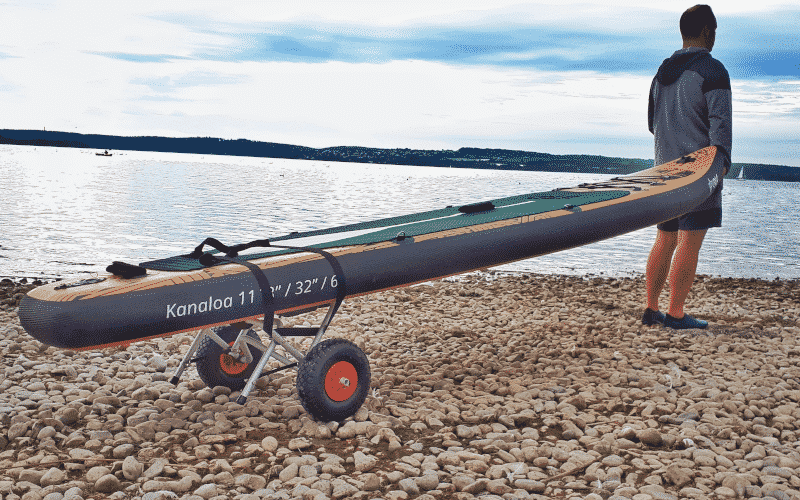
A board cart is bought for one reason: the walk from the car park to the water.
What decides whether it helps is not the frame or the load rating. It is the wheels, and specifically how they behave on soft dry sand.
Narrow solid wheels are fine on tarmac and gravel and sink to the axle in sand. Big low pressure balloon wheels float over it, but they are bulkier and cost more.
We compared eight paddle board carts, from a forty six dollar dolly that stows inside a hatch to a competition grade trolley with an adjustable padded platform, and sorted them by the ground they are actually for.

The best paddle board carts at a glance
| Cart | Wheels | Load | Standout features |
|---|---|---|---|
| Suspenz SUP and Surfboard CartTop pick | Airless | Boards up to 7 in thick | Powder coated aluminium, stainless hardware, neoprene foam padding |
| Bonnlo 12 inch Beach CartBest on sand | 12 in balloon | 300 lb | 22x3 mm aluminium tube, two ratchet straps, oversized wheels |
| Suspenz Double SUP Transport CartFor two boards | Airless | 1 or 2 SUPs up to 7 in | Aluminium frame, thick neoprene padding, rust free hardware |
| Suspenz Fishing Kayak Cart TrolleyHeaviest duty | Heavy duty | Any hull shape | 32 in adjustable padded bunker bars, four point tie-down |
| Pelican Universal SUP CartBest folding design | Large inflatable | Universal | Folds together, corrosion resistant metal, compact at 14.5 in wide |
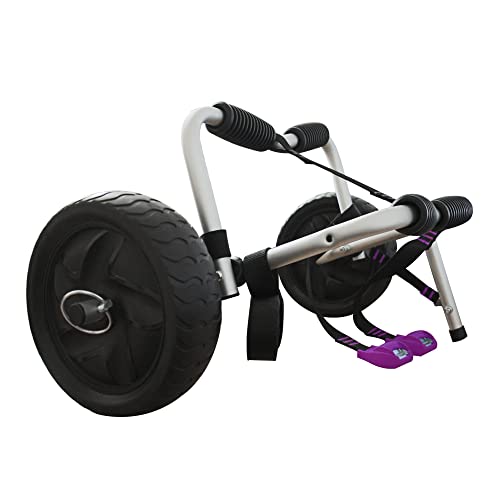
| Bonnlo Universal Kayak CarrierBest all-rounder | Solid PU airless | 200 lb | Anodised aluminium, folds flat, double kickstand, foam bumpers |
| Pinelicorn Double SUP CartBest value for two boards | 10 in solid | 176 lb | Carries two boards, corrosion resistant aluminium, no inflation |
| ASMSW Kayak and SUP TrolleyBest budget | Solid plastic | 100 lb | Breaks down for storage, two cam buckle straps, rubber protection |
The eight carts in detail
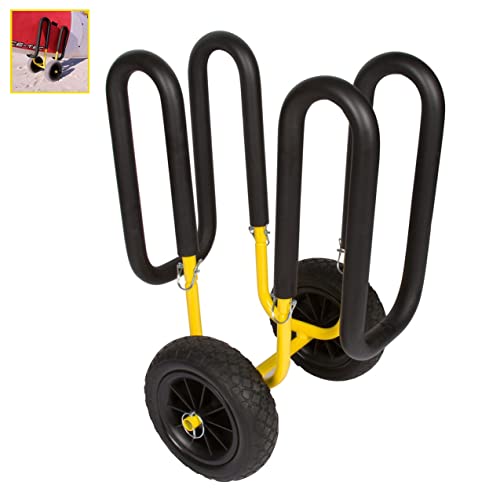
- Wheelsairless, puncture proof
- FitsSUPs and surfboards up to 7 in thick
- Framepowder coated aluminium
- Hardwarestainless steel, rust free
- Paddingthick neoprene foam
Best for: Anyone who wants a cart designed around a board rather than a kayak
Most carts sold for paddle boards are kayak carts with a different photograph. This one is genuinely built for boards, and the difference shows in how the board sits.
Powder coated aluminium with stainless hardware is the right specification for something that lives at the water's edge. Steel carts rust out at the welds within a couple of seasons of salt use.
Airless wheels are the sensible default. They roll well on grass, gravel and hard packed sand and need no maintenance at all, which is worth a lot for something used a dozen times a summer. Pair it with a set of carrier straps for the stretch where wheels do not help.
Strengths
- Built for boards, so the rails support the hull instead of pinching it
- Neoprene foam padding protects the rails on an inflatable as well as a hard board
- Aluminium and stainless throughout, so salt water does not destroy it
- Airless wheels, nothing to inflate before a trip
Weaknesses
- One hundred and thirty dollars
- Airless wheels are less capable on deep dry sand than balloon tyres
- Wheels12 in low pressure balloon
- Load300 lb
- Frame22x3 mm aluminium alloy tube
- Strapstwo 7.75 ft ratchet straps
- Terrainsoft sand, gravel, rough ground
Best for: Beach launches where the walk across dry sand is the hard part
Soft sand is where cheap carts fail. A narrow wheel cuts in and you end up dragging, which is exactly what the cart was meant to prevent.
The physics is simply ground pressure: a wide low pressure tyre spreads the same load over far more area, so it stays on top instead of sinking.
Buy it if your regular launch involves more than about fifty metres of dry sand. If it does not, the extra bulk is not worth carrying around.
Strengths
- Twelve inch balloon wheels genuinely float over soft sand
- 300 pound limit covers any board plus a full load of kit
- Ratchet straps rather than cam buckles, so the load stays put
- Aluminium tube, so nothing rusts
Weaknesses
- Big wheels take up real space in a car boot
- Inflatable, so it can go flat at the worst moment
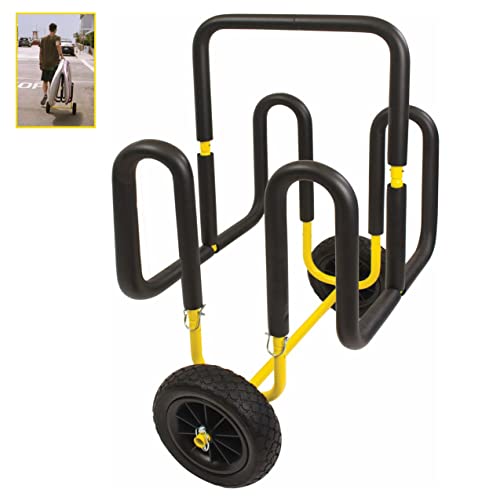
- Wheelsairless
- Capacityone or two SUPs or surfboards up to 7 in thick
- Framelightweight powder coated aluminium
- Hardwarestainless steel
- Paddingthick neoprene foam
Best for: Couples and families who move two boards at once
Two boards on one cart sounds like a small convenience until you have done the double walk from a distant car park a few times.
Construction matches the single cart: aluminium, stainless, neoprene padding. Nothing here corrodes, which is the main reason cheap carts get thrown away.
The seven inch thickness limit covers essentially every inflatable board on the market, so board choice is not a constraint.
Strengths
- Two boards in one trip, which halves the walk
- Same aluminium and stainless build as the single version
- Neoprene padding on both board positions
- Airless wheels need no upkeep
Weaknesses
- One hundred and seventy dollars
- Overkill if you only ever move one board

- Platform32 in padded bunker bars, adjustable width
- Orientationbi-directional, lengthwise or crosswise
- Tie-downfour point strap system spanning 32 in
- Hullstunnel, catamaran, V-shaped, jon boats, flat bottoms
- Award2023 Paddling Magazine best transport cart
Best for: Loaded fishing kayaks and anyone hauling more than a board
This one is included because paddle boards are not the only thing people wheel down to the water, and a loaded fishing kayak destroys light carts.
The adjustable bunker bars are what set it apart. Rotate them lengthwise or crosswise and the same cart carries a narrow hull or a wide flat one.
For a paddle board alone it is unnecessary. If your garage also holds a fishing kayak, buying one cart for both makes sense.
Strengths
- Adjustable padded platform carries hull shapes no board cart handles
- Four point tie-down keeps a heavy load stable over rough ground
- Bunker bars rotate, so wide and flat loads both work
- Built for weight, not for occasional beach use
Weaknesses
- One hundred and ninety dollars, the most expensive here
- Far more cart than a paddle board needs
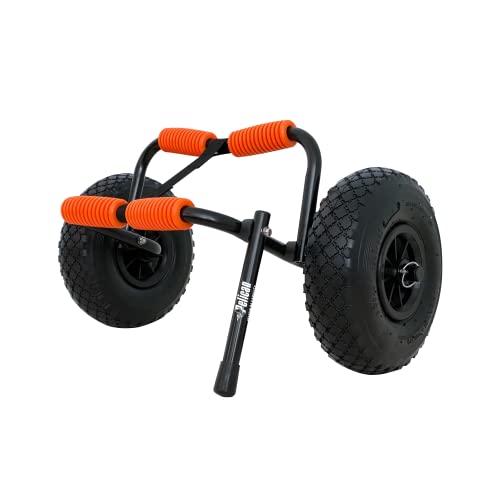
- Wheelslarge inflatable
- Framecorrosion resistant black metal
- Folded size14.5 x 12 x 23 in
- Assemblytool assembly, quick
- Usecanoe, kayak and stand up paddle
Best for: Small car boots and shared storage where the cart has to disappear
A cart that will not fit in the car with the board is a cart that stays at home. This one folds down to roughly the size of a shoebox and a half.
Large inflatable wheels are a fair compromise: better than solid wheels on sand, smaller and cheaper than full balloon tyres.
Pelican are a mainstream paddlesports brand, so parts and support exist, which is more than can be said for most unbranded carts.
Strengths
- Folds together into a genuinely small package
- Large inflatable wheels handle mixed terrain well
- Corrosion resistant finish for coastal use
- Around seventy dollars from a known brand
Weaknesses
- Metal rather than aluminium, so treat scratches promptly
- Inflatable tyres need checking before a trip

- Wheelslarge diameter solid PU, airless
- Load200 lb
- Frame20x2 mm anodised aluminium tube
- Foldingfolds down for car transport
- Extrasdouble kickstand, foam bumpers on each arm
Best for: Hard packed ground, slipways, grass and gravel
This is the sensible default if your launch is a slipway, a grass bank or a gravel path rather than a beach.
The double kickstand deserves a mention. Loading a board onto a cart that keeps tipping over is a two person job, and the kickstand makes it a one person job.
Anodised aluminium at fifty seven dollars is good value. The compromise is the solid wheels, and only you know how much sand is between your car and the water.
Strengths
- Solid PU wheels that never puncture and do not smell of rubber
- Folds flat, so it fits in a boot without a fight
- Double kickstand keeps it upright while you load the board
- Fifty seven dollars for an anodised aluminium frame
Weaknesses
- Solid wheels struggle in deep dry sand
- 200 pound limit is enough for a board but not for a loaded fishing kayak

- Wheelstwo 10 in solid
- Load176 lb
- Capacitytwo kayaks or surfboards
- Framealuminium, corrosion and rust proof
- Terrainbeach, stones and road surfaces
Best for: Two boards on a budget, on mixed but not deep sand
Sixty five dollars for a double cart is a real saving, and the basics are right: aluminium frame, ten inch solid wheels, two board positions.
Watch the load limit. Two inflatable boards with pumps and paddles get close to 176 pounds faster than you would think.
Wheels this size handle firm sand and stones, though not deep dry sand. Within those limits it is a lot of cart for the money.
Strengths
- Carries two boards for a third of the price of the Suspenz double
- Ten inch solid wheels, larger than most budget carts
- Aluminium frame rather than coated steel
- Nothing to inflate
Weaknesses
- 176 pound limit is modest for two loaded boards
- Less refined padding than the Suspenz carts
- Wheelssolid plastic, 20x6 cm
- Load100 lb
- Frameanodised aluminium tube, M-shaped
- Strapstwo cam buckle tie downs
- Storagebreaks down, stows inside a hatch deck
Best for: Short carries on hard ground, and cars with no boot space left
At forty six dollars the question is whether it works at all, and on hard ground it does. Anodised aluminium tube, cam buckle straps, solid tyres.
The stow-away trick is genuinely useful: broken down it fits inside a hatch, so you can take it with you rather than leaving it on the beach.
Know the limits before buying. One hundred pounds and small hard wheels means short carries on firm ground, which for a lot of launches is exactly the job.
Strengths
- Forty six dollars, the cheapest genuinely usable cart here
- Breaks down small enough to stow inside a kayak hatch
- Plastic tyres cannot puncture or go flat
- Rubber protection where the hull rests
Weaknesses
- 100 pound limit rules out heavy boards with a full load
- Small hard wheels are poor on sand and rough ground
How to choose a paddle board cart
Start with the ground, not the cart: Walk the route in your head. Tarmac, slipway, grass and gravel are fine with solid or airless wheels. More than about fifty metres of dry sand needs low pressure balloon tyres, and no amount of frame quality substitutes for that.
Airless or inflatable: Airless wheels never puncture and need no attention, which suits a cart used a few times a month. Inflatable balloon tyres perform far better on soft ground, at the cost of checking pressure and the occasional puncture.
Frame material: Anodised or powder coated aluminium with stainless hardware survives salt water. Coated steel rusts at the welds and the fasteners, usually in the second season. This is where cheap carts fail, not at the wheels.
Padding and straps: An inflatable board does not need scratch protection but it does need even support, and a hard board needs both. Ratchet straps hold better than cam buckles on rough ground, and any cart without straps at all will drop your board on the first kerb.
Folded size: The board, the pump, the paddle and the bags already fill a car. Check the folded dimensions before the load rating, because the cart that does not fit will not get used.
Frequently asked questions
Will a kayak cart work for a paddle board?
Usually yes, since most carts sold for boards are kayak carts. The difference is how the board rests: a board sits flat on the arms, so wide padded arms are better than the narrow V-shaped cradles built for a kayak hull. Check the arm width and the padding rather than the product name.Do I need balloon wheels?
Only if you cross soft dry sand. Balloon tyres spread the load so the wheel stays on the surface, which transforms a beach carry. On tarmac, grass, gravel or firm wet sand a solid airless wheel does the same job with less bulk and no punctures.Can I leave the cart on the beach while I paddle?
Most people do, and most carts survive it. The safer option is a cart that breaks down small enough to strap to the board or stow in a hatch, like the ASMSW. If you leave it, take the straps with you, since those disappear first.How much load capacity do I need?
An inflatable board with pump, paddle and bag is typically 35 to 50 pounds, so a 100 pound cart is enough for one board. Two boards plus kit gets close to 150 pounds, and a loaded fishing kayak needs 300. Buy above your real load, because the ratings assume smooth ground.Bottom line
For most paddlers the Suspenz SUP cart is the right buy: built for boards, aluminium and stainless so it survives salt, and airless wheels that need no thought. If your launch means a long walk over dry sand, the Bonnlo with twelve inch balloon wheels is the only real answer here, and nothing cheaper will do that job.
On a budget, the Bonnlo universal trolley at around fifty seven dollars covers hard ground properly, and the ASMSW at forty six is enough for short carries. Whichever you pick, check the folded size against your boot first, and remember the cart still has to share that space with the board bag.


