


A carry strap turns a board that has to be dragged into one that hangs off your shoulder while you carry the paddle in your other hand.
There are two designs. A sling wraps the board and holds it with velcro or buckles, and works on any board. A clip strap hooks onto the D-rings, which is quicker but only works if the board has them in the right places.
The other split is where the padding sits. Most straps put it on your shoulder, and the good ones also pad the point where the webbing touches the rail.
We compared nine, from a twelve dollar sling to a ninety five dollar padded carrier built for a thirty six inch board.


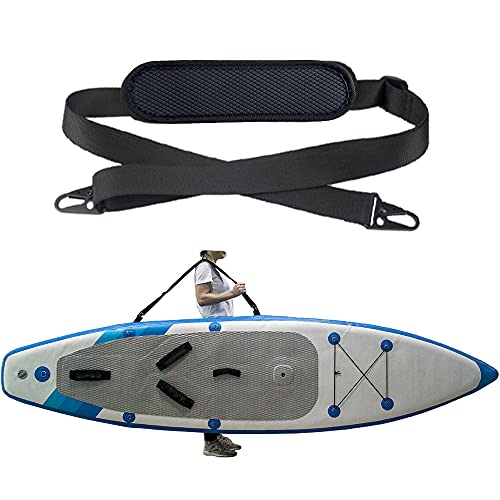
The best SUP carry straps at a glance
| Strap | Type | Fits | Standout feature |
|---|---|---|---|
| Big Board SchlepperTop pick | Sling | Any board size | Paddle loops that turn the paddle into a handle |
| Curve SUP Carry SlingBest premium | Sling | Boards 33 in and wider | 10 mm padded zones at the rail and hip |
| Suspenz Stow and GoBest for storage | Sling | Up to 36 in and wider | Storage hooks, so it doubles as a wall mount |
| niphean SUP Carrying StrapBest built | Sling or clip | 34 to 47 in plus extension | Aluminium buckles, 55 lb rated |
| GOBUROS Strap with BagBest with storage | Sling | Adjustable | A detachable pouch for phone and wallet |
| Pelican Universal StrapBest shoulder pad | Sling | SUP and kayak | A 3.5 x 13 in shoulder pad |
| OCEANBROAD Carry StrapMost versatile | Clip | Different heights and sizes | Doubles as a storage belt, with a bottle opener |
| THURSO SURF Shoulder StrapBest clip strap | Clip | Adjusts 40 to 59 in | Rustproof swivel clips onto D-rings |
| ZipSeven Carrier StrapBest value | Clip | Adjusts 29.5 to 59 in | Metal quick-release hook at 12 dollars |
The nine picks in detail
- Typesling
- Fitsany board size, fully adjustable
- Paddleloops hold the paddle, which then works as a handle
- Shoulderpadded pad for long walks
- Extradoubles as a wall storage hanger
- MakerBetter Surf than Sorry
- Guarantee100 percent satisfaction
Best for: Anyone who walks more than a hundred metres to the water
Carrying a board by a centre handle works for fifty metres and stops working after that, because the board swings and your arm gives out.
The paddle loops solve the second problem, which is what to do with the paddle. Slotted through the strap it becomes a grab handle at chest height.
It also hangs the board on a wall, which is the tidiest storage solution most people will find. Our bag guide covers the alternative for longer trips.
Strengths
- The paddle loops are the best idea in the category, giving you a real handle
- Adjusts to any board and any paddler height
- Doubles as wall storage, so it earns its space in the garage
- Under thirty dollars
Weaknesses
- Basic padding compared with the Curve
- A sling takes longer to fit than a clip strap
- Typesling with a two step velcro closure
- Fitsboards 33 in and wider
- Paddingstrategic zones with 10 mm padding at rail and hip
- Shoulderpadded double adjustable strap with heavy buckles
- Paddlepaddle grips for hands-free carry
- Storagelarge pocket
- Setupno loose buckles to tangle
Best for: Wide boards and long carries
The reason to spend this much is the padding at the rail. A bare webbing strap under load presses a line into a soft PVC rail, and over years that mark stays.
Velcro over buckles is the right call for a sling. There is nothing to thread, nothing to tangle and nothing to drop in the sand.
Check the width version before ordering. The wider board sling does not fit a twenty eight inch race hull well.
Strengths
- Rail padding, which almost nothing else here has
- Velcro closure fits in seconds and cannot tangle
- A large storage pocket for keys, phone and leash
- Made for genuinely wide boards, which most straps are not
Weaknesses
- Ninety five dollars
- Sized specifically, so you must buy the right version

- Typesling with storage hooks
- Fitsup to 36 in and wider kayaks and boards
- WebbingUV protected 600D nylon
- Paddingbehind the buckles, to protect the board
- Usetransport and wall storage
- Also fitssurfboards and small kayaks
- Pricearound 45 dollars
Best for: A strap that also hangs the board in the garage
UV protected webbing sounds like marketing until a strap left on a roof rack for two summers tears in your hand.
The storage hooks are the real feature. Wall hanging is the best way to store an inflatable long term, because a board left rolled tight holds creases.
Note the missing paddle loop, which means you still carry the paddle in your free hand.
Strengths
- Storage hooks included, so carrying and storing use one product
- UV protected webbing, which matters for anything left in a car
- Padding behind the buckles, where scratches actually happen
- Fits kayaks as well as boards
Weaknesses
- Forty five dollars
- No paddle loop

- Strap length34 to 47 in
- Extension webbing17 to 43 in
- Bucklesreinforced aluminium alloy
- Stitchingquadruple stitched webbing
- Capacity25 kg, around 55 lb
- Paddingthickened pad, cationic outer, elastic cotton inner
- MountingD-rings or wrapped, both supported
- Warrantyincluded
Best for: Heavy boards and people hard on equipment
Plastic buckles are the failure point on every cheap strap, usually while the board is over your shoulder on a gravel path.
Fifty five pounds of rated capacity covers any inflatable and most hard boards, with margin for the moment you catch it in a gust.
The dual mounting is what makes it worth the money, because you are not committing to a board that has D-rings in useful places.
Strengths
- Aluminium buckles rather than plastic, which is where cheap straps fail
- Quadruple stitched webbing rated to 55 lb
- Works with or without D-rings, so it fits any board
- A genuinely comfortable padded section
Weaknesses
- Twenty eight dollars for a simple strap
- The wide extension range makes setup fiddly the first time

- Typesling with buckle system
- Fitsdifferent board sizes and kayaks
- Bagdetachable, hangs on the strap or works alone
- Bag holdsstrap, phone, wallet
- Extra strapsfasteners to hold the paddle
- Paddingsoft shoulder pad plus a buckle pad
- Materialnylon with metal hardware
Best for: People who want to carry keys and phone without a second bag
The pouch is the difference between carrying a board and carrying a board plus a rucksack you then have to leave on the sand.
The buckle pad matters more than it sounds, because a metal buckle against a rail is the one part that actually scratches.
Do not treat the bag as dry storage. Use a dry bag for anything that must stay dry.
Strengths
- The detachable pouch is genuinely useful on a beach walk
- Paddle fastener straps, so both hands stay free
- A pad behind the buckle protects the board
- Metal hardware at a mid price
Weaknesses
- Twenty eight dollars
- The pouch is not waterproof

- Fitsvirtually any SUP and kayak
- Webbing1.5 in polypropylene
- Shoulder pad3.5 x 13 in, ergonomic
- Paddlebuilt-in paddle loop
- Carryhands-free
- BrandPelican
- Pricearound 23 dollars
Best for: Long walks where shoulder comfort is the limiting factor
Shoulder pad area is what decides whether a five hundred metre carry is annoying or painful, and thirteen inches spreads the load properly.
Wide webbing helps for the same reason. Inch and a half distributes pressure where a narrow strap cuts.
At twenty three dollars from a known brand it is the sensible default if you do not need storage or a wall mount.
Strengths
- A 3.5 by 13 inch shoulder pad, the largest here
- A paddle loop included at this price
- Pelican is a real brand with real quality control
- Fits kayaks as well as boards
Weaknesses
- Polypropylene webbing rather than nylon
- No rail padding

- Typeclip strap with two looped straps
- Adjustmentfits different board heights and sizes
- Shoulderwide thick non-slip pads
- Paddlepaddle holder built in
- Bucklequick release
- Extrasmultifunctional webbing buckle, metal hook doubles as a bottle opener
- Alsoworks as a storage belt
Best for: Getting several jobs from one twenty dollar strap
Non-slip shoulder material is the specification cheap straps miss, and a strap that walks off your shoulder every twenty paces is worse than no strap.
Quick release is the practical advantage of a clip strap. On and off in seconds, without wrapping anything round the board.
Check that your board has D-rings roughly a third of the way from each end before choosing this style.
Strengths
- Non-slip shoulder material, so it does not slide off in use
- Quick release buckle, which is faster than any velcro sling
- A paddle holder at twenty dollars
- Doubles as a storage belt at home
Weaknesses
- Clips need suitable D-rings
- Multi-function hardware adds bulk

- Typeclip strap
- Adjustment40 to 59 in
- Clipsrustproof swivel clips
- Attaches toD-rings or leash points
- Shoulderpadded mesh support
- Works withinflatable and hard boards
- Attachesin seconds
Best for: Inflatables with well placed D-rings
Swivel clips are the detail that separates this from the generic clip straps, because a fixed clip lets the whole strap twist as the board settles.
Mesh padding is the right choice for hot weather, where solid foam becomes a sweat patch.
THURSO makes boards as well as accessories, and the strap is designed around the D-ring positions boards actually have.
Strengths
- Swivel clips, which stop the strap twisting under the board
- Rustproof hardware, which cheap straps rarely have
- Padded mesh breathes on a hot walk
- Eighteen dollars from a real board brand
Weaknesses
- Useless on a board without D-rings
- Forty inch minimum is long for a short board
- Adjustment29.5 to 59 in
- Hookquick release metal hook
- Shouldersoft padded section
- Works withpaddle boards, surfboards, inflatable rafts and bags
- Colourblack
- Contentsone strap with pad
- Pricearound 12 dollars
Best for: A first strap, or a spare for the car
At twelve dollars the question is not whether it is the best strap but whether owning one beats owning none, and it does.
Metal hooks at this price are the reason to pick it over the other budget options, because plastic hooks snap cold and snap loaded.
Buy two and leave one in the car. That is still cheaper than a single mid range strap.
Strengths
- Twelve dollars, less than a third of the mid range straps
- Metal hooks rather than plastic, which is unusual at this price
- Adjusts down to 29.5 in, so it suits shorter boards and children
- Works on rafts and bags too
Weaknesses
- Thin padding compared with the Pelican
- One strap only, so heavy boards need care
How to choose a SUP carry strap
Sling or clip, decided by your board: A sling wraps around the board and works on anything, including hard boards with no fittings. A clip strap hooks onto D-rings and is far quicker, but only if your board has rings roughly a third of the way in from each end.
Check the padding on both ends: Every strap pads the shoulder. Very few pad the point where webbing crosses the rail, and that is where a loaded strap leaves a permanent mark on soft PVC. If you have an expensive board, rail padding is worth paying for.
Insist on metal hardware: Buckles and hooks are where cheap straps fail, and they fail while the board is off the ground. Aluminium or stainless costs a few dollars more and removes the whole failure mode.
Look for a paddle loop: Carrying the board hands-free is only half the problem solved if the paddle is still in your other hand. A loop that holds the paddle, or better, lets it act as a handle, changes how a long carry feels.
Match the length to your height and board: Most straps adjust between roughly forty and sixty inches, which covers most people. Shorter boards, children's boards and short paddlers need one that goes below thirty five inches, and not all do. The general principle is the same one that applies to any load-bearing webbing: wider spreads the load better.
Frequently asked questions
Do I need a strap if my board has a centre handle?
For a short walk from the car, no. For anything over about a hundred metres, or in any wind, yes. A handle puts the whole weight on one hand and lets the board swing, and a strap puts it on your shoulder with both hands free.Will a strap damage my board?
Bare webbing under load can leave a compression mark on a soft PVC rail over time. Straps with rail padding, or padding behind the buckles, avoid this. Inflating the board fully before carrying also helps, because a soft board deforms far more easily.Can I use one strap for a board and a kayak?
Most slings fit both, and several here say so explicitly. Clip straps are board specific, because kayaks rarely have D-rings in the right places for them.Should I carry the board inflated or deflated?
Inflated, if you are walking under about a kilometre. A strap makes that easy. For anything further, a backpack bag is more comfortable, and for very long distances a wheeled cart beats both.Bottom line
The Big Board Schlepper is the pick because it does the thing no other strap does properly, which is give you somewhere to put the paddle and then turn that paddle into a second handle. At under thirty dollars it also hangs the board on a wall when you get home.
If your board is wide and your walk is long, the Curve sling and its rail padding is worth the ninety five dollars. If you just want to stop dragging the board across a car park, the twelve dollar ZipSeven with its metal hooks does the essential job.


