

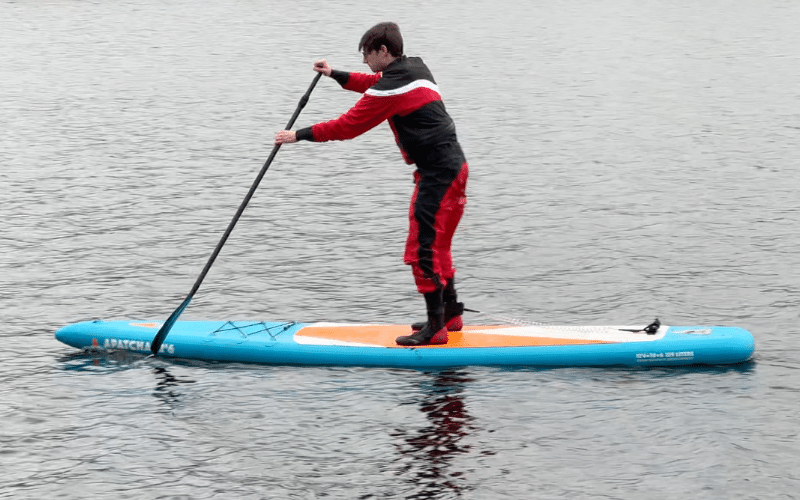
A paddler stays mostly dry until the moment they do not. That is the whole problem a wetsuit has to solve: keeping you warm enough to get back on the board after a fall in cold water.
The number on the label is the neoprene thickness in millimetres, torso first and limbs second. A 3/2 means 3 mm over the chest and 2 mm at the arms and legs.
Most paddlers over-buy. Unless you are surfing in winter you are standing in the air, not swimming, and a full 5 mm suit will cook you inside twenty minutes of paddling.
We compared nine suits, from a 42 dollar neoprene vest to a 245 dollar 4/3 winter full suit.


The best wetsuits for paddle boarding at a glance
| Suit | Thickness | Cut | Standout feature |
|---|---|---|---|
| O'Neill Reactor-2 Back ZipTop pick | 3/2 mm | Full suit, back zip | Seamless paddle zones under the arms |
| O'Neill Epic 4:3 Back ZipBest for cold water | 4/3 mm | Full suit, back zip | Krypto Armor knee pads and UltraFlex neoprene |
| O'Neill Women's Epic Back ZipBest women's full suit | 3/2 mm | Full suit, back zip | Blind stitched and triple glued seams |
| O'Neill Reactor-2 SpringBest spring suit | 2 mm | Short sleeve spring | Short arms, so nothing binds the paddle stroke |
| GILL Pursuit ShortyBest women's shorty | 3/2 mm | Shorty | Mesh Skin chest and back with thermal lining |
| O'Neill Reactor-2 JacketBest top layer | 1.5 mm | Long sleeve jacket | Front zip and a boardshort connector |
| Hevto Men WetsuitBest value full suit | 3/2 mm | Full suit, back zip | A full 3/2 for under 75 dollars |
| Lemorecn Wetsuit TopBest vest | 3 mm | Sleeveless vest | Front YKK zip, so it goes on and off wet |
| GoldFin Women ShortyBest value | 3 mm | Shorty, back zip | Flatlock seams at 42 dollars |
The nine wetsuits in detail
- Thickness3/2 mm
- Cutfull suit with back zip
- NeopreneUltra Stretch
- ShouldersSeamless Paddle Zones
- Chestwind-resistant Smoothskin panel
- Seasonspring, autumn and mild winter
- Pricearound 155 dollars
Best for: The one suit to own if you paddle from March to November
Wind chill, not water temperature, is what ends most cold paddle sessions. You are standing up in the breeze with a wet torso, and that evaporates heat far faster than immersion does.
That is why the Smoothskin chest panel matters more on a board than it does on a surfboard, and why paddlers routinely feel colder than the water reading suggests.
The seamless shoulder construction is the second reason to pick this suit. A repeated paddle stroke abrades stitched underarm seams first, which is where cheaper suits fail. Pair it with a buoyancy aid that sits above the suit collar.
Strengths
- Seamless panels under the arms, which is exactly where a paddle stroke wears a suit out
- A Smoothskin chest panel cuts wind chill, the thing that actually makes paddlers cold
- Ultra Stretch neoprene, so the stroke is not fighting the suit
- O'Neill fit and sizing is the most predictable in the category
Weaknesses
- A back zip lets in more water than a chest zip
- 3/2 is too warm for high summer
- Thickness4/3 mm
- Cutfull suit with back zip
- NeopreneUltraFlex
- KneesKrypto Armor knee pads
- Seamssealed for cold water use
- Seasonwinter and cold spring
- Pricearound 245 dollars
Best for: Winter paddling and anyone who falls in regularly in cold water
Kneeling is how most paddlers start a session and how everyone gets back on after a swim, and it wears through the knees of a suit faster than any other movement.
Reinforced knee panels are therefore worth more to a paddler than to a surfer, who spends the session lying down.
Below about ten degrees water, add boots and gloves or move to a drysuit instead. A 4/3 is the sensible limit for a suit you still want to paddle in.
Strengths
- Four millimetres over the chest is a genuine winter thickness
- Krypto Armor knees survive kneeling on a deck pad, which destroys plain neoprene
- UltraFlex keeps a thick suit paddleable rather than stiff
- The Epic line is O'Neill's long-running workhorse
Weaknesses
- Too warm for anything above roughly 15 degrees water
- A back zip on a winter suit flushes cold water down your spine

- Thickness3/2 mm
- Cutwomen's full suit with back zip
- NeopreneUltraFlex
- PanelsFluidFlex Firewall
- Seamsblind stitched and triple glued
- Seasonspring and autumn
- Pricearound 188 dollars
Best for: Women who want a proper three-season suit rather than a summer shorty
Seam construction is the single biggest difference between a cheap suit and a good one. Flatlock stitching goes right through the neoprene and lets a trickle of water through every seam.
Blind stitching only pierces part of the way, and gluing the panels first means the seam is watertight before a needle ever touches it.
A suit should feel too tight in the shop. It loosens in the water, and a loose suit flushes cold water in and out with every movement.
Strengths
- Blind stitched and triple glued seams keep water out far better than flatlock stitching
- FluidFlex Firewall panels add warmth without adding thickness
- A women's cut, which matters for how much water a suit lets in at the neck
- The same Epic construction as the men's line
Weaknesses
- Around 190 dollars
- Sizing runs snug, which is correct for a wetsuit but surprises first-time buyers

- Thickness2 mm
- Cutshort sleeve spring suit with long legs
- NeopreneUltra Stretch
- Zipback zip
- Seasonsummer and warm spring
- Legsfull length for kneeling
- Pricearound 125 dollars
Best for: Summer paddling where a full suit would overheat you
The short sleeve and long leg combination is close to the ideal paddling cut. Arms stay free, knees and shins stay protected, and the core keeps its insulation.
Two millimetres sounds like nothing but it holds off the wind, and wind is what makes a wet paddler cold in July.
This is the suit that gets worn most in practice by anyone paddling flat water in summer, especially on the all-round boards most people learn on.
Strengths
- Short arms leave the paddle stroke completely unrestricted
- Long legs still protect the knees on the deck pad
- Two millimetres is the right thickness for a windy summer day
- The same Ultra Stretch neoprene as the top pick
Weaknesses
- Bare arms get cold quickly once the wind picks up
- Not enough suit for a long swim back to shore

- Thickness3/2 mm zoned neoprene
- Cutwomen's shorty
- Chest and backMesh Skin with thermal lining
- Collardouble lined Glideskin
- BrandGILL, a sailing specialist
- Seasonsummer
- Pricearound 70 dollars
Best for: Warm summer days on open water where the wind still bites
GILL come from dinghy sailing, where people spend hours sitting wet in the wind. That is a closer problem to paddle boarding than surfing is.
The result is a shorty built around wind protection over the torso rather than raw thickness, which is the right trade for a standing sport.
Watch the neck. A collar that chafes will end a session faster than cold will, and the lined Glideskin here is one of the better ones at this price.
Strengths
- Mesh Skin on the chest and back is the sailing answer to wind chill
- A thermal lining under the mesh, which few shorties at this price have
- A Glideskin collar seals without chafing your neck
- Seventy dollars for a genuine marine brand
Weaknesses
- A shorty leaves knees and shins exposed on the deck pad
- 3/2 zoning is warm for high summer in the south

- Thickness1.5 mm
- Cutlong sleeve jacket
- NeopreneFluidFlex
- SeamsFlatloc stitched
- Zipfront zip
- Extraboardshort connector strap
- Pricearound 101 dollars
Best for: Layering over boardshorts on a cool summer morning
A neoprene jacket is the most underrated piece of paddling kit. Most of the time you are not cold because of the water, you are cold because of the wind on a wet torso.
One and a half millimetres over boardshorts covers that gap without turning a summer paddle into a sweat box.
The connector strap matters. Without one, a jacket rides up to your armpits the first time you go in, and then it is just a scarf. Keep a dry bag on deck for the layer you take off.
Strengths
- A front zip means you can get it on and off on the water
- The boardshort connector stops it riding up when you fall
- 1.5 mm is thin enough to wear all day without overheating
- Long sleeves cover the arms without a full suit's bulk
Weaknesses
- Flatlock seams let water through, so this is a windbreak not a wetsuit
- No leg coverage at all

- Thickness3/2 mm
- Cutfull suit with back zip
- Seasonspring and autumn
- Usesurfing, paddle boarding, snorkelling
- Zipback zip with a pull leash
- Pricearound 73 dollars
- Sizingruns snug, size up if between sizes
Best for: A first full suit for someone unsure how often they will use it
The honest case for a budget suit is arithmetic. Renting costs about twenty dollars a session, so this pays for itself before the season ends.
What you give up is seam sealing and stretch. It will let water through the seams and it will feel stiffer through the shoulders after an hour.
For someone paddling six times a year that is a fair trade. For someone paddling weekly, buy the Reactor-2 and keep it for a decade.
Strengths
- A full 3/2 suit for the price of a branded shorty
- Covers the whole body, which is what matters for a cold swim back
- Perfectly adequate for occasional spring and autumn use
- Cheap enough that hire fees overtake it in about four sessions
Weaknesses
- Seam quality is well below the O'Neill suits, so expect some flush
- Neoprene is stiffer, which you feel over a long paddle

- Thickness3 mm
- Cutsleeveless vest
- Zipfront YKK zip
- Usepaddle boarding, kayaking, diving
- Layeringworks under or over a suit
- Pricearound 42 dollars
- Seasonsummer and shoulder season
Best for: Adding core warmth without touching the paddle stroke
Core temperature is what your body defends, so insulating the torso alone buys more comfort per millimetre than covering the limbs does.
For a sport where the arms are moving constantly and the legs are mostly still, a vest is a better shape than it first appears.
Worn under a shorty it adds roughly a season at each end of the year for the price of a tank of fuel.
Strengths
- A vest leaves the shoulders completely free, unlike any sleeved layer
- A YKK zip, which is the part that fails first on cheap neoprene
- Layers under a shorty for a surprising amount of extra warmth
- Forty two dollars, so it is an easy thing to keep in the car
Weaknesses
- No arm or leg coverage at all
- 3 mm over the core alone will not save you in genuinely cold water
- Thickness3 mm
- Cutwomen's shorty with back zip
- Seamsflatlock
- Usepaddle boarding, snorkelling, swimming
- Zipback zip with pull cord
- Pricearound 42 dollars
- Seasonsummer
Best for: Occasional summer use where a real suit is not worth buying
A cheap shorty is not a compromise if the alternative is paddling in a t-shirt, which is what most people actually do.
Three millimetres over the core and thighs takes the edge off a windy afternoon and stops the shivering that follows a fall.
Rinse it in fresh water and dry it inside out and in the shade. Salt and sun kill budget neoprene long before use does.
Strengths
- Forty two dollars, which is roughly two session hire fees
- 3 mm is warmer than most shorties in this price bracket
- Flatlock seams sit flat and do not chafe under a buoyancy aid
- Easy to rinse, dry and forget in a car boot
Weaknesses
- Flatlock stitching passes water, so it flushes when you swim
- Build quality is what the price suggests, expect a couple of seasons
How to choose a wetsuit for paddle boarding
Buy thinner than a surfer would: You are standing in the air, not lying in the water, so a suit that suits a surfer at a given temperature will overheat you. A 3/2 covers most of the paddling year in temperate water, and a 4/3 is a winter suit rather than a default.
The fit decides the warmth: A wetsuit works by trapping a thin layer of water that your body then heats. Any gap at the neck, wrists or ankles lets that water flush out and replaces it with cold. If you can pinch loose neoprene at the lower back, the suit is too big.
Check the seams before the thickness: Flatlock stitching passes water and belongs on summer shorties. Blind stitched and glued seams keep it out and are what you pay for on a three-season suit. A well sealed 3/2 is warmer than a badly sealed 4/3.
Protect the shoulders and the knees: Paddling wears the underarm panels and kneeling wears the knees, which is not where a surf suit is reinforced. Seamless paddle zones and armoured knee pads are the two features worth paying for in this sport specifically.
Match the suit to the swim, not the paddle: The suit has to keep you functional after you fall in far from shore, not merely comfortable while you are upright. Cold water robs strength and judgement fast, and hypothermia starts long before you feel in danger. Dress for the water temperature, never for the air.
Frequently asked questions
What thickness do I need for paddle boarding?
As a rough guide, a 2 mm shorty or spring suit above 20 degrees water, a 3/2 full suit between roughly 13 and 20 degrees, and a 4/3 with boots below that. Because you stand rather than swim, you can usually go one step thinner than a surfing chart suggests, but only if you are confident you will not spend long in the water.Wetsuit or drysuit for winter paddling?
Below about ten degrees water a drysuit is the better answer, because it keeps you dry and lets you insulate underneath. A wetsuit is simpler, cheaper and better in the shoulder seasons where you expect to get wet anyway.Do I need a full suit if I never fall in?
Everyone falls in eventually, usually on the day the wind gets up. The point of the suit is the unplanned swim, so buy for the worst case rather than for the paddling you intend to do.How do I make a wetsuit last?
Rinse it in fresh water after every session, dry it inside out in the shade, and never leave it folded wet in a bag. Hang it over a wide hanger rather than a thin one, because a sharp crease at the shoulders is where neoprene eventually splits.Bottom line
The O'Neill Reactor-2 3/2 is the pick because its two standout features, the seamless underarm panels and the wind-resistant chest, target exactly the two things that wear out and chill a paddler rather than a surfer.
If your season runs into winter, step up to the Epic 4:3 with its armoured knees. And if you paddle a handful of warm afternoons a year, a 42 dollar shorty and a neoprene vest cover it for less than the price of three rentals.


