

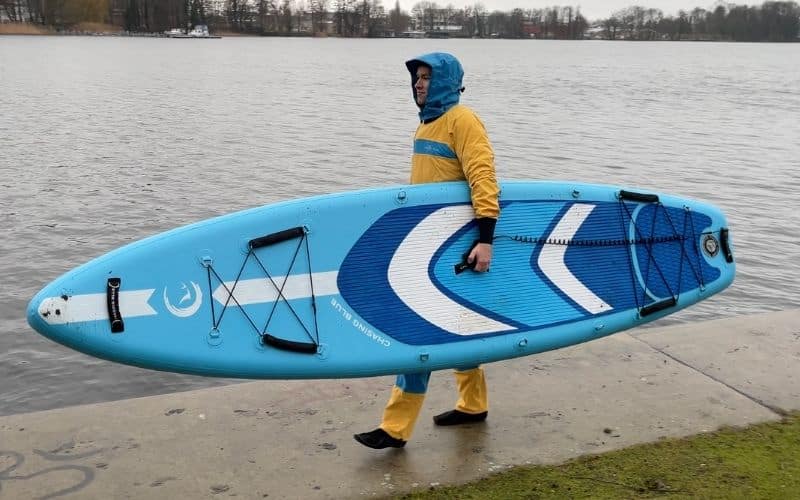
A drysuit is the piece of kit that decides whether paddling is a summer hobby or a year round one. It does not keep you warm on its own; it keeps the water out so that what you wear underneath can.
That distinction matters, because a wetsuit works by letting a thin layer of water in and heating it. In water below about fifteen degrees Celsius, that stops being pleasant and eventually stops being safe.
What you are paying for is three things: a fabric that is waterproof and still breathes, latex gaskets at the neck and wrists that seal against skin, and a zip that does not leak. Everything else is detailing.
We compared nine suits and one alternative on fabric construction, seals, entry system and the features that matter when you fall in wearing one.


The best drysuits for paddle boarding at a glance
| Suit | For | Entry | Standout feature |
|---|---|---|---|
| Lorange Kayak Dry SuitTop pick | Men | Front zip | Latex neck and wrist gaskets under 400 dollars |
| Gill Verso DrysuitBest premium | Men | Offset front zip | XPLORE 3 layer fabric with plant-based treatment |
| Gill Womens Verso DrysuitBest premium for women | Women | Offset YKK front zip | Women's specific cut with a grown on hood |
| Drryfsh Mens Dry SuitBest mid-range | Men | Front entry | Trimmable latex seals and multiple pockets |
| Drryfsh Womens Dry SuitBest back entry | Women | Back entry TIZIP | Detachable hood and a drop seat relief zip |
| PKEDW Mens Front ZipMost hard wearing | Men | Front zip | Reinforced knees and seat, integrated socks |
| PKEDW Womens HoodedLightest | Women | Front zip | OEKO-TEX 160D fabric with a removable hood |
| Kayak Drysuit with Stowable HoodBest detailing | Men | Front entry | Neoprene overskirt and two chest pockets |
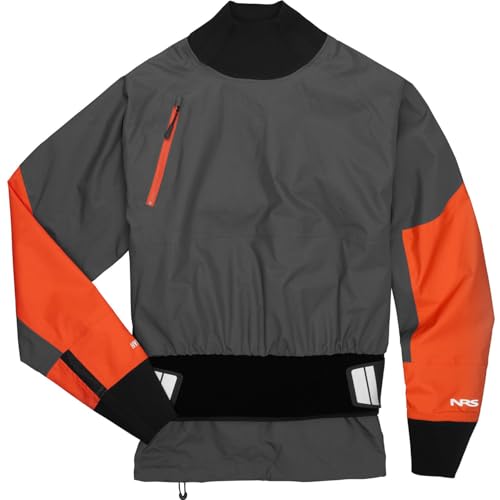
| NRS Stratos Semi-Dry JacketBest alternative | Men | Pull on | Neoprene wrist gaskets and a waist tunnel |
The nine picks in detail
- Formen
- Sealslatex neck and wrist gaskets
- Collarsplash collar over the neck seal
- Gasket typeflatwater paddling gasket for comfort
- Fittailored men's cut
- Colourblack
- Priceunder 400 dollars
Best for: Paddlers who want a real drysuit without spending five hundred dollars
The neck gasket is the part that decides whether a suit is a drysuit or a very good waterproof, and latex against skin is the only version that actually works.
A flatwater gasket is cut slightly looser than a whitewater one. You will let a little water in if you are fully submerged for a long time, which for a paddle boarder is a good trade for being able to breathe comfortably.
Wear thermal layers underneath, not cotton. The suit keeps water out; the layers do the warming, and the same principle applies to our wetsuit guide in reverse.
Strengths
- Latex at both the neck and the wrists, which is the actual definition of a drysuit
- A splash collar over the neck seal, so the gasket is protected
- The flatwater gasket is more comfortable than a whitewater one for long days
- Nearly two hundred dollars cheaper than the mid-range suits
Weaknesses
- Less published detail on the fabric than the pricier suits
- Fewer pockets and no hood
- FabricXPLORE three layer with plant-based treatment
- Seamsfully taped
- Gasketslaser-cut face inner neoprene Dryseal at neck and cuffs
- Skirtadjustable overskirt
- PocketPFD friendly zip sleeve pocket
- Material100 percent nylon with polyester reinforcement
- Caremachine washable at 30 degrees
Best for: Regular cold water paddling where comfort over hours matters
The gasket question is the real choice at this level. Latex is watertight and unpleasant; laser-cut neoprene is comfortable all day and slightly less absolute.
For a paddle boarder who expects the occasional fall rather than continuous immersion, neoprene is usually the better answer, and it does not perish in a drawer the way latex does.
The sleeve pocket sounds like a detail until you try to reach a chest pocket wearing a buoyancy aid.
Strengths
- Neoprene Dryseal gaskets are far kinder to skin than raw latex
- Three layer fabric that breathes properly rather than trapping sweat
- The sleeve pocket is reachable while wearing a buoyancy aid
- Gill build these for sailing, so the durability standard is high
Weaknesses
- Eight hundred and fifty dollars
- Neoprene seals are less absolutely watertight than latex under full immersion

- FabricXPLORE three layer with plant-based treatment
- Cutwomen's specific pattern
- Hoodgrown on hood with two way adjustment and a stow loop
- Zipoffset YKK anti-corrosion
- Chinsoft fleece inner chin guard
- PocketPFD friendly zip sleeve pocket
- Seamsfully taped
Best for: Women who want a suit cut for them rather than a small men's suit
Most women's paddling kit is a men's pattern with different colours, and the fit around the hips and shoulders is where that shows up as leaks and chafing.
The stowable hood is the practical feature here. On a board you rarely want a hood up, but on a cold windy return leg it changes the day.
An offset zip is a small mercy. A centre zip ends directly under your chin, which is exactly where you look down at the water.
Strengths
- A genuine women's pattern, not a resized unisex suit
- The hood stows away rather than flapping when you do not want it
- Offset zip keeps the hardware away from the chin
- Same three layer fabric as the men's version
Weaknesses
- Six hundred and ninety dollars
- A built-in hood adds bulk you will not always want

- Fabricthree layer waterproof breathable nylon shell with membrane finish
- Sealstrimmable latex wrist and neck
- Waistadjustable webbing buckle
- Zipfront entry waterproof zip
- Pocketssleeve Velcro pockets plus an inner chest pocket
- Testingevery suit fill tested
- Usepaddling, fishing, boating, rafting and sailing
Best for: Serious cold water use at a mid-range price
Trimmable gaskets are the feature that makes a mid-range suit wearable, because a neck seal that is one size too tight is genuinely unpleasant.
Cut one ring at a time, from the inside, and stop as soon as it stops choking. You cannot put the latex back.
Fill testing every suit is the kind of quality step that separates the mid range from the bargain end, where the first swim is the test.
Strengths
- Trimmable seals, so you can adjust the neck to your own comfort
- Fill tested individually, which is a real quality control step
- Front entry, so you can get in and out without help
- Three layer laminate rather than a coated two layer fabric
Weaknesses
- Five hundred and twenty nine dollars
- Latex needs care and eventually replacement

- Fabrictri-laminate with taped seams
- Hooddetachable and stowable
- Zipback entry TIZIP waterproof zip
- Reliefdrop seat relief zip
- Suspendersremovable internal
- Panelscontoured to reduce snagging
- Cuffsstretch neck and wrist seals
- Drainself-draining
Best for: Paddlers who dislike a zip across the chest
Front zips are convenient and they sit exactly where a buoyancy aid and a paddle shaft both press. A back zip solves that and creates a different problem, namely needing a friend.
The relief zip is not a luxury on any suit you will wear for four hours in the cold, and it is the feature most often missing from women's suits.
Internal suspenders mean you can peel the suit to your waist at the car park without it falling round your ankles.
Strengths
- A back zip removes the hard bar across your chest when leaning forward
- TIZIP is the industry standard waterproof zip
- Drop seat relief zip, which women's suits often omit
- Internal suspenders let you wear the top half down between sessions
Weaknesses
- You need help to do up a back zip
- Five hundred and forty eight dollars

- Fabricthree layer with waterproof coating
- Sealslatex neck and wrist gaskets
- Collarneoprene collar and cuffs over the latex
- Socksintegrated waterproof socks
- Reinforcementabrasion resistant knees and seat
- Waistdual adjustable overskirt with bungee drawcord
- Testingindividually water tested
Best for: Rocky launches, kneeling starts and general rough handling
Drysuits do not usually fail at the fabric. They fail at the knees, the seat and the seals, which is exactly where the reinforcement is here.
Integrated socks are the right choice for paddling, since ankle gaskets let water into the legs every time you stand in the shallows.
You will need shoes over the socks. Our footwear guide covers what fits over a drysuit sock without cutting it.
Strengths
- Reinforced knees and seat, which is where suits wear out first
- Neoprene over the latex protects the seals from sun and abrasion
- Integrated socks rather than ankle gaskets, which is warmer and drier
- Individually water tested
Weaknesses
- Five hundred dollars
- Integrated socks mean you must wear separate footwear over them

- Forwomen
- FabricOEKO-TEX certified 160D P/Taslon FD
- Layersthree layers with special coating
- Sealslatex neck and sleeve seals
- Hoodremovable
- Zipflexible front zip
- Neckself-draining
- Testingfill tested and guaranteed dry
Best for: Women who want cold water protection without a heavy suit
Weight and stiffness matter more on a paddle board than in a kayak, because you are standing and balancing rather than braced in a seat.
A lighter suit lets you feel the board, which is the reason many paddlers avoid heavy whitewater suits even in cold conditions.
The trade is durability. Treat a light suit as cold water clothing rather than protective gear, and keep it away from barnacles and gravel.
Strengths
- Light fabric, which matters when you are balancing rather than sitting
- Removable hood, so the suit works in spring and in winter
- OEKO-TEX certified fabric, a genuine standard rather than a claim
- Self-draining neck stops water pooling at the seal
Weaknesses
- Light fabric is less abrasion resistant than the reinforced suits
- Five hundred and forty eight dollars

- Fabricthree layer 100 percent nylon with DWR finish
- Hoodstowable and removable
- Zipswaterproof front entry plus relief zip
- Sealslatex neck and wrist gaskets
- Pocketstwo splashproof zippered chest pockets
- Waistneoprene overskirt with double-pull closure
- Kneesremovable neoprene pads at knee and drop seat
Best for: Paddlers who want every feature on one suit
This is the suit for someone who paddles a board in summer and a kayak in winter, since the overskirt and tunnel arrangement only makes sense in a cockpit.
Removable neoprene pads at the knee and seat are the sort of thing you appreciate a year in, when the same suit is still not worn through.
DWR finishes wear off. Re-treat the outside once a season or the fabric wets out, stops breathing and feels clammy even though it is not leaking.
Strengths
- Removable knee pads, which almost nothing else offers
- Both a front entry zip and a relief zip
- Two chest pockets rather than one
- The overskirt seals over a spray skirt tunnel, useful if you also kayak
Weaknesses
- Five hundred and sixty eight dollars
- All those features add weight and bulk
- Typesemi-dry jacket, not a full suit
- Fabriclightweight HyproTex waterproof breathable
- Wristspunch-through neoprene gaskets
- Cuffsself-draining neoprene overcuffs
- Waistdouble-pull hook-and-loop neoprene
- Tunnelcoated nylon inner tunnel for a spray skirt
- Fitregular
Best for: Cool weather rather than cold water, and paddlers who rarely fall in
Most paddle boarders do not need a drysuit. They need to stay dry in wind and spray on a cold day, and that is what a dry top does for a fraction of the money.
The honest line is about water temperature. Above about fifteen degrees, a jacket and neoprene trousers is sensible kit; below ten, it is not enough if you go in.
Layer it over a base layer and add neoprene trousers and the combination covers most of the shoulder season.
Strengths
- Two hundred and forty dollars rather than five hundred
- Neoprene wrist gaskets are comfortable enough to wear all day
- Far less bulk and heat than a full suit in spring and autumn
- Pairs with neoprene trousers for most of the benefit at half the price
Weaknesses
- Not a drysuit, so it will not protect you in a long immersion
- Only the top half, so your legs need separate kit
How to choose a drysuit for paddle boarding
Decide by water temperature, not air temperature: The rule most paddling organisations use is to dress for immersion once the water drops below about fifteen degrees Celsius, and to treat anything under ten as requiring a drysuit. Cold shock happens in the first minute, long before hypothermia becomes relevant.
Latex seals or neoprene seals: Latex is genuinely watertight and uncomfortable, needs talc, and perishes in sunlight. Neoprene is comfortable, lasts longer and lets a little water in under full immersion. For board paddling, where falls are brief, neoprene at the neck is a reasonable choice.
Socks, not ankle gaskets: Integrated fabric socks keep your feet dry and warm and let you wade in without letting water up the legs. You need footwear over them, and it needs to be roomy enough not to compress the sock or cut it on the seam.
Look for a relief zip: A drysuit is a sealed bag with you in it, and a four hour paddle without a relief zip is a genuine problem. Men's suits nearly all have one, women's suits often do not, and a drop seat is the version to look for.
The suit does not keep you warm: Wear thermal base layers and a mid layer underneath, in synthetic or merino, never cotton. A drysuit over a t-shirt in winter water is a suit that keeps you dry while you get cold, which is only half the job.
Frequently asked questions
Do I really need a drysuit for paddle boarding?
Only for cold water. Through summer on a lake, board shorts and a rash vest are fine. Once the water is under about fifteen degrees, falling in becomes a real risk rather than an inconvenience, and that is when a drysuit, or at minimum a wetsuit, stops being optional.Drysuit or wetsuit for paddle boarding?
A wetsuit is cheaper, simpler and warm enough down to roughly ten degrees of water, but it is clammy and restrictive when you are standing and dry most of the time. A drysuit is more comfortable to paddle in because you stay dry, and it is the only sensible choice in genuinely cold water. See our wetsuit guide for the alternative.How do I look after latex gaskets?
Rinse in fresh water after every use, dry out of direct sunlight, and dust the inside with unscented talc before storage. Avoid sunscreen and insect repellent on the gasket, both of which degrade latex quickly. Stored well, gaskets last a few seasons and can be replaced when they perish.Can I wear a buoyancy aid over a drysuit?
Yes, and you should. A drysuit traps some air and will float you briefly, but it is not a flotation device and air can migrate to your legs. Wear the same buoyancy aid you would wear otherwise, sized to fit over the suit.Bottom line
For most paddlers moving into cold water for the first time, the Lorange is the sensible entry, because it has the seals that define a drysuit at a price that does not require a decision about the whole hobby. Spend more and the Gill Verso is the one to have, since neoprene Dryseal gaskets and three layer fabric are what make a suit comfortable enough to wear for a whole winter.
Be honest about whether you need a suit at all. If your paddling stops when the clocks change and the water is still in double figures, an NRS dry top and neoprene trousers cover the same conditions for less than half the money, and they are far more pleasant to wear on a mild day.


