

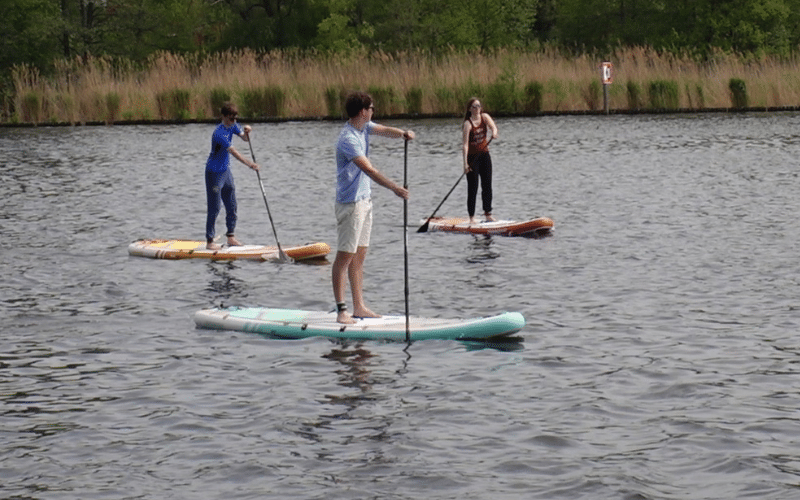
An all-around board is the one board that does everything acceptably and nothing brilliantly, which is exactly what almost every paddler actually needs.
The shape is a compromise on purpose: wide enough to stand on with confidence, long enough to hold a line, and blunt enough at the nose to turn when you ask it to.
Prices run from a hundred and thirty dollars to eight hundred, and the money buys rigidity rather than shape. A cheap board and an expensive board look similar rolled out on the grass; they feel completely different once you stand in the middle of one.
We compared nine all-around boards on width, capacity, construction and what comes in the box, because the accessories decide whether a cheap board is actually cheap.


The best all-around paddle boards at a glance
| Board | Size | Capacity | Standout feature |
|---|---|---|---|
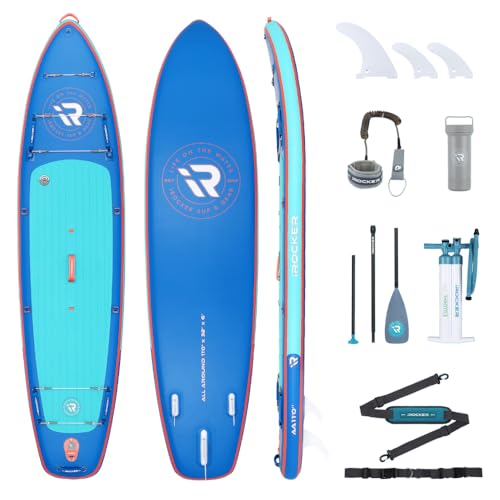
| iROCKER All Around 11 8.0Top pick | 11 ft | Multiple riders and gear | Welded seams and a magnetic accessory puck |
| ISLE ExplorerBest for long days | Wide touring shape | Cargo front and rear | AIRTECH Fusion Lite build, grooved EVA deck |
| Retrospec Weekender XLBest mid-range | 11 ft x 35 in x 8 in | 400 lb | Dual bungees and eleven D-rings |
| SALT LIFE Wide Stable iSUPBest step-up budget | 10 ft 6 or 11 ft x 32 in | Adult and recreational use | Drop-stitch double-rail construction |
| FEATH-R-LITE Inflatable SUPLightest package | 10 ft 6 x 33 in x 6 in | Beginner to intermediate | Very light for its size, three fin setup |
| Roc 10 ft 6 Paddle BoardBest beginner package | 10 ft 6 | 350 lb | Three year warranty, complete accessory pack |
| FunWater Ultra-Light SUPBest value | Standard all-around | All skill levels | Double wall PVC, 35 percent lighter |
| DAMA Extra Wide All-AroundBest for load | 11 ft 6 x 34 in x 6 in | 450 lb | Highest capacity here, pet friendly deck |
| SLOOSH 10 ft 6 Paddle BoardBest budget | 10 ft 6 x 33 in x 6 in | Beginner focused | Centreline standing guide, full kit at 130 dollars |
The nine all-around boards in detail
- Length11 ft
- Levelskilled beginner to intermediate
- Seamswelded across the whole range
- Nosetapered, cuts through chop
- Handleremovable centre handle
- MountMAGTITE magnetic puck for cup holder or speaker
- Conditionsflatwater, choppy bays and small surf
Best for: Anyone buying one board to keep for years
The gap between a three hundred dollar board and an eight hundred dollar board is stiffness, and stiffness is what you feel on the twentieth stroke rather than the first.
Welded seams are the specification worth paying for. A glued rail is the part that fails first on a board left inflated in the sun for a summer.
The magnetic mount is a genuinely good idea, and it works with the kind of gear covered in our Bluetooth speaker guide rather than needing a bungee.
Strengths
- Welded seams rather than glued, which is what stops a board delaminating
- The tapered nose keeps speed in chop that stops blunt budget boards dead
- The removable centre handle dries properly and is not in the way when sitting
- Magnetic mount takes a cup holder or speaker without a strap
Weaknesses
- Eight hundred dollars, six times the cheapest board here
- Aimed at skilled beginners upward rather than a complete first timer

- Shapeadventure and touring, wide stance
- ConstructionAIRTECH Fusion Lite
- Cargosix point front bungee plus rear storage
- Deckgrooved brushed EVA traction pad
- Includedcarbon shaft paddle, backpack, high pressure pump, leash, fin
- Suitsyoga, fishing, pets and touring
- BrandSan Diego, making boards since 2004
Best for: Paddlers who cover distance rather than potter near the launch
Most all-around boards are designed around the first hour on the water. This one is designed around the third, which is a different problem entirely.
The carbon shaft paddle matters more than people expect, since an aluminium paddle adds weight at the end of a lever you lift several thousand times a day.
If you find yourself paddling further each time out, look at the shape difference in our touring board guide before spending again.
Strengths
- A touring lean without giving up the stability of an all-around shape
- Fusion Lite construction is light for a board this size
- Carbon shaft paddle in the box, which is rare at any price
- Six point bungee takes real cargo, not a token dry bag
Weaknesses
- Nearly seven hundred dollars
- The touring bias makes it less playful than a blunt all-around board
- Size11 ft x 35 in x 8 in
- Capacity400 lb
- Pressure12 to 15 PSI
- Attachmentdual bungee systems and 11 D-rings
- Includedadjustable paddle, pump, fins, leash
- DeckEVA pad with action camera mount
- Usesfishing, touring and lake days
Best for: A family board that has to carry people and kit
Width is the cheapest stability there is, and thirty five inches is the point where standing up stops being an event and becomes something you do without thinking.
The eight inch thickness is the less obvious half. A thicker board resists bending under a heavy rider, which is why the capacity figure is credible here.
All those D-rings only pay off if you use them. A kayak seat and a cooler both need somewhere to clip.
Strengths
- Thirty five inches wide with an 8 inch thickness, so it barely flexes
- Four hundred pounds means a paddler plus a child or a dog and gear
- Eleven D-rings is more attachment than most boards offer
- Camera mount built into the deck rather than bolted on later
Weaknesses
- Thirty five inches is a lot of board to paddle against a headwind
- Eight inches of thickness sits you higher, which feels odd at first

- Sizes10 ft 6 or 11 ft
- Width32 in on both sizes
- Constructiondrop-stitch with double rail
- Decktextured non-slip EVA
- Includedpaddle, pump, leash and kit
- Levelbeginners and recreational paddlers
- Storagepacks down for a car boot
Best for: Someone who wants a known name without spending four figures
Double rail construction is the single specification that separates the two hundred dollar boards from the hundred and thirty dollar ones, since it is the rail that takes the load when you stand off centre.
Choosing between the two lengths is straightforward. The 11 foot tracks better in a straight line, the 10 foot 6 turns more willingly and fits a smaller car.
The bundled paddle is the usual aluminium item. Upgrading it is the cheapest real improvement you can make, as our paddle guide explains.
Strengths
- Double rail construction rather than the single rail on cheaper boards
- Two lengths at the same width, so you pick glide without losing stability
- Complete kit included at two hundred and fifty dollars
- Thirty two inches is stable without being a barge
Weaknesses
- Not in the same rigidity class as the welded seam boards
- Only two sizes, and no wide 34 inch option for heavy loads

- Size10 ft 6 x 33 in x 6 in
- Weightlight for its dimensions
- Finsthree removable
- Includedpaddle, three fins, leash, pump, backpack, phone bag, repair kit
- Styleminimalist, plain graphics
- Levelbeginner to intermediate
Best for: Anyone carrying the board any distance from the car
Board weight is the reason expensive boards sit unused in garages. A board you can carry one handed to the water gets paddled; a board that needs two trips does not.
Three removable fins let you set the board up differently for a river and a lake, which is more useful than the specification sheet suggests.
Light boards are the ones that most reward a proper pump, because the last three PSI are the ones that make them stiff. See our electric pump guide.
Strengths
- Genuinely light, which is the specification people regret ignoring
- Thirty three inches wide, a good middle ground for most adults
- Three fin setup gives a choice between tracking and manoeuvrability
- Waterproof phone bag and repair kit both included
Weaknesses
- Light construction means it needs full pressure to feel solid
- Minimalist graphics will bore anyone wanting a bright board

- Size10 ft 6
- Capacity350 lb
- Warrantythree years from the maker
- Materialclaimed 50 percent stronger than the previous grade
- Decknon-slip comfort deck
- Includedfull premium accessory pack
- Usersyouth and adults
Best for: A first board where the warranty matters more than the spec sheet
The three year warranty is the reason this board keeps appearing in these lists. At two hundred dollars, most makers offer ninety days and hope.
Ten foot six is the classic beginner length because it is short enough to turn easily and long enough to hold a line at walking pace.
It is a good first board and a poor tenth one. If your paddling is already going somewhere specific, our beginner board guide sets out when to skip this tier.
Strengths
- Three year warranty, which almost nobody at this price offers
- 350 lb capacity is generous for a 10 ft 6 board
- One of the highest selling boards on Amazon, so faults are well known
- Complete accessory pack, nothing else to buy on day one
Weaknesses
- Two hundred dollars buys a package, not a performance board
- Ten foot six tracks less well than the 11 foot boards here
- Materialultra light double wall PVC, 35 percent lighter than similar boards
- Finsthree detachable
- Deckanti-slip EVA
- Handleergonomic centre handle
- Includedpaddle, fins, pump, backpack, phone bag, leash, repair kit
- Waterlakes, rivers and calm sea
- Levelall skill levels
Best for: The best board per dollar for casual summer paddling
The value question with cheap boards is not what the board costs, it is what you have to buy afterwards. Here the answer is nothing.
Double wall PVC at this price is the specification that makes it worth recommending, because single layer boards at similar money taco under an adult.
Get the pressure right and it feels like a board twice the price. Get it wrong and it feels like a lilo, which is true of every inflatable but especially the light ones.
Strengths
- Thirty five percent lighter than comparable boards at the price
- Complete kit, so a hundred and seventy dollars really is the total
- Double wall PVC rather than single layer at this price point
- Three fins, which is unusual on a budget board
Weaknesses
- Light construction flexes more under a heavy rider
- Hand pump only, and this board needs its full pressure

- Size11 ft 6 x 34 in x 6 in
- Capacity450 lb
- Riderstwo adults plus a child, or pets
- Materialdrop-stitch with PVC and EVA
- Cargowidened front elastic rope, four steel D-rings
- Paddlefloating single sided paddle included
- Inflationhigh flow valve, 5 to 10 minutes by hand
Best for: Households sharing one board between adults, children and a dog
Capacity is the specification that decides whether a board works for a family, and it is the one budget boards usually fudge with an optimistic number.
Four hundred and fifty pounds on a board this size is credible, and the wide deck is what makes the second passenger practical rather than theoretical.
The non-slip EVA is the part that matters if a dog comes along. Our dog board guide covers claws and deck pads in detail.
Strengths
- Four hundred and fifty pounds is the highest capacity on this list
- Eleven foot six by thirty four inches is a genuinely large platform
- A floating paddle, which sounds trivial until you drop one
- A hundred and forty dollars for a board this size
Weaknesses
- Large and heavy to carry to the water on your own
- Six inches thick rather than eight, so it flexes more than the Retrospec

- Size10 ft 6 x 33 in x 6 in
- ConstructionFortaFusion
- Decklarge EVA non-slip pad with centreline standing guide
- Includedbackpack, double action pump, paddle, leash, phone pouch, three fins, repair kit
- Pumpdouble action for faster inflation
- Levelbeginners and recreational
- Priceunder 130 dollars
Best for: A second board, or a first one bought without commitment
There is a floor below which an inflatable board stops being a board, and a hundred and thirty dollars with a real EVA deck and a double action pump sits just above it.
The printed centreline is a small, clever thing. Beginners stand too far back almost every time, and a visible mark fixes that faster than any instruction.
Treat the included leash as a starting point and check it before every session, because it is the one accessory that has to work when everything else has gone wrong.
Strengths
- A hundred and thirty dollars including everything you need
- The centreline guide genuinely helps a first timer find the balance point
- Double action pump rather than the single action pumps at this price
- Thirty three inches wide, not a narrow board pretending to be stable
Weaknesses
- The cheapest construction here, and it shows in stiffness
- Budget accessories throughout, particularly the paddle
How to choose an all-around paddle board
Width first, then length: Thirty two inches is stable for most adults, thirty four to thirty five is stable for everyone including a passenger, and anything under thirty is a board for someone who already paddles. Length changes how well the board tracks, but width is what decides whether you enjoy the first day of stand up paddleboarding or spend it in the water.
Judge the construction, not the graphics: Welded seams beat glued rails, double rails beat single rails, and 8 inch thickness beats 6 inch for heavy riders. Those three lines explain almost the whole price range on this page.
Pressure is not optional: An inflatable board is only as stiff as the air in it, and the difference between 10 and 15 PSI is the difference between a board and a pool toy. Every board here has a rated maximum, and reaching it by hand is hard work on a hot day.
Count what is in the box: A cheap board with a paddle, pump, leash, fins, backpack and repair kit can be better value than a mid-priced board sold bare. Work out the real total before comparing prices, because a decent paddle alone is eighty dollars.
Be honest about the load: Your weight, plus a dog, plus a cooler, plus a wet bag adds up faster than people expect, and a board paddled near its limit sits low and pushes water. Leave a hundred pounds of margin against the rated capacity.
Frequently asked questions
What length all-around board should I buy?
Ten foot six is the standard for paddlers under about 180 lb who want an easy turning board. Eleven feet suits heavier paddlers, anyone carrying gear and anyone who wants the board to hold a line without constant correction. Above eleven foot six you are into touring board territory, where the shape changes as well as the length.Is an expensive board actually better for a beginner?
It is better, but it is not necessary. A stiffer board is more stable, easier to paddle and less tiring, which does help a beginner. A two hundred dollar board is enough to learn on, and the money is better spent on lessons and a decent paddle if the budget is tight.How much weight can these boards really carry?
The rated capacity is what the board floats, not what it paddles well with. A 350 lb board carrying 340 lb sits deep, drags and feels unstable. Aim to load a board to around two thirds of its rating, which for most of the boards here means one adult plus gear or a child.Do I need three fins or one?
One large centre fin tracks better in a straight line on flat water and is what most people should use. The three fin setup helps in small surf and in moving water where you want quicker turns. Both are supplied on most boards here, so it is a five minute experiment rather than a purchase.Bottom line
If you already know you will still be paddling in five years, the iROCKER All Around 11 is the board that will still feel right then, because welded seams and a proper shape do not become obsolete. At half the money the Retrospec Weekender XL is the more sensible family choice, since 35 inches and 400 lb solve the problems that actually stop people going out.
At the other end, the budget boards here are not compromises so much as different products. A hundred and seventy dollar FunWater with a full accessory kit gets a family onto the water for a summer, and if it turns into a habit, the money you did not spend covers most of a better board later.


