

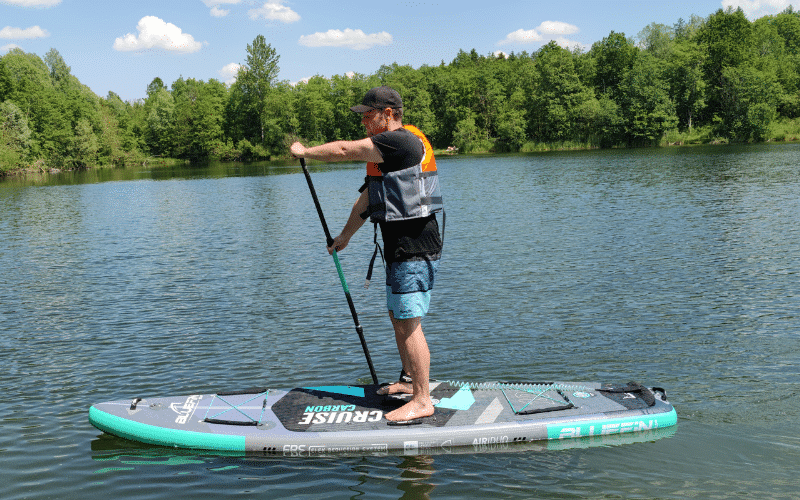
A life vest is the one piece of paddle boarding kit you hope never to need.
On flat water it feels like an accessory. The moment a gust pushes you off the board in cold water, it turns into the only thing that matters.
The catch is that most life jackets are built for sitting in a boat, not for standing and paddling. Bulk across the shoulders, foam that rides up when you swim back to your board, and no ventilation on a hot day are the usual complaints.
We compared ten vests that suit paddling, from the ventilated Onyx MoveVent Dynamic to the slim belt packs that sit around your waist until you pull the handle.


The best life vests for paddle boarding at a glance
| Model | Type | Approval | Standout features |
|---|---|---|---|
| Onyx MoveVent Dynamic Paddle VestTop pick | Foam, paddle cut | USCG and Transport Canada | Mesh ventilation, zippered pocket, whistle, SOLAS reflective tape |
| Onyx M-16 Manual Inflatable Belt PackLeast in the way | Inflatable belt pack | USCG, 16 years and older | 17 lb buoyancy, oral back-up tube, under 1 lb |
| BLUESTORM Cirro 16 Manual Inflatable Belt PackWidest fit | Inflatable belt pack | USCG Type V with Type III performance | 16.5 lb buoyancy, fits 30 to 52 inch chests, D-rings |
| Onyx Kayak Fishing Life JacketFor anglers | Foam, high back | USCG approved | Multiple pockets, tool holders, mesh lower back |
| Stearns Adult Classic Series Life VestBest value | Foam, classic cut | USCG approved | Nylon shell, three buckles, open sides, 90 lb and up |
| awesafe Adult Watersport Universal VestMost storage | Foam, high back | Type III performance | Neoprene shoulders, back pocket, twin zippered pockets |
| Hardcore Life Jacket Paddle VestSizes for the whole family | Foam, paddle cut | USCG approved Type III, UL listed | Cordura polyester, 1 inch webbing, quick release buckles |
| O'Neill Women's SuperLite Life VestWomen's cut | Foam, minimal bulk | USCG approved | Coated polyester shell, Delrin quick release buckles |
| Onyx General Purpose Boating Life JacketSpare for guests | Foam, universal | USCG approved | Chest strap, large armholes, bright colours |
| Connelly Teen Nylon Life VestFor teens | Foam, teen sizing | USCG approved | 90 to 120 lb range, hidden belts, quick release buckles |
The ten life vests in detail
- Typefoam, paddle cut
- ApprovalUSCG and Transport Canada
- Ventilationmesh panels front and back
- Adjustmentside belts and shoulder straps
- Extraszippered pocket, whistle, SOLAS reflective tape
Best for: Paddlers who want a proper foam vest they can wear all day without overheating
The MoveVent Dynamic is the vest we keep coming back to, because it was drawn for people who paddle standing up rather than sit in a boat. The sculpted foam sits away from the shoulders, the armholes are cut wide, and the open sides let air through.
That matters more than it sounds. The main reason paddlers leave a life jacket strapped to the board instead of wearing it is heat, and a vest on the board saves nobody.
The details are sensible too. There is an expandable zippered pocket for a key and a bar, a whistle on the strap, and SOLAS grade reflective tape for the last hour before dusk. Six adjustment points let you pull it tight so it cannot ride up when you swim back to the board.
If you only ever paddle in warm, calm, sheltered water, one of the belt packs below is the lighter answer. For everything else this is the vest we would buy.
Strengths
- Dual approval from the US Coast Guard and Transport Canada
- Mesh panels front and back keep air moving on hot days
- The mesh back panel clears a kayak seat, so it works beyond the board
- Large armholes and open sides leave the paddle stroke free
Weaknesses
- Bulkier than a belt pack when you are only out for half an hour
- Costs roughly twice what a plain foam vest costs
- Typemanual inflatable belt pack
- ApprovalUSCG, users 16 and older
- Buoyancy17 lb from a 16 g CO2 cylinder
- Weightunder 1 lb
- Backuporal inflation tube
Best for: Warm days and flat water, where a foam vest would end up on the board instead of on you
A belt pack solves the wearing problem by being small enough to forget. This one weighs under a pound, sits at the small of your back, and only becomes a life jacket when you pull the handle.
The trade is honest and worth stating plainly. A foam vest floats you whether you are conscious or not. A manual belt pack needs you to act, and then needs you to pull the bladder over your head. If you paddle alone in cold water, choose foam.
For summer sessions on a lake it is the pack that actually gets worn, which is why it sits this high. Buy a spare 16 gram cylinder with it and inflate the bladder once at home so your hands know the movement. If you want the same idea in a throwable form instead, our Restube PFD review covers the other side of that argument.
Strengths
- Weighs less than a pound and sits out of the way around the waist
- 17 pounds of buoyancy once the handle is pulled, with an oral tube as backup
- The inflation handle clips down so it cannot snag on a leash or paddle
- Rearming kits are cheap, so a practice inflation costs little
Weaknesses
- Manual only, it does nothing until you pull the handle
- Not approved for under 16s, and not for non-swimmers

- Typemanual inflatable belt pack
- ApprovalUSCG Type V with Type III performance
- Buoyancy16.5 lb
- Fit30 to 52 inch chests, one universal size
- ExtrasD-rings, pillow style bladder
Best for: Households where one belt pack has to fit several people
The Cirro 16 is the belt pack to pick when more than one person will use it. The single universal size spans a 30 to 52 inch chest, so it moves between adults in a family without any refitting.
Performance is where it counts: 16.5 pounds of buoyancy puts it level with a foam Type III vest once inflated. The bladder is a pillow shape that comes up in front of the chest rather than around the neck, which is quicker to get into when you are already in the water.
Read the Type V label carefully. It counts as an approved life jacket only while it is worn, so leaving it in the deck bag is the one thing that voids it.
Strengths
- One universal size covers 30 to 52 inch chests
- 16.5 pounds of buoyancy, on par with a Type III foam vest
- Pillow style bladder inflates in front of the chest, easy to get over the head
- D-rings take a whistle, a knife or a small light
Weaknesses
- Type V approval means it only counts as a life jacket while worn
- Manual inflation only, same caveat as every belt pack here
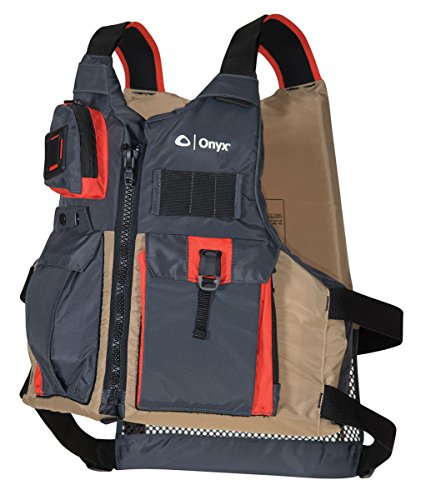
- Typefoam, high back
- ApprovalUSCG approved
- Storagemultiple zippered pockets and tool holders
- Backmesh lower back and shoulders
- HardwareD-ring attachments
Best for: Paddlers who fish from the board and want their gear on the vest, not in a bag
If you fish from your board, the vest becomes your tackle box. This one carries that load properly: zippered pockets, tool holders and D-rings across the front, so pliers and a line cutter never leave your body.
The high back is built to clear a kayak seat, which is also useful on a board with a seat fitted. Mesh across the lower back and shoulders keeps some air moving despite the extra material.
For plain paddling it is more vest than you need. For fishing it saves you a dry bag, and the gear stays where you can reach it one handed.
Strengths
- Pockets and tool holders keep pliers, line and a knife within reach
- High back design clears a seat if you fish sitting down
- Mesh lower back and shoulders keep it breathable despite the volume
- Heavy duty nylon takes hooks and abrasion
Weaknesses
- The most bulk of any vest here, noticeable on a long flat paddle
- Overkill if you never carry tackle
- Typefoam, classic cut
- ApprovalUSCG approved Type III
- Shellnylon over PE flotation foam
- Adjustmentthree buckles, open sided
- Sizingadults from 90 lb, standard and oversized
Best for: A first vest, or a spare that lives in the car for whoever comes along
This is the vest most people picture when they hear life jacket, and there is nothing wrong with that. Nylon shell, PE foam, three buckles, Coast Guard approved, done.
The open sided cut breathes better than it looks, and the standard and oversized options mean it fits far more body shapes than the paddle specific vests do. For a spare that lives in the car boot for visitors, it is hard to argue with.
What you give up is shoulder freedom on a long stroke and any kind of storage. If you paddle several times a week you will notice both. If the vest exists so that a friend can come along on a Sunday, it is exactly enough.
Strengths
- Coast Guard approved at the lowest price in this comparison
- Open sided design with three buckles keeps it breathable and adjustable
- Standard and oversized fits cover most adults
- Simple nylon and foam construction with little to go wrong
Weaknesses
- Plain boating cut, less shoulder freedom than the paddle specific vests
- No pockets and no reflective tape
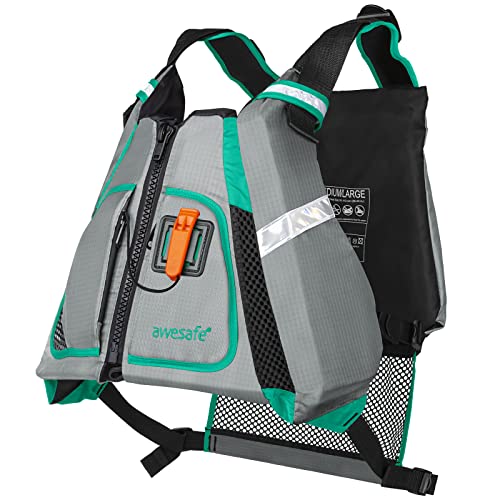
- Typefoam, high back
- PerformanceType III style, stable face-up float in calm water
- Shouldersneoprene
- Storageback pocket plus twin expandable zippered pockets
- VisibilitySOLAS grade reflective strips
Best for: Day paddlers who carry phone, keys and a snack and do not want a deck bag
The awesafe carries more than any other foam vest in this list. Two expandable zippered pockets with mesh drainage sit on the chest, and a back pocket takes a light shell or a spare layer, which on a summer paddle is most of what you would otherwise carry in a bag.
Neoprene on the shoulders is the part you feel. Over a few hours in a rash vest, plain webbing rubs and neoprene does not.
One point of care: where a vest has to satisfy a local rule, check the approval label on the item you receive rather than the listing text. For the pockets and the comfort, it earns its place either way. Our list of waterproof smartphone bags covers the other half of that problem.
Strengths
- Twin expandable zippered pockets with mesh drainage, plus a back pocket
- Neoprene shoulders chafe less than plain webbing on bare skin
- Breathable mesh high back keeps it usable on hot days
- SOLAS grade reflective strips help at dusk
Weaknesses
- Universal sizing is a compromise at both ends of the range
- Check the current approval marking before you rely on it for regulations
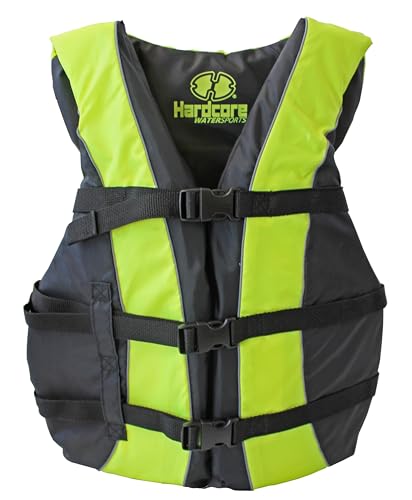
- Typefoam, paddle cut
- ApprovalUSCG approved Type III, UL listed
- ShellCordura polyester over closed cell PE foam
- Webbing1 inch adjustable straps
- Sizingchildren through adults
Best for: Families kitting out several people at once in matching sizes
Kitting out a family usually means three different brands and three different sizing charts. This vest runs the full range from child to adult, so you measure once and order the same model for everyone.
The build is straightforward and tough: Cordura polyester over closed cell foam, one inch webbing, quick release buckles. It is UL listed and Coast Guard approved as a Type III, which is what a lake or a coastal park will ask for.
Take the sizing seriously. It runs snug, and a vest that rides up in the water is worse than no vest at all because it hides the fault until you need it.
Strengths
- One model across child and adult sizes, so everyone gets the same fit logic
- UL listed and Coast Guard approved Type III
- Cordura polyester shell resists abrasion better than plain nylon
- Quick release buckles are easy to work with cold hands
Weaknesses
- Sizing runs snug, order with the chest measurement in front of you
- No pockets and no ventilation panels

- Typefoam, minimal bulk
- ApprovalUSCG approved
- Shellcoated polyester over PE foam
- BucklesDelrin quick release
- Fitrelaxed women's cut, sizes from 30 to 33 inch chest
Best for: Women who find unisex vests too high in the chest and too wide at the shoulder
Most life jackets sold as universal are a men's pattern with a smaller label. The SuperLite is not, and if you have ever had a vest sit up under your chin, that is the difference you are paying for.
It is deliberately light on material. That keeps the shoulders free and the bulk down, at the cost of the spare buoyancy the heavier vests carry. For flat water paddling that is the right trade.
The Delrin buckles are worth a mention for anyone paddling salt water, since they do not seize the way cheap metal hardware does after a season. If you paddle in colder water, our wetsuits for paddle boarding comparison pairs with it.
Strengths
- Cut for a woman's chest instead of a scaled down men's vest
- Minimal bulk leaves the paddle stroke free
- Delrin quick release buckles do not corrode in salt water
- A relaxed fit that suits a range of body types
Weaknesses
- Less foam than the heavier vests, so less spare buoyancy
- No pockets, no reflective tape
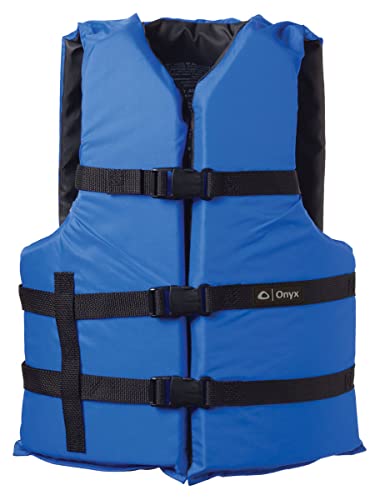
- Typefoam, universal adult
- ApprovalUSCG approved
- Adjustmentadjustable belts plus chest strap
- Cutopen sided with large armholes
- Visibilitybright colour options
Best for: The vest you keep in the car so nobody has to stay on the beach
Every household that owns a board ends up needing a spare vest, usually at short notice. This is the one to buy for that job: approved, cheap, and adjustable enough to fit whoever turns up.
The chest strap is the part that matters. Universal vests fail by riding up over the ears in the water, and the strap across the chest is what stops it.
Nobody will call it comfortable on a three hour paddle. It is not meant for that. It is meant to be in the car when a friend wants to try the board.
Strengths
- The cheapest approved vest here by a clear margin
- Chest strap stops it riding up, the usual failing of universal vests
- Large armholes and open sides make it wearable on a board
- Bright colours make a head easy to spot from shore
Weaknesses
- Universal sizing means it fits nobody perfectly
- Basic foam and nylon, no pockets or ventilation panels

- Typefoam, teen sizing
- ApprovalUSCG approved
- Range90 to 120 lb
- Beltshidden belts for mobility
- Bucklesquick release with adjustable straps
Best for: Teenagers who have outgrown a youth vest but swim inside an adult one
The weight range between a child's vest and an adult vest is where most families give up and hand over something too big. That is the failure this vest exists to fix, and it is a real safety issue rather than a comfort one, because an oversized vest floats up and the wearer floats down.
The hidden belts are a good touch for board use. With nothing loose on the outside, there is less to catch on a leash or a paddle shaft.
Check the printed weight range against the actual person, not their age. Ninety to 120 pounds is the number that counts.
Strengths
- Covers the 90 to 120 lb gap that adult vests fit badly
- Hidden belts keep the outside clean so nothing catches on a leash
- Quick release buckles and adjustable straps are simple enough to fit unsupervised
- Coast Guard approved for the weight range printed on the label
Weaknesses
- Only useful inside that weight range, so it is outgrown quickly
- Plain nylon build with no storage
What makes a good life vest for paddle boarding
Approval: In the United States that means a US Coast Guard approved device, and the label inside the vest is what counts, not the product description. The Coast Guard's own guidance on wearing a life jacket is short and worth the two minutes. A stand up paddle board counts as a vessel outside a designated swimming area, which is why the rule applies to you at all.
Cut: A paddling vest is scooped at the arms and shortened at the waist so that the stroke stays free and nothing digs in when you sit down. A boating vest with full shoulders will rub within the hour.
Ventilation: Mesh panels and open sides decide whether the vest gets worn in July. This is the single biggest reason foam vests end up strapped to the board instead of the paddler.
Fit under load: Tighten every strap and have somebody pull up on the shoulders. If the vest lifts past your ears on land, it will do the same in the water, where it is useless.
Foam or inflatable: Foam works whether you are conscious or not and needs no maintenance. An inflatable belt pack is barely noticeable but needs a pull on the handle and a cylinder that has not been fired. Cold water, open water and solo paddling all argue for foam. Warm, sheltered water is where the belt pack wins, because it is the one you will actually wear.
Frequently asked questions
Do I legally need a life vest on a paddle board?
In US waters a stand up paddle board is treated as a vessel when it is used outside a designated swimming, surfing or bathing area, so an approved life jacket has to be on board for each person, plus a sound signalling device. Rules differ by state and by country, so check locally before you launch.Is an inflatable belt pack safe enough for paddle boarding?
For a competent swimmer in warm, sheltered water it is a sensible choice, and it is far better than a foam vest left on the board. It is manual, so it does nothing until you pull the handle. For cold water, open water, non-swimmers and anyone under 16, choose a foam vest instead.What size life vest do I need?
Adult vests are sized by chest measurement and by weight, not by clothing size, so measure before ordering. Once it arrives, tighten every strap and have somebody pull up on the shoulders. If it rides up towards your ears, it is too big.How do I care for a life vest?
Rinse it in fresh water after salt water use and dry it in the shade, since sunlight is what degrades the shell and the foam. Store it loose rather than compressed. For belt packs, check the cylinder and the green status indicator at the start of every season.Bottom line
The Onyx MoveVent Dynamic is the vest we would buy first. It is approved on both sides of the border, it is cut for standing and paddling rather than sitting in a boat, and the mesh panels mean it stays on your body on the days when a plain foam vest would end up strapped to the deck.
If heat is what keeps you from wearing one at all, the Onyx M-16 belt pack is the honest compromise, with the BLUESTORM Cirro 16 as the choice when several people share one. And if you are still assembling the rest of your kit, our comparisons of SUP leashes and swim buoys cover the two pieces of safety gear that belong next to it.


