

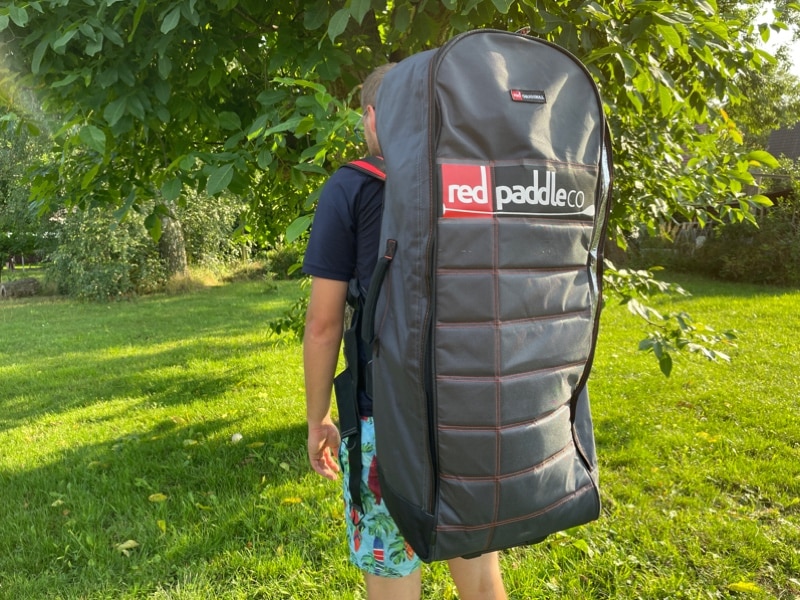
The bag that comes with an inflatable board is usually the first thing owners replace. It is cut to the exact volume of a factory-rolled board, which is not how anyone rolls a board at the end of a wet afternoon.
A better bag is bigger, stronger and carries properly. The difference between a hundred litre bag and a hundred and twenty is the difference between kneeling on the zip and closing it one-handed.
What separates them is fabric weight, strap design and whether there are wheels. A loaded board bag is twenty five to thirty five pounds, and every one of those pounds sits on your shoulders.
We compared nine bags, eight for inflatables and one padded travel cover for hard boards.


The best paddle board bags at a glance
| Bag | Capacity | Fabric | Standout feature |
|---|---|---|---|
| NIXY iSUP BackpackTop pick | Large | Waterproof | Three wheel base for rolling |
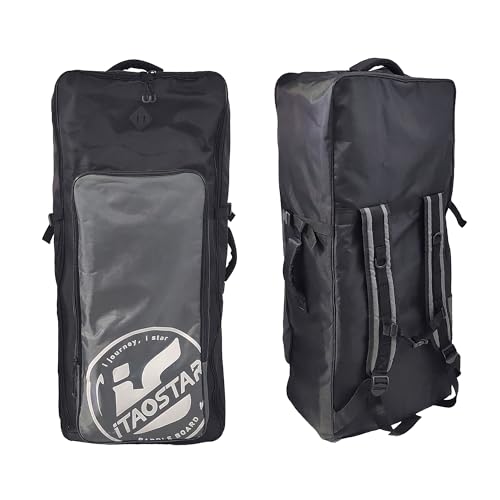
| iTAOSTAR G-B01CBest value | 120 L | 1680D | Bottom exhaust hole for packing |
| BPS rPET SUP BagMost sustainable | X-Large | Recycled rPET | 60 bottles diverted per bag |
| Modoker 2-in-1Most versatile | 110 L | Water resistant | Backpack and hand carry in one |
| niphean Wide Strap BackpackMost comfortable | Large | Sun resistant | Extra wide straps and a chest buckle |
| SUSIEBAY iSUP BagBest budget | 108 L | 600D | Thirty dollars |
| HEYTUR Trolley BagBest wheeled | Large | Heavy duty | Trolley wheels and a pull handle |
| Abahub 12 ft BackpackFor big boards | 41 x 21 x 13 in | 1680D nylon | Fits boards up to 12 ft 6 |
| Curve SUP Travel CoverFor hard boards | 8 ft 2 to 12 ft 6 | 600D polycanvas | 20 mm nose and tail foam |
The nine picks in detail
- Typebackpack with wheels
- Wheelsthree wheel design
- Strapspadded shoulder straps
- Fabricwaterproof
- Capacityboard plus accessories
- Weightlightweight construction
- BrandNIXY
Best for: Anyone who carries a board further than the car park
Wheels are the feature people dismiss until the first airport or the first half mile of gravel path with a board on their back.
Three wheels rather than two means the bag stands up on its own when you stop, which matters when you are also holding a paddle and a pump.
The fabric being properly waterproof matters on the return leg, since the board goes in wet and everything else in the bag shares that.
Strengths
- Wheels and straps together, so you choose per situation
- Waterproof rather than merely water resistant fabric
- NIXY build boards, so the bag is sized around real ones
- Padded straps that survive a thirty pound load
Weaknesses
- Eighty nine dollars is mid-range money for a bag
- Wheels add weight you carry when you are not rolling
- Capacity120 litres
- Fabric1680D
- Liningsoft protective inner layer
- Zipsheavy duty dual zipper
- Strapsadjustable
- Ventilationventilation holes
- Exhaustbottom exhaust hole for packing
Best for: Replacing a tight factory bag without spending much
Denier is the number worth reading on a bag. At 1680 denier the fabric is roughly three times heavier than the 600D used on budget bags, and that is where bags fail.
The exhaust hole is a small idea that solves a real annoyance, because a rolled board traps air and fights the zip.
A hundred and twenty litres takes a board, pump, paddle, fin, leash and a towel, which is the honest packing list.
Strengths
- 1680D fabric at fifty dollars, which is unusual
- 120 litres means you are not fighting the zip
- The bottom exhaust hole lets trapped air out as you pack
- Soft lining stops the board picking up scuffs
Weaknesses
- No wheels
- Nothing distinguishes it beyond doing the basics well

- SizeX-Large
- Materialrecycled rPET
- Impactover 60 plastic bottles diverted per bag
- Carrybackpack straps or padded side handles
- Pocketrear pocket
- Paddingpadded straps
- GuaranteeBPS Right Choice replacement or refund
Best for: Paddlers who would rather their kit was made from recycled material
Recycled PET makes a fabric indistinguishable from ordinary polyester, so the only trade here is price rather than durability.
Side handles matter more than you expect. Lifting a loaded bag into a car boot by the shoulder straps is how straps get torn out.
The rear pocket is where the leash and the wet buoyancy aid go, so the dry things inside stay dry.
Strengths
- Genuinely recycled fabric rather than a vague green claim
- Padded side handles as well as straps, useful for two-person carries
- A stated replacement guarantee
- Rear pocket for the wet things you do not want inside
Weaknesses
- Sixty dollars for a bag without wheels
- Recycled polyester is no tougher than the virgin equivalent

- Capacity110 litres
- Modesbackpack or hand carry
- Fabricwater resistant and washable
- Strapsadjustable padded, ergonomic weight distribution
- Contentsboard, pump, paddle and gear
- Colourgreen
- Usebeach and water environments
Best for: Short carries where a full backpack harness is overkill
Sand is what actually destroys board bags, working into the zip until it stops running. A fabric you can rinse and scrub is a longer-lived bag.
The two carry modes are not a gimmick. Beach to car is a duffle job; car park to lake is a backpack job.
Pair it with a carry strap if you also move the board inflated.
Strengths
- Washable fabric, which is rare and genuinely useful after sand
- Converts between backpack and duffle without any fuss
- 110 litres holds a full setup
- Sixty dollars
Weaknesses
- Water resistant rather than waterproof
- No wheels or trolley option

- Strapsextra wide padded with chest buckle
- Adjustmentadjustable length
- Fabricsun resistant, tear and wear resistant
- ProtectionUV, scratch and dirt
- Fits10 ft, 10 ft 6 and 11 ft boards plus pump, paddle, fin and leash
- Zipsdual smooth-glide
- Pocketfront pocket
Best for: Anyone whose current bag digs into their shoulders
Strap width is the single biggest comfort variable on a loaded board bag, and cheap bags use narrow webbing because it is cheap.
A chest buckle stops the straps sliding off your shoulders on uneven ground, which is where most of the swearing happens.
Check the length before buying if you paddle a twelve foot touring board. This is sized for the all-around range.
Strengths
- Wide straps and a chest buckle, which is the whole comfort story
- UV resistant fabric, so it does not go chalky in a season
- Dual zips make loading easy even when full
- Forty dollars
Weaknesses
- No waist belt, which would help more than the chest buckle
- Sized for boards up to eleven feet, so not for touring hulls
- Capacity108 litres
- Size90 x 40 x 30 cm
- Fabric600D
- Strapsadjustable padded shoulder strap with quick release buckle
- Foldsfolds flat for storage
- Fitsmost standard inflatable boards and surfboards
- Returns30 day return
Best for: A spare bag, or a first replacement on a tight budget
At thirty dollars the calculation is simple. If your factory bag has split, this replaces it for less than the cost of a tank of fuel.
600D fabric is the budget standard. It is fine for a bag that lives in a car boot and travels twice a year, and it is not fine for airline handling.
Folding flat is genuinely useful, because a board bag otherwise occupies a cupboard all winter.
Strengths
- Thirty dollars, which is a third of the price of the leaders
- 108 litres, so it is still bigger than most factory bags
- Folds flat when not in use
- Quick release buckles rather than knots
Weaknesses
- 600D fabric will not take years of rough handling
- Straps are adequate rather than comfortable when fully loaded
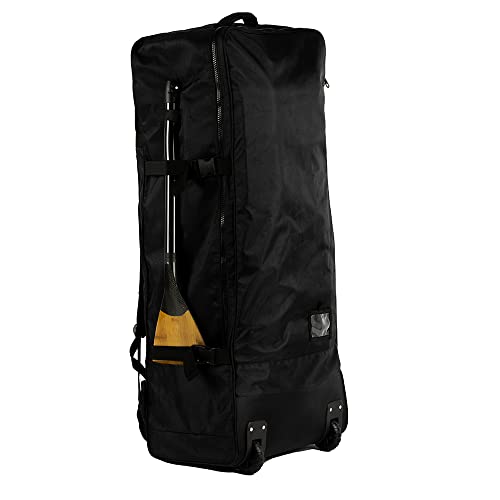
- Typetrolley bag with wheels
- Carrypadded shoulder straps or trolley handle
- Capacityboard, pump and accessories
- Openingwide opening with a sturdy zipper
- Buildheavy duty outdoor materials
- Usealso works for camping and general gear
Best for: Long paved approaches, airports and anyone with a bad back
Wheels only help on hard surfaces. On sand or a grass bank you carry the bag and its wheels, which is why the straps still matter.
For airport travel, though, a wheeled bag changes the trip entirely. Thirty pounds on wheels is a stroll and thirty pounds on your back is not.
The wide opening is the underrated feature. Board bags with a narrow mouth force you to roll the board tighter than it wants to go.
Strengths
- Wheels take the entire load off your shoulders on hard ground
- Wide opening, so packing is not a wrestling match
- Doubles as general travel luggage
- Straps remain, so grass and sand are still possible
Weaknesses
- Ninety nine dollars
- Wheels are useless on soft sand and add weight everywhere else

- Size41 x 21 x 13 in
- Fitsinflatable boards up to 12 ft 6
- Fabric1680D nylon
- Zipsheavy duty two-way
- Strapsadjustable shoulder with velcro back pads, chest and waist bands
- Pocketstwo front, three internal and a paddle bag
- Experienceover 10 years of SUP manufacturing
Best for: Touring and race boards that no standard bag will take
Touring boards roll bigger than all-round boards, and the standard hundred litre bag simply will not close around one.
The waist band is what distinguishes this from every other bag here. Shoulder straps carry a board badly; a hip belt carries it properly.
If you have moved up to a touring board, this is the bag that stops the upgrade being a daily annoyance.
Strengths
- Genuinely sized for a 12 ft 6 board, which most bags are not
- A waist band, which is the strap that actually carries the weight
- Separate paddle bag attached to the side
- 1680D nylon and two-way zips
Weaknesses
- A hundred and twenty four dollars
- Oversized for a ten foot board, so it packs loosely

- Sizes8 ft 2 to 12 ft 6
- Nose and tail20 mm boosted foam zones
- Core7 mm waterproof shock absorbing foam
- Base600D water resistant polycanvas
- Uppersilver tarpee reflective
- Strapdetachable double adjustable shoulder strap
- Closurenon-zip big tooth, corrosion proof
- Extrasadjustable fin slot and internal stash pocket
Best for: Hard boards, which no inflatable backpack will protect
A hard board is a different problem. It cannot be rolled, it dents, and the damage always happens at the nose or the tail.
Silver reflective fabric is not decoration. A dark board bag left in the sun cooks the board inside, which delaminates epoxy over time.
Measure your board before ordering, including the nose rocker. These covers are cut close, which is what makes them protective.
Strengths
- Twenty millimetres of foam at the nose and tail, where boards break
- Silver reflective upper keeps the board cool in the sun
- A closure that cannot corrode, unlike a metal zip
- Fin slot, so the fin stays on for short trips
Weaknesses
- A hundred and forty five dollars
- Sized per board, so you must measure before ordering
How to choose a paddle board bag
Buy more capacity than the board needs: The factory bag is sized for a factory roll and nothing else. A hundred and ten to a hundred and twenty litres leaves room for the pump, the paddle, a fin and a wet towel, which is what you are actually carrying home.
Read the denier: 600D is a car boot bag, 1680D is a bag that survives baggage handlers and gravel. The difference in price is fifteen or twenty dollars, and the difference in lifespan is years.
Straps carry weight, wheels carry distance: A loaded bag is twenty five to thirty five pounds. Wide padded straps with a chest clip make that manageable, a waist belt makes it comfortable, and wheels make it irrelevant on hard ground and useless on sand.
Check the length against your board: Most bags are cut for boards up to about eleven feet. Touring and race boards roll longer and thicker, and forcing one into a short bag strains the zip until it fails.
Hard boards need a padded cover, not a backpack: Inflatable bags are unpadded sacks. A hard board needs foam at the nose and tail, a reflective upper so it does not overheat, and a fitted length. They are not interchangeable purchases.
Frequently asked questions
What size bag do I need for my paddle board?
Measure the rolled board rather than trusting the board length. A ten to eleven foot inflatable rolls into roughly 100 to 110 litres with its accessories, and a twelve foot touring board wants 120 litres or a bag specifically rated to 12 ft 6. Extra volume costs nothing except a slightly looser pack.Can I put a wet board in the bag?
You can get it home that way, but unroll and dry the board before storing it. Trapped moisture in a rolled board grows mould along the seams and inside the fin box, and no amount of bag ventilation prevents that.Are wheeled board bags worth it?
On hard ground and at airports, very much so. On sand and grass, the wheels are dead weight and you carry the bag anyway. Buy wheels if your usual carry is a long paved path, and skip them if it is a beach.Will an inflatable board bag fit a hard board?
No. Inflatable bags are unpadded and sized for a roll, so a hard board arrives dented. Use a fitted padded travel cover, sized to the board, with foam at the nose and tail.Bottom line
The NIXY backpack is the one to buy if you carry a board any distance, because it combines padded straps with a wheeled base and a genuinely waterproof shell. For half the money the iTAOSTAR G-B01C does everything except roll, in fabric three times heavier than the bag your board came in.
Two situations break the pattern. A twelve foot touring board needs the Abahub and its waist belt, and a hard board needs the Curve cover with real foam at the nose and tail, because no inflatable backpack protects anything that cannot be rolled.


