

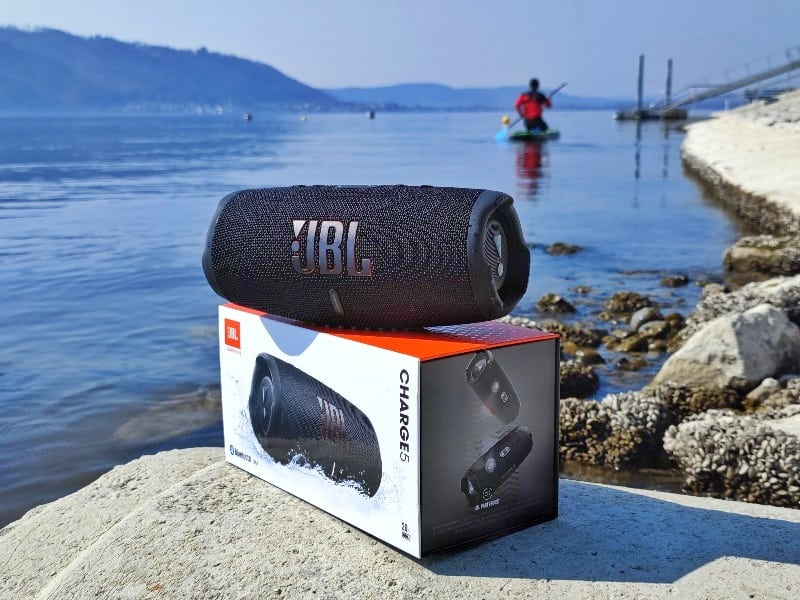
A speaker on a paddle board has one job the marketing never mentions: surviving the moment it goes in the water.
Everything sold as waterproof handles rain and spray. Far fewer float, and fewer still float the right way up with the driver clear of the surface. That difference decides whether a dropped speaker is a nuisance or a hundred dollars on the lake bed.
The second thing that matters is how it attaches. A speaker rolling loose on the deck ends up overboard on the first wake, so a loop, a clip or a mount is not an accessory, it is the point.
We compared nine speakers from eighteen to a hundred and thirty dollars, sorted by whether they float, how they attach and how they actually sound outdoors.


The best waterproof Bluetooth speakers at a glance
| Speaker | Rating | Floats | Playtime |
|---|---|---|---|
| Ultimate Ears WONDERBOOM 4Top pick | IP67, 1 m for 30 min | Yes | 14 hours |
| Soundcore Boom 3iBest on the water | IP68, salt water rated | Yes, upright | 16 hours |
| Yak-Power DryTunesBest mounted option | IP67, fully submersible | Yes | 10 hours at full volume |
| Bose SoundLink FlexBest sound quality | IP67, rust resistant | Not stated | 12 hours |
| Ultimate Ears MINIROLLBest small speaker | IP67, 1 m for 30 min | Not stated | 12 hours |
| JBL Clip 5Best clip-on | IP67 waterproof and dustproof | No | 12 hours plus 3 boost |
| JBL Flip 6Loudest mid-range | IP67 waterproof and dustproof | No | 12 hours |
| Ortizan X10Best budget speaker | IPX7, fully immersible | Not stated | 30 hours |
| XLEADER X8Cheapest pick | IP67 certified | Yes | 24 hours |
The nine speakers in detail
- RatingIP67, submersible to 1 m for 30 minutes
- Floatsyes
- Battery14 hours
- Sound360 degree, Outdoor Boost mode
- Range131 ft (40 m)
- Attachmentloop on the body, drop proof
Best for: One speaker that covers the board, the beach and the garden
The combination that matters here is float plus loop. A floating speaker you can also tie down is a speaker that neither sinks nor drifts away while you chase it.
360 degree output is a fair trade on a board, where the speaker is at your feet and there is no wall to reflect off.
Clip it to a deck D-ring rather than dropping it in a dry bag. A speaker inside a sealed bag loses most of its volume and all of its bass.
Strengths
- Floats and is dust proof and drop proof, the full set of failure modes covered
- Outdoor Boost genuinely helps, since open water swallows bass
- Fourteen hours outlasts any realistic session
- The loop takes a carabiner, so it ties to a D-ring properly
Weaknesses
- Sixty five dollars is mid range money for entry level volume
- 360 degree sound wastes output when you only sit on one side
- RatingIP68 waterproof and dust tight
- Floatsyes, stays upright and sound forward
- Salt waterrated 5x salt water resistant
- Power50W with BassUp 2.0, bass to 56 Hz
- Battery16 hours
- Extrasvoice amplifier, emergency alarm, detachable strap
Best for: Sea paddling and anyone who has already lost one speaker overboard
Floating is not enough on its own. Most floating speakers land on their side or face down, and a driver pointed into the water is a muffled speaker.
Anker's weighting keeps it upright, which is why this one is worth the premium for anyone paddling where a drop is likely.
Salt water resistance is the other genuine difference. Salt destroys speaker grilles and charging ports faster than immersion in fresh water ever does.
Strengths
- Floats the right way up, which almost nothing else here does
- IP68 and salt water rated, the only speaker built for the sea
- Fifty watts is loud enough to matter against wind and engine noise
- Detachable strap and a water bottle footprint, so it stows anywhere
Weaknesses
- A hundred and thirty dollars, the priciest speaker compared
- Bigger and heavier than the clip-on options

- RatingIP67, fully submersible with no ingress
- Floatsyes, for easy retrieval
- Batterydual lithium, 4800 mAh, 10 hours at 103 dB
- Mountingremovable magnetic base with 1/4-20 thread
- Pairingparty button links unlimited speakers within 200 ft
- Includedmagnetic base, steel rail pad, wrist strap
Best for: A speaker that stays put on the deck rather than rolling around
Every other speaker here is a general purpose speaker that happens to float. This one was designed to bolt to a boat, and that shows in the mount.
The 1/4-20 thread is the useful detail: any camera mount already on your board becomes a speaker mount.
It pairs with any number of others, which is a party feature for groups and irrelevant on your own. The retrieval float is the reason to buy it.
Strengths
- Magnetic base with a 1/4-20 thread fits standard action camera mounts
- A hundred and three decibels at full volume, genuinely loud
- Forty hours at conversational volume, which is how most people use it
- Built by a kayak fishing brand, so the mounting is thought through
Weaknesses
- A hundred dollars for sound quality that is functional rather than refined
- Magnetic base needs the steel pad fitted somewhere on the board

- RatingIP67, sealed against water, dust and debris
- Battery12 hours
- Soundcustom transducer, PositionIQ adjusts to orientation
- Builddrop resistant and rust resistant
- ChargingUSB-C
- AppBose Connect for settings and updates
Best for: Listening properly rather than just making noise
If the speaker mostly lives on a beach towel and occasionally comes onto the board, this is the one that sounds best doing it.
PositionIQ is not marketing filler. A speaker lying flat on a deck sounds different from one standing up, and this compensates.
Tie it down. Without a published float rating, assume it sinks and rig it accordingly, ideally to the same D-ring as your waist pack.
Strengths
- Clearly the best sounding speaker in this comparison
- PositionIQ adapts the output to how the speaker is lying
- Rust resistant hardware, which matters at the coast
- Bose support and firmware updates over years
Weaknesses
- Bose does not publish a float rating, so treat it as a sinker
- Eighty nine dollars buys louder speakers elsewhere in this list
Ultimate Ears MINIROLL Waterproof Bluetooth Speaker
Best small speaker- RatingIP67, submersible to 1 m for 30 minutes
- Battery12 hours
- Sizepalm sized
- PairingAuracast, unlimited speakers
- Range131 ft (40 m)
- Materialat least 40 percent recycled plastic
Best for: A small speaker that disappears into a deck bag
Small speakers lose to wind, which is the thing nobody accounts for. On a still lake this is plenty; in a breeze it disappears.
Where it earns its place is packing. Twelve hours from something this size means it lives permanently in the bag rather than being a decision.
The strap keeps it attached, and it should stay attached, since a palm sized speaker in dark water is not something you find again.
Strengths
- Palm sized, so it takes no space in a bag or pocket
- Twelve hours of playtime from a speaker this small
- Auracast pairing links as many as you like for a group paddle
- Fifty dollars for genuine UE build quality
Weaknesses
- No float rating published, unlike the WONDERBOOM
- Small drivers mean it struggles against wind on open water

- RatingIP67 waterproof and dustproof
- Attachmentintegrated carabiner with a wide opening
- Battery12 hours, plus 3 with Playtime Boost
- SoundJBL Pro Sound with bass boost
- PairingAuracast, two for stereo
- Weightpocketable
Best for: Clipping to a board handle, a leash or a backpack strap
A built in carabiner changes how a speaker gets used. It clips to the handle of the board and stays there without a thought.
That is fortunate, because it sinks. The clip is not a convenience feature here, it is the reason the speaker survives.
For a paddler who also cycles and hikes, this is the one that ends up on every bag, which is a fair argument on its own.
Strengths
- The carabiner is built in, not an afterthought loop
- Wide opening takes a D-ring or a thick strap
- Fifteen hours with boost, more than the specification suggests
- JBL tuning is punchier than its size deserves
Weaknesses
- Does not float, so the carabiner is doing safety duty
- Seventy dollars for a small speaker

- RatingIP67 waterproof and dustproof
- Soundtwo way system, racetrack woofer and separate tweeter
- Battery12 hours
- Formcylindrical, sits or stands
- Bassdual passive radiators
- Usepool, park, beach
Best for: A group on the water who want to actually hear it
The Flip is the default portable speaker for good reason, and the separate tweeter is why it stays intelligible when everything else turns to mush at volume.
Note the change from earlier models: this generation does not float. People who owned a Flip 4 assume it does and find out the hard way.
Buy a silicone sleeve with a strap if it is going on a board. Without one there is nothing to attach it to.
Strengths
- A two way system rather than a single driver, so vocals stay clear at volume
- The loudest speaker here short of the Boom 3i
- Twelve hours covers a full day out
- Widely supported, with cases and mounts available everywhere
Weaknesses
- Does not float, unlike earlier Flip generations
- A hundred and fifteen dollars, and there is no strap or clip included
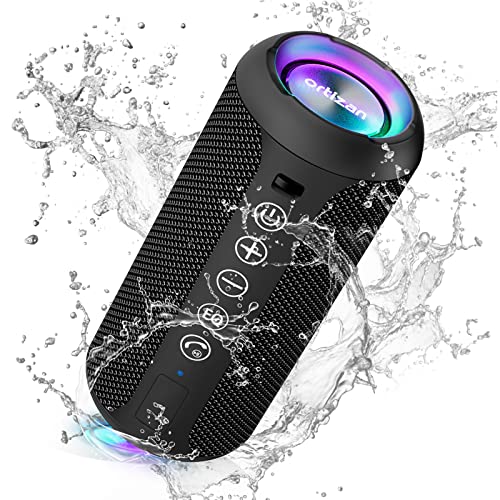
- RatingIPX7, full immersion
- Power24W (2 x 12W) stereo drivers
- Battery30 hours at moderate volume
- Bluetooth5.3, 66 ft range
- ExtrasRGB light show, built in microphone
- Size3 x 3 x 6.7 in, 1.28 lb
Best for: Loud enough for a group without spending real money
Thirty hours is the standout number. It means the speaker is charged when you want it, which is the failure mode that actually spoils days out.
The light show is aimed at a different buyer and can be switched off, which also extends the battery further.
IPX7 without a dust rating is the compromise at this price. Sand gets into the grille and stays there, so rinse it after beach use.
Strengths
- Thirty hours of playtime, the longest here by a distance
- Twenty four watts of stereo output for thirty two dollars
- Bluetooth 5.3 holds the connection better than budget speakers usually do
- Two drivers give it actual stereo separation
Weaknesses
- IPX7 covers water only, with no dust rating
- No float rating and no clip, so it needs its own tether
- RatingIP67 certified
- Floatsyes
- Power10W full range driver
- Battery24 hours
- Size3.8 in
- Attachmentclip and lanyard included
- Bodyremovable silicone cover
Best for: A speaker you can genuinely afford to lose overboard
The cheapest sensible speaker for a board is one that floats and clips on, and this does both for less than the cost of a leash.
It is quiet. On a still morning that is fine, and against a headwind you will be turning it up and hearing distortion instead of music.
Buy this one for a child's board or a surf launch, and keep something better for the days that matter.
Strengths
- Eighteen dollars, floats, and comes with both a clip and a lanyard
- Twenty four hours of playtime at this price is unusual
- Removable silicone cover rinses clean after sea use
- IP67 rather than the IPX ratings most cheap speakers claim
Weaknesses
- Ten watts, so wind and open water beat it easily
- Unknown brand, so replacement parts and support are unlikely
How to choose a speaker for the water
Floating is worth more than any sound specification: A speaker that sinks is gone the first time it slides off a wet deck. Check for an explicit float claim, not just a waterproof rating, and prefer one that floats upright with the driver clear of the surface.
Understand the rating: The first digit of an IP rating covers dust and the second covers water, so IP67 protects against both while IPX7 only claims water. On a sandy beach that difference is real, since grit in a grille is what kills speakers that never got wet.
Plan the attachment before you buy: A loop, a carabiner or a mount decides whether the speaker stays on the board. Speakers with no attachment point need a silicone sleeve with a strap, which is an extra purchase people forget until the speaker has already gone in.
Loudness beats fidelity outdoors: Open water has no walls to reflect off and wind removes the top end, so a speaker that sounds warm indoors sounds thin on a lake. Look for an outdoor or bass boost mode, and expect to need more watts than you would at home.
Rinse it after salt water: Salt dries into the grille and the charging port and corrodes contacts from the inside. Rinse the speaker under fresh water with the port cover closed, dry it upright, and it will outlast the battery rather than the other way round.
Frequently asked questions
Will a waterproof speaker survive being dropped in a lake?
An IP67 speaker survives a metre of water for half an hour, so the drop itself is fine. Whether you get it back depends on whether it floats. Speakers that sink are usually unrecoverable in anything deeper than waist height, which is why the float claim matters more than the rating.How far does Bluetooth reach on the water?
Further than on land, since there is nothing in the way. Ten metres is the conservative figure and the better speakers quote forty. In practice a phone in a deck bag and a speaker at the tail of the board will never be a problem, though a body between them will cut the signal.Should I use a speaker or headphones?
Headphones if you paddle in company or near others, since sound carries a long way over water and what feels reasonable on your board is audible on the far bank. A speaker suits an open lake or a group. Bone conduction waterproof headphones leave your ears open for boat traffic, which a speaker cannot do.Is it rude to play music on the water?
Sound travels remarkably well across flat water, and noise carries to anglers, wildlife and other paddlers hundreds of metres away. Keep the volume to what you can hear on your own board, and switch it off entirely near reed beds and nesting areas.Bottom line
The WONDERBOOM 4 is the sensible default: it floats, it survives a full submersion, it has somewhere to tie a line and it plays for fourteen hours. Nothing else at sixty five dollars covers all four.
Pay up for the Soundcore Boom 3i if you paddle in the sea or in chop, because floating upright and salt water resistance are the two things that decide whether a speaker lasts a season. Spend eighteen dollars on the XLEADER instead if the honest plan is to lose it.


