


Getting the board to the water is the part of paddle boarding nobody photographs, and the part where things actually go wrong.
There are two ways to do it. Soft pads wrap around your crossbars, cost forty to sixty dollars and pack away in a bag. J-bars bolt to the bars, hold the board on edge and free up roof space for a second one.
The decision is simpler than it looks: soft pads for an inflatable board or occasional trips, J-bars if you carry a hard board regularly or need to fit two.
We compared ten roof rack solutions for paddle boards, including the straps that hold everything down, since a good pad with a bad strap is still a board on the motorway.
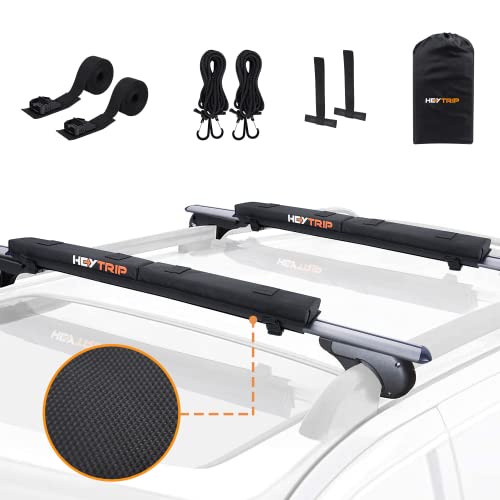


The best SUP roof racks at a glance
| Product | Type | Size | Standout features |
|---|---|---|---|
| HEYTRIP Aero Crossbar PadsTop pick | Soft pads | 30 in | Built-in non-slip mat, two 15 ft tie-downs plus bow and stern lines |
| IKURAM R Folding J-Style RackBest J-bar | J-bar, aluminium | 3-in-1 | Folds flat, oversized rubber saddles, padded uprights |
| Ho Stevie! Tie Down StrapsBest straps | Straps only | 15 ft pair | 1.25 in webbing, silicone buckle covers, stacks multiple boards |
| COR Surf Aero Roof Rack PadsBest build quality | Soft pads | 28 in | 600D PVC coated oxford, silicone covered cam straps, two sizes |
| Abahub 35 inch Soft Rack PadsWidest coverage | Soft pads | 35 in | 1680D fabric, EVA foam, neoprene sleeved cam buckles, full kit |
| Ediors Folding J-Bar Rack, 2 PairsBest for two boards | J-bar, steel | 2 pairs | 1.5 mm steel tube, folds flat, takes 36 in wide 150 lb loads |
| MeeFar Kayak Roof Rack Pad SetMost complete kit | Soft pads | Universal | Fits cars with or without gutters, six straps and ropes, storage bag |
| Dakine Aero Rack Pads 34 inchBest brand pads | Soft pads | 34 in | 600D polyester, water resistant, hook and loop closure |
| HIKULA 28 inch Aero Rack PadsBest value | Soft pads | 28 in | 600D polyester, non-slip mat, two 15 ft scratch resistant straps |
| Golkcurx Universal Soft Rack PadsFor cars without rails | Soft pads | Universal | Works without side rails, safety locks, shockproof construction |
The ten options in detail
- Typesoft crossbar pads
- Width30 in
- Gripbuilt-in non-slip mat inside the pad
- Strapstwo 15 ft tie-downs with padded cam locks
- Extrastwo 15 ft bow and stern lines
- Storagefoldable
Best for: Anyone with crossbars who carries a board a few times a month
This is the set to buy if you are starting from nothing. Pads, tie-downs and bow and stern lines, which together are the complete system rather than half of it.
The non-slip mat inside the pad is the detail that separates good pads from bad ones. Without it the pad rotates around the bar under load, and then the board is resting on the edge of the pad instead of the middle.
Use the bow and stern lines. They are the part everyone skips, and they are what stops the whole load lifting at motorway speed.
Strengths
- Thirty inches covers the crossbar properly, so the board never touches metal
- Non-slip mat inside means the pad does not rotate on the bar
- Bow and stern lines included, which most sets leave out
- Folds away into a bag between trips
Weaknesses
- Pads alone do not stop a board sliding sideways in a crosswind
- Around forty six dollars
- TypeJ-bar carrier, aluminium
- Design3-in-1, folds flat when empty
- Saddlesoversized all-weather rubber
- Uprightspadded
- Fittingstandard crossbars, no professional install
Best for: Hard boards and regular trips, where loading needs to be quick
J-bars carry the board on its edge, which means the roof has room for a second board, and it also means the wind hits far less surface area.
Aluminium is the reason to pick this over the cheaper steel racks. Steel J-bars rust from the inside where the powder coat gets chipped by the strap ratchet.
Folding matters more than you would expect. An empty J-bar left upright whistles at speed and costs real fuel over a season.
Strengths
- Aluminium rather than steel, so it does not rust where the coating chips
- Folds down when empty, which kills the wind noise and saves fuel
- Thick rubber saddles protect a hard board's rails
- Carries the board on edge, freeing half the roof
Weaknesses
- Ninety dollars
- Needs crossbars, so it is not an option on a bare roof
- Typetie-down straps, pair
- Length15 ft
- Width1.25 in webbing
- Bucklesmetal with silicone covers
- Useworks with any rack, stacks multiple boards
Best for: Anyone whose rack came with poor straps, which is most people
Straps are where cheap rack kits save money, and they are the one component holding your board to the car. Buying a good pair separately is the best twenty eight dollars in this list.
The silicone buckle covers do two jobs: they stop the buckle chipping your paint, and they stop it denting the rail of the board.
Fifteen feet sounds excessive until you stack two boards. Then it is exactly right, and it works with any pads or bars you already own.
Strengths
- Silicone covered buckles, so the metal never touches roof or board
- Fifteen feet is long enough for two or three stacked boards
- Wide 1.25 inch webbing, stronger than the thin straps in cheap kits
- Twenty eight dollars for a pair that lasts years
Weaknesses
- Straps only, no pads
- Cam buckles can over-tighten a soft board if you pull hard

- Typesoft crossbar pads
- Width28 in, small and large sizes
- Fabric600D oxford with PVC coating
- Straps10 ft silicone covered cam buckle
- Webbing1.5 mm dura soft nylon with stainless buckles
Best for: Aero crossbars, and anyone who wants a set that lasts
COR Surf make surf equipment, and this shows in the details: coated fabric that shrugs off rain, and straps that will not mark the car.
Choosing the right size matters. Aero crossbars are much wider than old round factory bars, and a pad sized for the wrong one either flaps or will not close.
The ten foot straps are the only real limitation. For one board they are fine, for stacking two you want fifteen.
Strengths
- PVC coated 600D fabric, the most weather resistant here
- Silicone covered cam buckles included rather than sold separately
- Two sizes, so narrow factory bars fit as well as aero bars
- Strong velcro that holds at speed
Weaknesses
- Sixty dollars
- Ten foot straps are shorter than the fifteen foot standard

- Typesoft crossbar pads
- Width35 in
- Fabric1680D with reinforced PVC coating
- PaddingEVA foam cargo mat
- Strapstwo 13 ft cam buckle straps with neoprene sleeves
- Kitcomplete securing set
Best for: Wide boards, and roofs where the load sits across a long span
Wider pads spread the load over more of the board and give you more room to position it, which helps with wide touring boards.
The 1680D fabric is nearly three times the denier of the standard 600D. That is the sort of specification that decides whether a pad survives five seasons of UV.
Measure your crossbars before buying. A 35 inch pad on a short bar simply overhangs and does nothing useful at the ends.
Strengths
- Thirty five inches is the widest pad here, spreading the load furthest
- 1680D fabric is heavier than the usual 600D
- Neoprene sleeved buckles protect both car and board
- Complete kit, nothing else to buy
Weaknesses
- Fifty seven dollars
- Long pads need long crossbars, so check your car first

- TypeJ-bar carrier, steel, two pairs
- Tube1.5 mm thick, 1.18 in diameter
- Capacity36 in wide loads up to 150 lb
- Foldingfolds flat when not in use
- Fitmentoval, square and factory crossbars
Best for: Two boards on one roof, or a board and a kayak
Two pairs of J-bars for sixty dollars is the cheapest way to get two boards on a roof properly secured.
The wide mouth is worth noting. Thick inflatable boards do not fit narrow kayak J-cradles, and this one accepts them.
Steel is the compromise at this price. Keep an eye on the coating where the straps rub, and touch it up before rust starts, or it will not last as long as an aluminium set.
Strengths
- Two pairs, so two boards travel on edge side by side
- Sixty dollars for four J-bars is very good value
- Folds flat to cut wind noise when empty
- Wide open mouth takes thick inflatable boards as well as hard ones
Weaknesses
- Steel, so it will rust eventually where the coating is damaged
- Heavier to lift on and off than aluminium
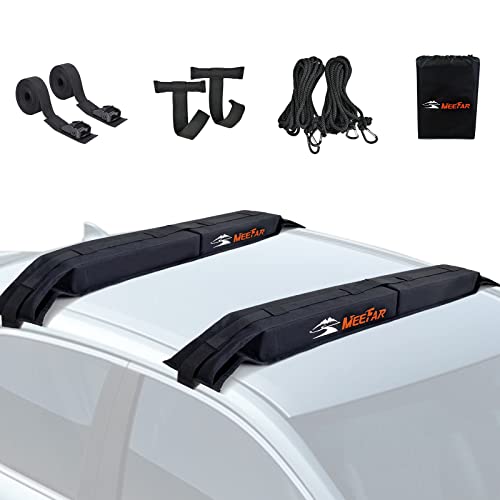
- Typesoft pads, universal
- Fitmentcars with or without gutters
- Kittwo tie-down straps, two quick loop straps, two ropes
- Gripbuilt-in non-slip mat
- Storagefoldable with a storage bag
Best for: Cars without crossbars, where the pads sit directly on the roof
Not every car has crossbars, and this set is built for that: pads that sit on the roof itself, with loop straps that anchor through the door frames.
It works, and thousands of people carry boards this way. Be aware that the whole load is held by straps passing through the cabin, so the doors have to be closed on them properly.
Check your speed and your load. This arrangement is fine for an inflatable board on a normal road, and it is not the setup for two hard boards at motorway speed.
Strengths
- Works on a bare roof, not just on crossbars
- Quick loop straps for door frame anchoring included
- Non-slip backing to protect the paint
- Comes with a storage bag
Weaknesses
- Eighty dollars, the most expensive pad set here
- A bare roof setup is always less secure than crossbars

- Typesoft crossbar pads
- Width34 in
- Fabric600D polyester, water resistant and non-fading
- Closurehook and loop
- Settwo pads
- Coloursseveral
Best for: Surfers and paddlers who want the pads everyone at the beach uses
Dakine have been making rack pads for surfers for decades, and these are the default choice at any surf break for a reason.
The fabric is the part you notice years later. Cheap pads fade to a chalky grey after two summers, these do not.
Budget for straps, since they are not in the box. Pair them with the Ho Stevie! straps above and you have a set that will outlast the car.
Strengths
- Dakine build quality and a name that holds resale value
- Non-fading fabric, so they still look right after years of UV
- Very quick to fit and remove with hook and loop
- Thirty four inches covers wide aero bars
Weaknesses
- Straps are not included, so budget for a pair
- Fifty five dollars for pads alone
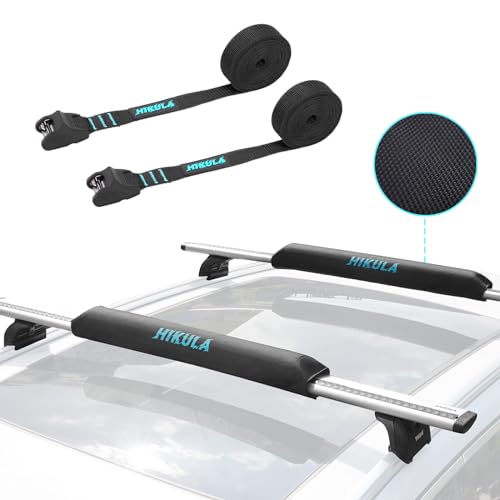
- Typesoft crossbar pads
- Width28 in
- Fabric600D polyester
- Gripbuilt-in non-slip mat
- Strapstwo 15 ft scratch resistant straps
- Storagefoldable with a bag
Best for: Occasional trips on a tight budget
Forty dollars for pads and straps together is the value pick, and nothing important has been left out.
The non-slip mat is present, which is the specification that actually matters. Everything else here is a matter of fabric quality and finish.
Twenty eight inches suits narrower bars. On a wide aero crossbar you will want the thirty or thirty four inch options instead.
Strengths
- Forty dollars including two 15 ft straps
- Non-slip mat, which cheaper pads leave out
- Standard 600D fabric that holds up to normal use
- Packs into a bag when not in use
Weaknesses
- Twenty eight inches is on the narrow side for aero bars
- Basic hardware compared with COR Surf or Dakine
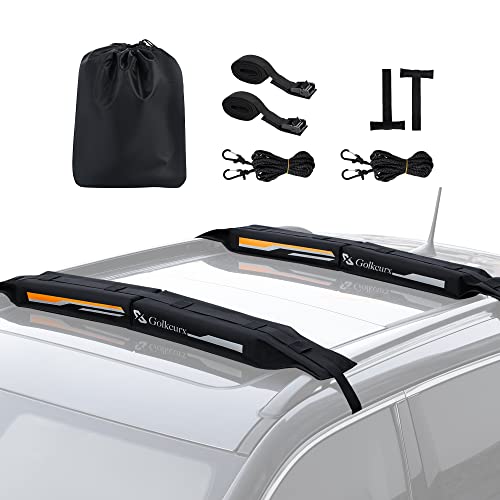
- Typesoft pads, universal
- Fitmentcars without side rails, or with more than 1 in of gap
- Installno tools, all straps included
- Gripbuilt-in non-slip mat
- Safetylocks and buckles, shockproof construction
Best for: Cars with no rails at all, or rails too close to the roof for a strap
The gap under your roof rails decides whether standard pads work at all. Less than an inch and you cannot get a strap through, which rules out most kits.
This set is built for that case, and it is the reason it is on the list despite being otherwise ordinary.
As with every roof mounted system, drive conservatively and check the straps at your first stop, since they always need a pull tighter after the first few miles.
Strengths
- One of the few sets designed around cars with no rails
- No tools needed, fitted in a couple of minutes
- Non-slip backing protects the paint
- Forty five dollars
Weaknesses
- No crossbars means less security at high speed
- Otherwise an ordinary pad set
How to choose a SUP roof rack
Pads or J-bars: Soft pads are cheaper, pack away and are fine for an inflatable or an occasional trip. J-bars carry the board on edge, hold it far more securely and leave room for a second board, but they need crossbars and they live on the car. If you paddle most weekends with a hard board, buy the bars.
Measure your crossbars first: Pad widths run from 28 to 35 inches, and a pad that overhangs the end of a short bar protects nothing. Aero bars are wide and flat, older factory bars are narrow and round, and several sets here come in two sizes for exactly that reason. Check what type of roof rack your car has before ordering.
Straps decide safety, not pads: Look for at least 1.25 inch webbing, cam buckles with silicone or neoprene covers, and a length of 15 feet. Never use ratchet straps on a board: they generate far more force than a hand ever will and they crush a board's rails without you noticing.
Use bow and stern lines: Two lines from the nose and tail of the board to the towing eyes or bumper are what stop the load lifting or pivoting at speed. Most people skip them, and they are the cheapest insurance in the whole setup.
Check the load again after ten minutes: Every strap settles, and a board that felt tight in the car park will be loose at the first junction. Stop and pull them tight once, then you can forget about them.
Frequently asked questions
Can I carry an inflatable board on the roof still inflated?
Yes, and many people do for short trips. Use pads rather than J-bars, since an inflated board flexes, put it deck down, and add bow and stern lines. At motorway speed the lift on a large flat board is considerable, so tighten more than you think you need to.Do I need crossbars?
For J-bars, yes. For soft pads, no: sets like the MeeFar and Golkcurx are designed to sit on a bare roof with the straps passing through the door frames. That works fine at moderate speed with one board, but crossbars are always the more secure option.Board deck up or deck down?
Deck down, fin up if it is a hard board, so the fin does not catch the wind and the deck pad is protected. On J-bars the board sits on its rail, which is why the padded saddles matter.Ratchet straps or cam straps?
Cam straps, always. Ratchets multiply your hand force enough to dent a board's rails or crush an inflatable, and there is no feedback to tell you when to stop. Cam buckles tighten to roughly the force you can pull by hand, which is what a board wants.Bottom line
For most paddlers the HEYTRIP pads are the right buy: a complete kit with a non-slip mat, proper tie-downs and the bow and stern lines that other sets leave out. If you carry a hard board regularly, the IKURAM R aluminium J-bars are worth the ninety dollars, because loading gets faster and the board rides on its edge where the wind cannot get under it.
Whatever you buy, spend the extra on decent straps and use bow and stern lines every time. When the board is off the roof again, keep it somewhere sensible, which is what our guide to wall racks is for.


