

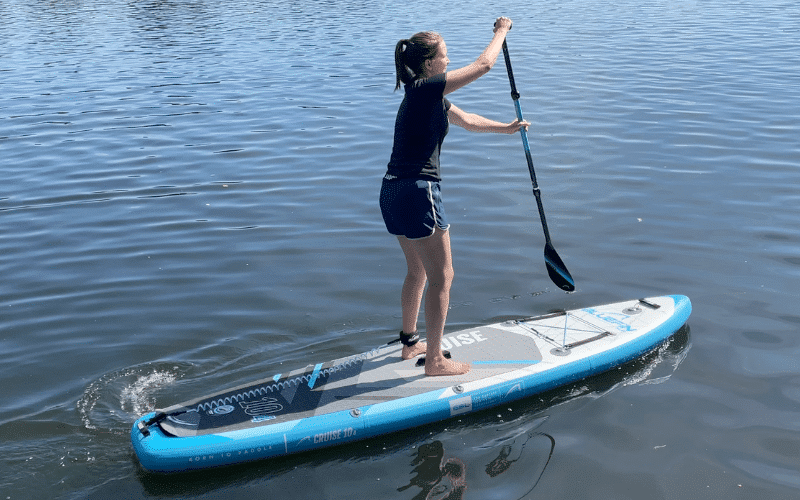
A beginner board is not a worse board, it is a wider one. Almost everything that makes a first session enjoyable comes down to how much platform there is under your feet when you stand up for the first time.
The rest is smaller than the marketing suggests. Fin systems, deck graphics and accessory counts change very little about whether you spend the first hour standing or swimming.
In Britain there is a second question underneath the first: how cold the water is when you fall in, and whether the board you bought comes with a leash you would actually trust.
We compared nine boards sold on Amazon UK on width, capacity, stability and what comes in the box, from a hundred and twenty pounds to four hundred.


The best beginner paddle boards in the UK at a glance
| Board | Size | Capacity | Why it suits a beginner |
|---|---|---|---|
| Bluefin Cruise 10 ft 8Top pick | 10 ft 8 x 6 in | Adults and youth | Stable, stiff and complete, with UK support |
| AKSPORT 11 ftMost stable | 11 ft x 34 in x 6 in | 200 kg | The widest deck here, plus a kayak seat |
| Cressi Ultra iSUPBest construction | 320 x 81 x 15 cm | 130 kg | Double layer build that does not sag underfoot |
| TIGERXBANG 10 ft 6Best all rounder | 10 ft 6 x 33 in x 6 in | 350 lb | Classic beginner dimensions with three fins |
| SereneLife 10 ft 6Best value | 10 ft 6 x 32 in | 350 lb | Full kit and a double action pump at 160 pounds |
| Portal 10 ft 6Lightest to carry | 10 ft 6 x 33 in x 6 in | 300 lb | 17.8 lb board with safety ropes on the deck |
| HUIIKE 10 ftBest small car board | 10 ft x 33 in x 5.9 in | 286 lb | Short, easy to turn, seat and footrest included |
| Trail Portofino 10 ftBest British package | 10 ft x 33 in x 4.75 in | All skill levels | Laminated shell and rail bands for less flex |
| SereneLife Kids 7 ft 9Best for children | 7 ft 9 x 30 in | 90.7 kg | 5.19 kg board a child can carry themselves |
The nine beginner boards in detail
- Size10 ft 8, 6 in thick
- Constructionpatented ESL fused build
- Decksupersized croco diamond grip pad
- FinUS surf fin in a universal box
- Includedpaddle, leash, pump, bag, phone case, fins, cup holder
- BrandBritish
- Levelbeginner to experienced
Best for: Someone who expects to still be paddling in three years
The awkward truth about beginner boards is that the good ones are not beginner boards at all. They are ordinary all round boards that happen to be forgiving.
Stiffness helps a beginner more than anyone. A board that flexes underfoot moves while you are trying to balance on it, which is exactly the wrong feedback when you are learning.
Our Bluefin Cruise review covers the board in detail, and whether the Cruise suits beginners answers the obvious follow up.
Strengths
- Stable enough for a first session and stiff enough to keep afterwards
- A complete kit, including a leash you can trust from day one
- The large deck pad forgives standing too far forward or back
- UK based support rather than a marketplace seller
Weaknesses
- Four hundred pounds is a lot to spend before you know you like it
- Ten foot eight is more board than a light paddler strictly needs
- Size11 ft x 34 in x 6 in
- Capacity200 kg
- Kayak modeseat, footrest and double blade paddle
- Paddlethree piece aluminium, 62.5 to 88 in
- Finsthree removable
- Extrascup holder, phone pouch, camera mount base
- Coverone year on punctures, seams and valves
Best for: Nervous beginners and anyone learning with a child aboard
Width is the cheapest confidence there is. Every inch above thirty two makes the first hour easier and the tenth hour slower.
For learning that trade is worth taking. Speed is something you can want later; standing up is something you need on the first day.
The kayak seat is a better beginner feature than it sounds. Sitting down when your legs give out is what turns a bad session into a long one.
Strengths
- Thirty four inches is the width at which almost nobody falls in
- Two hundred kilos means a second person can climb on to try
- The kayak seat gives you somewhere to rest when your legs go
- Warranty wording that names the failures rather than staying vague
Weaknesses
- Wide boards are slow, and this one will not keep up on a group paddle
- Eleven feet rolled up is a heavy carry for one person

- Size320 x 81 x 15 cm, roughly 10 ft 6 x 32 in
- Capacity130 kg
- ConstructionDWF double layer drop stitch
- Railsreinforced and heat sealed
- Hullhydrodynamic profile
- Includedboard, paddle, leash, pump, backpack
- BrandCressi, family owned since 1946
Best for: A beginner who wants one board rather than an upgrade in two years
There is a point where a stiff narrow board feels more stable than a soft wide one, because a board that bends underfoot never sits still.
Cressi has been making water gear since 1946, which is not a guarantee of anything, but it does mean somebody answers when a valve fails.
Swapping the bundled paddle is the cheapest upgrade in the sport, and our paddle guide explains what changes when you do.
Strengths
- Double layer construction at three hundred pounds is unusual value
- Heat sealed rails, which is the joint that fails on cheap boards
- A serious water sports brand with European service
- Thirty two inches with a stiff core feels more stable than wider soft boards
Weaknesses
- No electric pump, and the aluminium paddle is basic
- One hundred and thirty kilos rules out carrying a passenger

- Size10 ft 6 x 33 in x 6 in
- Capacity350 lb
- Finsthree detachable
- Storagefront bungee system
- Includedadjustable paddle, safety leash, three fins, repair kit, backpack
- Deckanti slip EVA
- Levelbeginners and casual paddlers
Best for: The standard first board for an adult paddling alone
Ten foot six by thirty three inches has been the default beginner size for a decade because it balances turning and tracking without doing either badly.
The three fin option is worth playing with. One large fin holds a line on a lake; three shorter ones turn quicker on a river.
If the plan is to progress rather than potter, compare it against the shapes in our wider beginner board guide.
Strengths
- Ten foot six by thirty three inches is the classic beginner recipe
- Three hundred and fifty pounds of capacity leaves room for gear
- Three fins let you try tracking against manoeuvrability
- Two hundred pounds with everything included
Weaknesses
- Budget construction, so full pressure is not optional
- A hand pump only, which is hard work on a warm day
- Size10 ft 6 x 32 in
- Capacity350 lb
- Materialdrop stitch reinforced engineered PVC
- Decknon slip EVA pad
- Finsthree
- Paddlethree piece aluminium
- Includedleash, removable fin, repair kit, backpack, double action pump
Best for: A first board bought before the hobby has proved itself
Not everybody knows whether they will like paddling, and there is nothing wrong with finding out for a hundred and sixty pounds.
The double action pump is the detail that separates this from the cheaper boards, because it moves air on both strokes and makes fifteen PSI achievable.
What you should not skimp on is what goes around you rather than under you. A buoyancy aid is the purchase that matters most in cold water.
Strengths
- A hundred and sixty pounds for a complete, usable package
- Three hundred and fifty pounds of capacity is generous at the price
- A double action pump, which halves the work of inflating
- Thirty two inches is a genuine adult width
Weaknesses
- The lightest construction here, and it shows under a heavy rider
- No UK service presence if a seam goes

- Size10 ft 6 x 33 in x 6 in
- Capacity300 lb
- Weight17.8 lb
- Finstwo fixed plus one detachable centre fin
- Deckanti slip EVA with criss cross safety ropes
- Includedbackpack, hand pump, paddle, leash, fin, repair kit, phone case
- Warrantyone year with 30 day returns
Best for: Beginners who will walk to the water rather than park beside it
Carrying weight is the reason boards stop getting used, and seventeen pounds is the difference between a spontaneous evening paddle and leaving it in the shed.
The deck ropes are a small thing that beginners appreciate. Something to grab when a wake goes past stops a wobble becoming a swim.
Two of the three fins are fixed, which is fine on flat water and a nuisance on a shallow river where fins hit gravel.
Strengths
- Under eighteen pounds, so getting to the launch is not the hard part
- Criss cross deck ropes give a nervous beginner something to hold
- Thirty three inches wide with a full accessory kit
- One year warranty and a thirty day return window
Weaknesses
- Two fixed fins mean less choice than three detachable ones
- Light construction flexes under heavier riders

- Size10 ft x 33 in x 5.9 in
- Capacity286 lb
- Constructionmilitary grade PVC with a double sidewall layer
- Kayak modeseat and footrest included
- Paddledual use aluminium
- Includedbackpack, leash, pump, three fins, carry strap, repair kit, 5 litre dry bag, phone case
- Extrasunique serial number
Best for: One adult, a small car and a cupboard rather than a garage
Ten foot boards have gone out of fashion, which is a shame for beginners, because a shorter board turns when you ask it to rather than eventually.
The double sidewall is the construction detail worth noting, since the rail is what carries the load when you stand off centre.
Respect the capacity figure. An adult plus a rucksack and a dog is already at the limit of this board.
Strengths
- Ten feet is short enough to turn easily while learning
- A double sidewall layer at under two hundred pounds
- Kayak seat, footrest and a dry bag included
- Packs smaller than every other board here
Weaknesses
- Two hundred and eighty six pounds of capacity is the lowest here
- Short boards wander more on a straight line than 11 ft ones

- Size10 ft x 33 in x 4.75 in
- Constructiondrop stitch with a laminated shell and rail bands
- Pressure15 PSI in under five minutes with the supplied pump
- Deckpadded carry handle and bungee cord
- Fittingstwo D-ring tow points
- Includedpump with gauge, paddle, backpack
- BrandTrail Outdoor Leisure, UK
Best for: Beginners who want a UK seller and a thinner, lower board
Thickness is the specification beginners never look at. A thinner board sits you lower to the water, which feels noticeably more secure on the first outing.
The trade off is stiffness for heavier riders, which is why almost every board above ninety kilos of load uses six inches instead.
The pressure gauge is worth having. Guessing at pressure is the most common reason a new board feels disappointing.
Strengths
- A British outdoor brand rather than an anonymous marketplace name
- Thirty three inches wide, which is wider than most ten foot boards
- The 4.75 in thickness sits you lower and feels more stable at first
- Pump with a pressure gauge included, so you can hit 15 PSI properly
Weaknesses
- A thinner board flexes more under a heavy paddler
- Ten feet is a compromise on tracking compared with 10 ft 6

- Size7 ft 9 in x 30 in
- Capacity90.7 kg
- Board weight5.19 kg
- Agesuitable from about five upwards
- Constructionmarine grade single layer drop stitch with heat welded seams
- Includedpaddle, pump, leash, fins, repair kit, backpack
- Uselakes, rivers and calm sea
Best for: Children learning alongside a parent on their own board
Children learn faster on a board that fits them. An adult board is too heavy to carry, too wide to reach around and too long to turn.
Seven foot nine at five kilos is the important pairing here: a child who can carry their own board treats it as theirs.
Every other safety rule still applies, and more so. A buoyancy aid is not negotiable for a child in British water.
Strengths
- Light enough that a child can carry and launch it themselves
- Thirty inches wide on a short board is very stable for a small rider
- Heat welded seams, which is unusual at a hundred and twenty pounds
- A complete kit, so nothing else is needed on day one
Weaknesses
- Ninety kilos of capacity means it is not an adult board
- Single layer construction, so it needs looking after
How to choose a first paddle board
Buy width before anything else: thirty two inches suits most adults, thirty three to thirty four suits anyone who is nervous or carrying a passenger, and under thirty is for people who already paddle. Everything else on the spec sheet matters less than this one number on your first day.
Do not confuse cheap with light: a soft board that flexes under your feet feels unstable no matter how wide it is, which is why a stiff 32 in board can beat a floppy 34 in one. Full pressure fixes most of this, and a pump with a gauge is what makes full pressure possible.
Spend on the leash and the buoyancy aid: the board keeps you afloat and the leash keeps the board with you. In water under fifteen degrees, which is most of the British year, those two items matter more than any board feature.
Pick your water before your board: a canal or a sheltered lake forgives almost any choice, while an estuary adds wind, tide and traffic. Start somewhere dull, because a first session in the wrong place puts people off the sport entirely.
Take a lesson if one is available: an hour with an instructor fixes stance, paddle grip and the habit of looking at your feet, and it does more for your first month than a hundred pounds of extra board would. British Canoeing affiliated clubs run them on most large waters.
Frequently asked questions
What size paddle board should a beginner buy?
Ten foot six by thirty two or thirty three inches is the standard answer for an adult under about ninety kilos. Heavier paddlers, or anyone who wants a passenger or a dog aboard, should look at eleven feet by thirty four inches. Shorter boards turn more easily but wander on a straight line.Is paddle boarding hard to learn?
Most people are standing and moving within the first half hour on flat water. Kneeling first, standing in the middle of the board and looking at the horizon rather than your feet covers ninety percent of the technique. What takes longer is learning to read wind and tide, which is where the actual risk lives.How much should a beginner spend?
A hundred and fifty to two hundred and fifty pounds gets a complete package that is genuinely usable. Below that the construction gets soft and the accessories become disposable. Above three hundred you are buying stiffness and warranty support, both real, neither essential in the first season.Do I need a wetsuit to start in the UK?
Outside of high summer, yes. British inland and coastal water sits between six and fifteen degrees for most of the year, which is cold enough for cold water shock on an unexpected fall. A shorty or a 3 mm full suit covers spring and autumn, and a buoyancy aid should be worn regardless of the season.Bottom line
If the budget allows it, the Bluefin Cruise 10 ft 8 is the first board least likely to be replaced, because it is stable enough to learn on and stiff enough to keep. The AKSPORT 11 ft is the more forgiving choice for anyone genuinely nervous about standing up, and it costs two hundred pounds less.
At the bottom of the range the SereneLife 10 ft 6 is enough board for a first summer, and the money saved is better spent on a wetsuit and a buoyancy aid than on a stiffer hull. In British water those two items change more about the day than any board on this page.


