

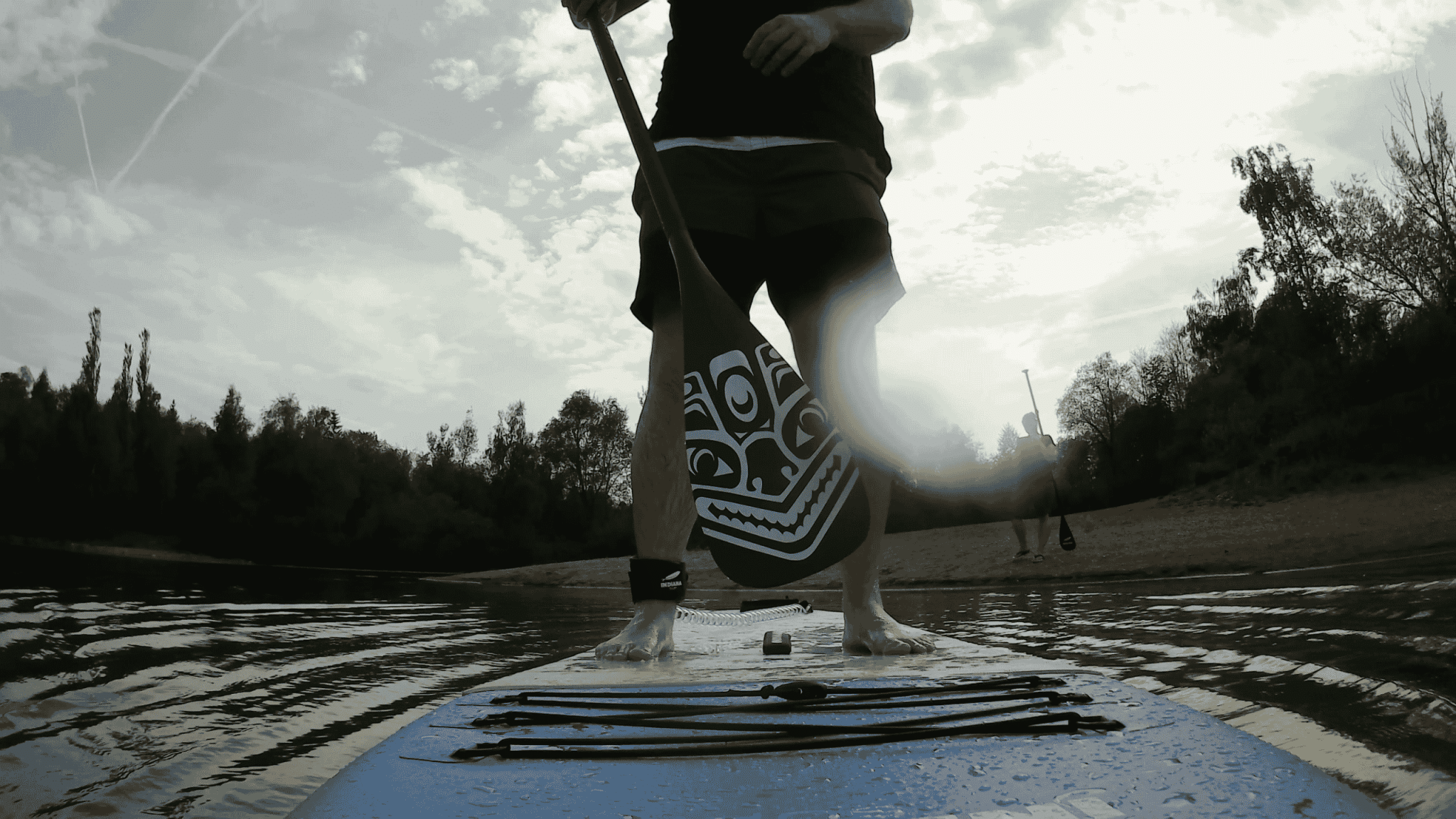
The paddle that came in the box with your board is almost certainly the weakest part of your setup.
It is the only piece of equipment you hold for the entire session, and its weight is lifted and swung several thousand times an hour. Half a pound of difference is not a specification, it is whether your shoulders last three hours or one.
The choice comes down to shaft material and how many pieces the paddle breaks into. Carbon is light and stiff, fibreglass sits in the middle, aluminium is cheap and heavy. Three pieces travel well, two pieces feel better in the water.
We compared nine paddles from twenty to a hundred and sixty five dollars, weighed the trade-offs, and marked the one that most people should actually buy.


The best SUP paddles at a glance
| Paddle | Shaft | Pieces | Adjustment range |
|---|---|---|---|
| Abahub Carbon Fiber PaddleTop pick | Carbon composite | 3 | 67 to 86 in |
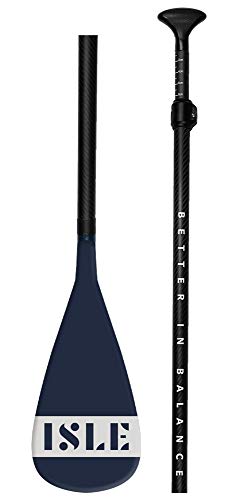
| ISLE Carbon Shaft PaddleBest in the water | Carbon fibre | 2 | 67 to 83 in |
| OCEANBROAD Carbon Fiber PaddleBiggest blade | Carbon fibre | 3 | 67 to 86 in |
| Overmont Carbon Fiber PaddleBest locking system | Carbon fibre | 3 | 69 to 85 in |
| Awstrokine 4-Piece Carbon PaddleBest for travel | Carbon fibre | 4 | 67 to 83 in |
| SereneLife Carbon SUP PaddleBest mid-price carbon | 60% carbon, 40% fibreglass | 3 | Lever lock, fits any height |
| Freein Fiberglass PaddleBest value | Fibreglass | 3 | 71 to 83 in |
| Karltion Aluminium PaddleBest budget pick | Marine grade aluminium | 3 | 65 to 87 in |
| Drift 3-Piece Travel PaddleCheapest spare | Aluminium | 3 | Adjustable |
The nine paddles in detail
- Shaftcarbon composite
- Bladefibreglass reinforced polypropylene, 91 sq in, double concave
- Pieces3
- Range67 to 86 in (170 to 218 cm)
- Included36 x 11 in travel bag
- Suitspaddlers above 5 ft
Best for: Almost everyone replacing the paddle that came with the board
This is the paddle that changes a session. Against the aluminium stick in the box it is roughly a pound lighter, and that pound is lifted with every stroke you take.
The shaft has a little give in it, which sounds like a fault and is not. A completely rigid shaft transfers every catch straight into the shoulder, and a touring pace over several hours is kinder on a shaft with some spring.
Set it to your height plus six to eight inches to start with. If you mostly do flatwater distance on a touring board, go towards the longer end; for surf or yoga go shorter.
Strengths
- Carbon shaft at a price most fibreglass paddles sit at
- Double concave blade holds water cleanly through the stroke
- Travel bag included, which protects the blade in a car boot
- Wide 67 to 86 in range covers a whole household
Weaknesses
- Blade is composite rather than carbon, so not the lightest option
- Three joints mean slightly more flex than a two piece
- Shaftcarbon fibre
- Bladenylon, 92.85 sq in
- Pieces2
- Range67 to 83 in
- Markingsclearly marked length scale on the shaft
- BrandISLE, San Diego, building boards since 2004
Best for: Someone who paddles often enough to feel the difference a joint makes
Every extra joint in a paddle is a place where power leaks and where sand eventually grinds. Two pieces is the format serious paddlers use, and this is the accessible version of it.
The marked shaft is a small thing that turns out to matter. Once you know your number you set the paddle in seconds instead of guessing, and a paddle set two inches wrong ruins an otherwise good session.
It comes from a board brand rather than an accessory seller, which shows in the blade shape. If you already own an inflatable board with a mediocre paddle, this is the single upgrade that pays back most.
Strengths
- Two pieces, so only one joint can flex or rattle
- Marked scale on the shaft, so the setting is repeatable
- Nylon blade shrugs off contact with the board rail
- Stiff light shaft that noticeably delays arm fatigue
Weaknesses
- A hundred and sixty five dollars, by far the priciest here
- Two pieces are longer packed down, which matters in a car

- Shaftcarbon fibre, around 850 g complete
- Bladefibreglass reinforced nylon, 98 sq in, curved and grooved
- Pieces3
- Range67 to 86 in (170 to 218 cm)
- Handlepatterned oval anti slip grip
- Includedtravel bag, water stoppers fitted
Best for: Heavier paddlers and anyone who wants more bite per stroke
Blade area is a lever. More area moves more water per stroke, which suits a heavy board, a loaded touring setup or a rider with the shoulders to use it.
The trade is cadence. If you paddle quickly, a big blade tires you faster than a small one that you swing more often, so match this to a slow deliberate stroke.
The oval handle is the underrated feature. A round grip lets the blade rotate a few degrees without you noticing, and those degrees are why a stroke feels slippery.
Strengths
- 98 square inches is the largest blade in this comparison
- Oval patterned handle stops the twist you get from a round grip
- Water stoppers keep the shaft from filling and dripping
- Floats in fresh and salt water when assembled
Weaknesses
- A big blade is harder work at a high cadence
- Nylon blade rather than carbon adds weight at the tip

- Shaftcarbon fibre
- Pieces3, quick release button
- Range69 to 85 in (175 to 215 cm)
- Lockinganti twist clip plus rubber ring at the joint
- Handlecurved ergonomic T-grip
- Suitsbeginners through experienced paddlers
Best for: Anyone whose last paddle developed a rattle at the joint
Joint slop is what kills a three piece paddle. After a season the sections develop a fraction of movement, the blade twists mid stroke and the paddle starts to feel vague.
The rubber ring here is a direct answer to that, and it is the reason this one is in the list over several near identical carbon paddles.
The 69 inch minimum is worth noting before buying. For a child or a paddler under five foot four the Karltion below adjusts short enough, and so does a proper kids board setup.
Strengths
- Rubber ring at the shaft joint cuts the play that develops over time
- Anti twist clip keeps the blade angle where you set it
- Quick release button makes assembly a few seconds
- Curved T-grip sits properly in the palm for steering
Weaknesses
- 69 in minimum is long for shorter paddlers and children
- Seventy dollars, at the top of the mid range

- Shafthigh strength carbon fibre
- Bladereinforced polypropylene, beaver tail with 10 degree angle
- Pieces4, converts to a kayak paddle
- Range67 to 83 in in SUP mode
- Packed size34 x 7.7 in
- Weight2.67 lb complete
Best for: Flying with a board, or paddling a board that has a seat fitted
An inflatable board packs into a rucksack and then the paddle refuses to. A four piece shaft solves that and is the reason this one is in the list at all.
The kayak conversion is genuinely useful rather than a gimmick. Fit a seat to your board and a single bladed paddle becomes hard work, which is why double bladed paddles exist as a category.
Accept the compromise knowingly. Four joints flex more than two, so this is the travel and seat paddle rather than the one for a long flatwater push.
Strengths
- Packs to 34 in, which fits a carry-on or a board backpack
- Converts to a double bladed kayak paddle in seconds
- 2.67 lb complete despite the extra hardware
- Twist lock plus quick connect buttons hold both modes securely
Weaknesses
- Four sections is the most joints of any paddle here
- A dedicated two piece paddle is stiffer for pure SUP use
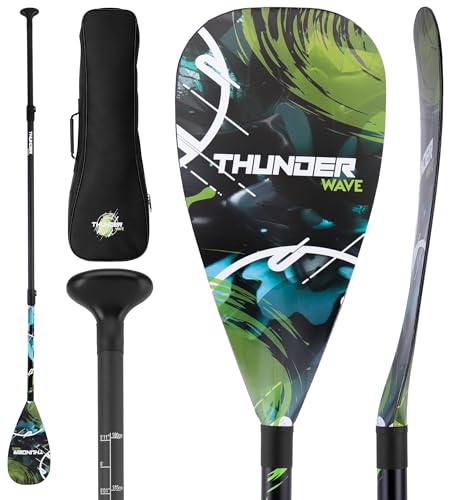
- Shaft60% carbon fibre, 40% fibreglass
- Bladeteardrop with 10 degree offset
- Pieces3
- Lockoval lever lock clamp
- Sizingadd 6 to 8 in for surf, 8 to 10 for flatwater, 10 to 12 for racing
- Includedzippered carry bag
Best for: Carbon feel and a proper lever lock for under forty dollars
Blended shafts get dismissed unfairly. Forty percent fibreglass costs stiffness and buys spring, and for a recreational paddler that trade is usually the right way round.
The lever lock is the reason to pick this over the anonymous carbon paddles at the same price. Clamps stay tight as they wear; pins do not.
The sizing guidance printed on the listing is sound: six to eight inches over your height for surf, ten to twelve for a race board.
Strengths
- Carbon and fibreglass mix costs less than full carbon and flexes more forgivingly
- Oval clamp resists the twist a round clamp allows
- Teardrop blade with a 10 degree offset, the standard modern shape
- Rated for salt water and supplied with a bag
Weaknesses
- Blended shaft is not as stiff as a full carbon one
- Manufacturer's stated weight is clearly a typing error, so treat it as unknown

- Shaftfibreglass
- Bladereinforced nylon (PA66), angled
- Pieces3
- Range71 to 83 in (180 to 210 cm)
- Locklever lock rather than pin
- Weight2 lb
- Buoyancyfloats in fresh and salt water
Best for: Upgrading from aluminium without spending carbon money
Fibreglass is the honest middle ground. It is heavier than carbon by a few ounces and lighter than aluminium by a lot, and at this price that is a straightforward win.
The lever lock is the practical advantage over the pin system on cheaper paddles. Pins wear into their holes and start to rattle; a lever clamps the same whatever the wear.
If you are outfitting a second board or a first board for a beginner, this is where the money goes furthest.
Strengths
- Twenty seven dollars for a fibreglass shaft is unusual
- Lever lock adjusts faster than a pin and clamps without play
- Two pounds, close to carbon paddles at a third of the price
- Nylon blade survives grounding in shallow water
Weaknesses
- Narrower 71 to 83 in range excludes short and very tall paddlers
- Fibreglass is stiffer than carbon in the wrong way, less spring
- Shaftmarine grade aluminium
- Bladeplastic, suited to shallow water and rock
- Pieces3
- Range65 to 87 in (152 to 220 cm)
- Weight1.88 lb (0.87 kg)
- Packed length33.85 in
Best for: A spare paddle, a guest paddle, or a first paddle on a strict budget
Aluminium is what everyone starts on and what everyone eventually replaces. The point of a good aluminium paddle is that it survives the treatment a spare paddle gets.
The 65 inch minimum is what makes it worth keeping. Almost no carbon paddle goes short enough for a child, so this ends up being the paddle the kids use.
Wear gloves with it in cold water. A wet aluminium shaft draws heat out of your hands quicker than any other material here.
Strengths
- Thirty dollars, and it floats
- Widest range here, 65 to 87 in, so it fits children and tall adults
- 1.88 lb is light for aluminium
- Plastic blade takes hits on rocks that would chip a composite one
Weaknesses
- Aluminium shaft gets cold and slippery in spring water
- No spring in the shaft, so long sessions are harder on the arms

- Typethree piece adjustable travel paddle
- Pieces3
- Adjustmentquick connect, adjustable to rider height
- Packedbreaks into three compact sections
- Userecreational paddling, cruising
- Pricearound twenty dollars
Best for: The paddle that lives in the car so a forgotten one never ends a trip
There is a category of purchase that is not about quality at all. A spare paddle in the car is worth having because the alternative to a mediocre paddle is sometimes no paddling.
The listing is thin on detail, and that is fair warning: treat this as a backup rather than a main paddle for anyone who cares how a stroke feels.
Keep it with the pump and the leash in the boot, and it earns its twenty dollars the first time someone leaves the good paddle in the garage.
Strengths
- Twenty dollars, the cheapest complete paddle here
- Breaks into three, so it fits behind a seat or in a boot
- Quick connect assembly with no tools
- Perfectly adequate for flat water and short sessions
Weaknesses
- Manufacturer gives no shaft material or weight figures
- No blade area or length range published, so fit is a gamble
How to choose a SUP paddle
Weight matters more than any other number: You lift the paddle roughly a thousand times an hour. A pound saved is a pound not lifted a thousand times, which is why carbon fibre shafts cost what they do. If the budget only stretches to fibreglass, that is still a large step down from aluminium.
Set the length before you judge the paddle: The usual starting point is your height plus six to eight inches, shorter for surf and yoga, longer for flatwater distance. A good paddle set two inches wrong feels worse than a cheap one set correctly, and most complaints about a new paddle are really complaints about the setting.
Count the joints honestly: Two pieces are stiffer and feel better; three pieces fit in a car; four pieces fit in a rucksack. Every joint adds a little flex and a place for grit. Decide how you actually transport the board first, then buy the fewest pieces that fit.
Blade area follows your body and your pace: Ninety square inches suits most recreational paddlers. Go bigger if you are heavy, carrying gear or paddling slowly with power; go smaller if you paddle at a high cadence or have had shoulder trouble. Blade shape matters less than the stroke you put into it.
Check the lock and the handle: A lever lock or an anti twist clip holds better over seasons than a bare pin, and an oval or patterned grip stops the blade rotating in your hand. These two details separate a paddle that still feels tight after two summers from one that rattles.
Frequently asked questions
How long should my SUP paddle be?
Start at your height plus six to eight inches. Shorten it by two or three inches for surf, waves or yoga, where a quick low stroke matters, and lengthen it slightly for flatwater touring, where a long reach suits a slow cadence. Adjustable paddles let you test both within one session.Is a carbon paddle worth the money?
If you paddle more than a few times a season, yes. A carbon shaft saves roughly half a pound over aluminium, and that difference compounds over thousands of strokes into noticeably less shoulder fatigue. For occasional summer use on flat water, a fibreglass paddle at a third of the price is enough.Which way round does the blade go?
The blade angles forward, away from you, when the paddle is upright in front of you. It looks wrong to most beginners and is correct: the angle keeps the blade vertical through the powerful middle part of the stroke instead of pushing water upwards at the end.Do SUP paddles float?
Most do when fully assembled and closed, because the sealed shaft traps air. Paddles taken apart, or ones whose end caps have been lost, can sink. If your paddle has water stoppers or plugs, check they are still fitted before deep water.Bottom line
For most people the Abahub carbon paddle is the right answer: a carbon shaft, a properly shaped blade and a travel bag for around sixty three dollars, which is a fraction of what the same specification cost a few years ago. It is the upgrade that changes how far you can comfortably paddle.
Spend more only if you paddle often, in which case the two piece ISLE is stiffer and better balanced. Spend less and the Freein fibreglass paddle still gets you most of the way, while the Karltion stays useful forever as the spare that fits children, guests and the day you forget the good one.


