


Getting a paddle board to the water by bike sounds eccentric until you have circled a beach car park twice on a Saturday in July.
There are three ways to do it. A board carrier with wheels that clips to your seat post, a proper cargo trailer that the board straps onto, or a side rack that carries the board alongside the bike.
Each has a different failure mode. Carriers are the lightest and cheapest but only take one board. Trailers handle weight and gear but cost more and need storage. Side racks are cheap and quick, and they turn your bike into a sail in a crosswind.
We compared nine options on capacity, how they attach, what they do on sand and whether they work when you are walking rather than riding.


The best bicycle trailers for paddle boards at a glance
| Option | Type | Capacity | Standout feature |
|---|---|---|---|
| SUP Wheels Evolution XTop pick | Board carrier and trailer | One wide board | Airless wheels that work in sand |
| Evolution Surfboard Bike TrailerBest for hard boards | Board carrier and trailer | One or more boards | Strap handle for walking as well as riding |
| Rambo Canoe and Kayak TrailerHeaviest duty | Extendable cart | 300 lb | Extends to 10 ft with ratchet straps |
| Burley FlatbedBest flatbed | Two wheel cargo trailer | 100 lb | Aluminium frame, folds flat for storage |
| Burley COHO XCBest off-road | Single wheel trailer | 70+ litre bay | Coil-spring suspension and a kickstand |
| Thule Reacha SportBest hand cart hybrid | Trailer and hand cart | 77 lb | Snap lock bike connector, tool-free adjustment |
| VEVOR Bike Cargo TrailerBest value | Two wheel cargo trailer | 160 lb | 16 in tyres and a steel frame for 106 dollars |
| MBB Longboard Bicycle RacksBest side rack | Side mounted rack | Up to 25 lb | Aluminium and stainless, quick release bars |
| Ho Stevie! Surfboard Bike RackBest budget | Side mounted rack | Boards to 8 ft | Clamps to a seat post in minutes |
The nine options in detail
- Typeboard carrier that doubles as a bike trailer
- Boardswide hard and inflatable boards, windsurfers
- Wheelsairless, never go flat
- Surfacedesigned to roll on sand
- Attachmentconnects to the bike seat with no tools
- Loadtakes the majority of the board's weight
Best for: One board, one person, a short ride to the water
The clever part of this design is that it is a board trolley first and a bike trailer second, which is the right way round for how people actually use them.
Airless wheels sound like a downgrade until the first time you push a pneumatic-tyred trolley across soft sand, at which point the case makes itself.
It is the natural companion to an inflatable, since the board itself is already the light part. Our inflatable board guide covers the boards that suit this best.
Strengths
- Airless wheels are the right answer for sand and beach parking
- No tools to attach or remove, so it takes seconds
- Takes almost all the board's weight, so you steer rather than carry
- Works as a walking trolley when you get off the bike
Weaknesses
- One board at a time and nowhere for gear
- A hundred and fifty six dollars for what is essentially a set of wheels
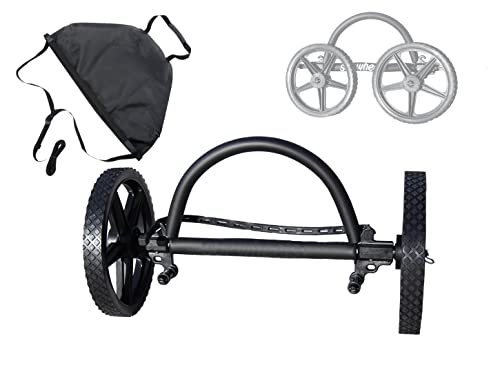
- Typeboard carrier and bike trailer
- Handlestrap handle for walking or golf cart towing
- Boardssurfboards and paddle boards
- Stabilitybetter in wind than a side rack
- Builddesigned for beach conditions
- Securitylocks up together with the bike
Best for: Hard boards and surfboards rather than wide inflatables
The wind argument is the one people underestimate. A board carried on a side rack is a vertical surface at head height, and a gust from the side is genuinely dangerous.
Towing the board behind you keeps it low and in line, which changes riding into the wind from a fight into a chore.
Being able to lock it to the bike matters at a busy beach, where the alternative is carrying it into the water with you.
Strengths
- Genuinely better in a crosswind than a bike side rack
- The strap handle makes it usable on foot, not just behind a bike
- Locks up with the bike, so it is not a theft problem at the beach
- Built for salt and sand rather than repurposed from garden kit
Weaknesses
- Not the extra wide version, so very wide boards are a poor fit
- A hundred and forty dollars, and it carries nothing but boards
- Capacity300 lb maximum
- Lengthextends up to 10 ft
- Frameadjustable steel
- Paddingthick foam contact points
- Strapsratchet straps included
- Terrainbuilt for rough ground and ebikes
- Assemblybolt together at home
Best for: Long or heavy craft, or two boards at once
This is a kayak and canoe trailer that happens to work for boards, and the capacity figure tells you which problem it was designed for.
What that buys a paddle boarder is the ability to carry two boards, or a board plus a cooler and chairs, without ever thinking about the load rating.
Padded contact points are worth checking on any trailer. Steel against an inflatable rail wears through the outer layer faster than you would expect.
Strengths
- Three hundred pounds is far beyond what any board weighs, so it never strains
- Extends to ten feet, which covers touring boards and canoes
- Padded contact points rather than bare steel against the hull
- Ratchet straps supplied, not an afterthought
Weaknesses
- Three hundred dollars and it is heavy to store
- Overkill for a twenty pound inflatable

- Capacity100 lb
- Framelightweight aluminium
- Bedopen, no sides
- Chassistwo wheels with the Burley hitch system
- Wheelspush button removal
- Storagefolds flat
- Usegeneral cargo as well as boards
Best for: People who will use the trailer for other things the rest of the year
An open flatbed is the most useful shape for a paddle board, because sides are exactly what gets in the way of a ten foot object.
The hitch is where cheap trailers give themselves away. A trailer that wanders behind the bike is unpleasant at any speed and dangerous downhill.
Strap the board down at three points rather than two and it will not pivot. Cam straps are better than ratchets here, since it is easy to over tighten a ratchet on an inflated board.
Strengths
- Aluminium, so the empty trailer does not eat into your capacity
- The open bed takes an awkward long load without fighting sidewalls
- Burley's hitch is one of the better designs for tracking behind a bike
- Folds flat and the wheels pop off for storage
Weaknesses
- Three hundred and twenty dollars
- A hundred pounds is less than the steel trailers offer

- Wheelssingle wheel
- Suspensioncoil spring
- Cargo bay70+ litres with removable side panels
- Kickstandheight adjustable for loading
- Hitchquick release, fits hubs from 126 to 197 mm
- Terrainsingle track and narrow trails
- Profileslim, low rolling resistance
Best for: Launches at the end of a trail rather than a road
Two wheel trailers are wider than your handlebars, and that is the specification that stops them on a trail.
A single wheel follows the bike's line exactly, which means anywhere you can ride, the trailer goes too, at the cost of some low-speed balance.
Suspension is not a luxury on a loaded board. Repeated hard knocks are how fin boxes and rails get damaged in transport, not on the water.
Strengths
- A single wheel tracks through gaps a two wheel trailer cannot
- Coil spring suspension protects the board on rough ground
- The kickstand makes loading possible without a second person
- Removable side panels for strapping a long board across
Weaknesses
- Five hundred and twenty dollars
- Single wheel trailers lean with the bike, which takes practice

- Capacity77 lb
- Framelightweight aluminium, adjustable width
- Modeshand cart and bike trailer
- Connectorsnap lock bike connector, quick to swap
- Drawbarextendable
- Assemblytool free
- Cargo trunktextile, adjusts to frame width and doubles as a storage bundle
Best for: A ride to the water followed by a walk down a path
Most launches involve a stretch that no bike can ride, and that is the gap this fills better than anything else here.
Unclip the bike connector and it becomes a hand cart with the same load already strapped down, which removes the usual carry-and-return routine.
The price only makes sense if you will use it beyond paddling. As a camping and market cart that also carries a board, it earns its keep.
Strengths
- Switches between hand cart and bike trailer in seconds
- Width adjusts to the load rather than the other way round
- Tool free assembly and adjustment throughout
- The cargo trunk packs the whole trailer away when folded
Weaknesses
- Six hundred and sixty dollars, easily the most expensive here
- Seventy seven pounds is the lowest capacity of the trailers
- Capacity160 lb
- Framesteel with powder coated finish
- Tyres16 x 1.75 in with iron hubs
- Hitchuniversal, fits bikes from 22 to 28 in
- Storagefolds compact
- Releasequick release
- Toolkitcomplete installation kit included
Best for: Trying the idea without committing three hundred dollars
Wheel size is the specification worth reading on any cheap trailer. Small wheels drop into every pothole and drag on grass.
Sixteen inches with proper tyres is enough to make a loaded trailer roll rather than fight you, which is most of what a trailer needs to do.
Load the board so its weight sits slightly ahead of the axle. Too far back and the trailer lifts the hitch; too far forward and it presses on your seat post.
Strengths
- A hundred and six dollars for 160 lb of capacity
- Sixteen inch tyres roll over rough ground far better than small ones
- Universal hitch fits almost any bike
- Folds down, so it does not permanently occupy a garage
Weaknesses
- Steel, so the trailer itself is heavy before you load it
- Budget hitch and bearings, and it tracks accordingly
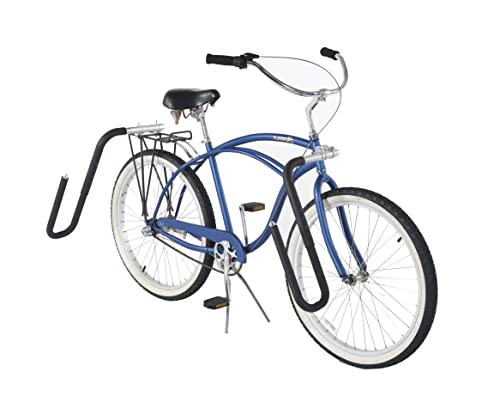
- Typeside mounted board rack
- Boardsshortboards, longboards and SUPs to about 25 lb
- Barsquick release, no tools
- Materialaluminium and stainless steel
- Mountinghead tube, seat post or rear rack
- Originthe original MBB design
Best for: Short flat rides where a trailer is more than you need
Side racks are the traditional beach cruiser answer, and for a light board on a flat two mile ride they are hard to argue with.
The limit is honest here. Twenty five pounds covers most inflatables and few hard boards, and going over it makes the bike handle badly.
Ride it once without the board to see how the bars change your clearance, because a rack that catches a kerb at speed is worse than a long walk.
Strengths
- No trailer to store, and the bars come off in seconds
- Aluminium and stainless throughout, so it survives salt
- Three mounting options, so it fits awkward frames
- Carries a light inflatable comfortably
Weaknesses
- Twenty five pounds is a real limit, and heavy boards exceed it
- A board at hip height catches every crosswind

- Typeseat post clamp side rack
- Boardsup to 8 ft
- Materialanodised aluminium
- Bikescruisers, road, mountain and BMX
- Not forlightweight titanium or carbon seat posts
- Installclamps on with the supplied hardware
Best for: Short surfboards and small boards on a cruiser
This is a surfboard rack, and the eight foot limit is the number that decides whether it is relevant to you at all.
Plenty of paddlers own a short board or a kids board that fits, and for those it is the cheapest solution on this page by a wide margin.
Take the seat post warning seriously. Clamping a lever arm onto a carbon post is how carbon posts fail, and they fail suddenly.
Strengths
- Under ninety dollars, the cheapest way to ride with a board
- Anodised aluminium, so the colour does not chip like paint
- Fits almost any steel or aluminium seat post
- Installs in minutes with the included hardware
Weaknesses
- Eight feet is a surfboard limit, not a paddle board one
- Explicitly not for carbon or titanium seat posts
How to choose a bike trailer for a paddle board
Decide between towing and side carrying first: A towed load stays low and in line, which is safer in wind and on descents. A side rack is cheaper, lighter and instant, but the board sits at hip height acting as a sail. If your ride is more than about two miles or ever windy, tow it.
Wheel size decides how it rolls: Sixteen inch wheels handle kerbs, gravel and grass. Small hard wheels stop dead at the first pothole. On sand, airless or wide wheels are the only ones that work at all, which is why the purpose-built board carriers use them.
Check the hitch against your bike: Most trailers clamp to the rear axle or the seat post, and quick release skewers, thru-axles and carbon posts all have their own rules. A bicycle trailer hitch that does not fit properly is the one part that will fail on the road.
Strap the board at three points: Two straps let a long board pivot around the middle, and a pivoting board hits your rear wheel. Use three points and pad anywhere the frame touches a rail, because the outer layer of an inflatable wears through faster than the fabric underneath.
Remember the walk at the end: Many launches finish with a footpath, steps or soft sand. A carrier or a hand-cart hybrid keeps working there; a two wheel cargo trailer usually does not, and you end up carrying the board anyway. A carrier strap covers that last stretch cheaply.
Frequently asked questions
Can you really tow a paddle board behind a bike?
Yes, and it is easier than it sounds once the board is low and in line with the bike. The two things that make it unpleasant are crosswinds and a board that pivots, and both are fixed by towing rather than side carrying and by strapping at three points instead of two.What about an inflatable board in a backpack?
For many people that is the simplest answer, since a rolled inflatable and its accessories fit in the supplied backpack and a bike needs no accessories at all. It is heavy on your shoulders, though, at around thirty pounds, which is why the wheeled carriers exist.Will a bike trailer damage my board?
Only where it touches. Look for padded contact points, add pipe insulation or foam where there are none, and avoid ratchet straps on an inflated board because they are easy to over tighten. Carry the board deflated if the trailer is short, which also removes the wind problem.Do these fit an electric bike?
Most do, and several are sold specifically for ebikes because the extra power makes towing sensible. Check the hitch against your rear axle type, and remember that a heavier bike plus a loaded trailer needs more stopping distance than you are used to, particularly on a hill.Bottom line
For most paddlers, the SUP Wheels Evolution X is the right shape of solution: it is a board trolley that also tows, the wheels work on sand, and it costs less than half what a cargo trailer does. If you already know you want to carry two boards, chairs and a cooler, the Rambo cart is the one with capacity to spare.
The cheap end is worth trying before spending big. A VEVOR trailer at just over a hundred dollars will tell you within two rides whether biking to the water is something you will actually keep doing, and a side rack does the same job for less if your board is light and your route is short.


