

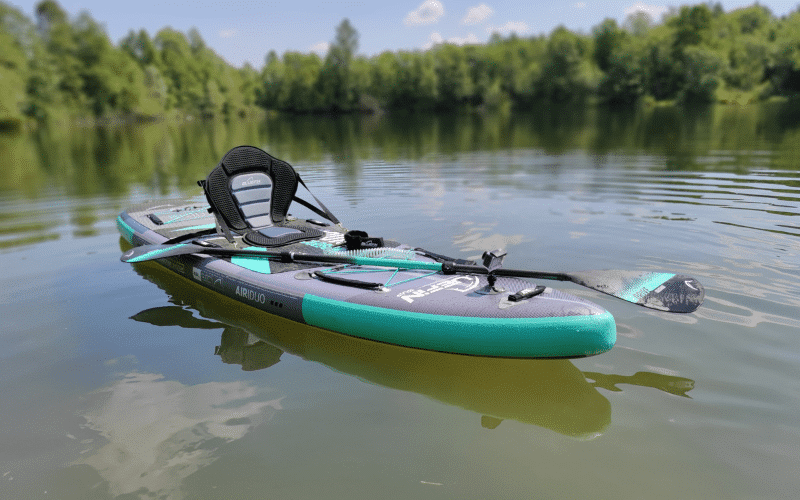
A seat changes what a paddle board is for.
Standing is the fun part for an hour. After that, on a windy lake, with a fishing rod, or with a passenger who is not enjoying themselves, sitting down is what keeps you on the water.
Two very different things get sold as boards with seats. Some are proper hybrids designed around a seat from the start, with rail attachment systems and a double bladed paddle in the box. Others are ordinary all-rounders with a cheap inflatable seat thrown in.
We compared nine, from a hundred and seventy dollars to a thousand, and the difference between those two groups is most of what you need to know.


The best paddle boards with seats at a glance
| Board | Size | Capacity | Standout feature |
|---|---|---|---|
| ISLE Switch 3.0Top pick | 11 ft 6 in x 35.5 in x 6 in | 475 lb | ISLE-LINK rail loops, 23 lb board |
| BOTE LowRider Aero 10 ft 6Most equipped | 10 ft 6 in | Two seat capable | Two seats, hybrid paddles, Rac and MAGNEPOD mounts |
| Blue Water Toys CrossoverBest convertible kit | 10 ft x 32 in x 6 in | Single rider | Paddle converts from SUP to kayak blade |
| iTAOSTAR Adventure 12' x 35Best long board | 12 ft x 35 in | 450 lb | Five fins, seat, footrest and kayak conversion kit |
| MYBOAT Bass Hunter 11 ft 6Best for fishing | 11 ft 6 in x 34 in x 6 in | 420 lb | Rod holders plus kayak seat and camera mount |
| Flypark 10'8 x 35 Fishing SUPBest short fishing board | 10 ft 8 in x 35 in x 6 in | 430 lb | Two rod holders, 30 in ruler, 19.8 lb bundle |
| SOLAVERO 11'6 x 35 with SeatBest capacity for the money | 11 ft 6 in x 35 in x 6 in | 550 lb | Removable inflatable seat, military grade PVC |
| 11' iSUP with Kayak SeatBest light package | 11 ft x 33 in | 485 lb | Dual layer PVC and a removable kayak seat |
| FunWater iSUP with Kayak SeatBest budget | Ultra light double wall PVC, 17 lb | Beginner rated | Three-section double ended paddle included |
The nine boards in detail
- Size11 ft 6 in x 35.5 in x 6 in
- Capacityup to 475 lb
- Weight23 lb inflated
- ConstructionAir-Tech Fusion Lite, 25 percent lighter
- AttachmentISLE-LINK webbing loops along both rails with steel G-hooks
- Deckfull nose to tail brushed traction pad
- Includedseat, paddle, high pressure pump, travel bag
Best for: Anyone who will genuinely switch between standing and sitting on the same trip
The ISLE-LINK system is the reason this sits at the top. On most boards the seat clips to four D-rings that somebody positioned for an average person, and if you are taller or shorter you live with it.
Here the loops run the length of both rails, so the seat position is yours to set, which is the difference between comfortable for twenty minutes and comfortable for three hours.
The light construction is the other half of the argument. A hybrid you have to wrestle to the water gets used as a paddle board, and then you paid for a seat system you never fit.
Strengths
- The rail loop system means the seat mounts anywhere, not at one fixed point
- Twenty three pounds is exceptionally light for a board this size
- Full length deck pad, so kneeling and yoga work as well as sitting
- 475 lb capacity covers a rider plus a child or a dog
Weaknesses
- Eight hundred dollars, four times the budget options
- The seat and rail hardware add setup time each session

- Size10 ft 6 in
- ConfigurationSUP or kayak, one or two seats
- Includedremovable kayak seats and hybrid SUP and kayak paddles
- MountsBOTE Rac System, MAGNEPOD attachment points
- Coolerdedicated KULA cooler tie-downs
- Usecruising, fishing, exploring
Best for: Paddlers who want an accessory ecosystem rather than one board
BOTE sell a system rather than a board, and the LowRider is the entry point to it. If you already own their coolers or racks, this is the obvious choice.
The hybrid paddles matter more than the mounts. A double bladed paddle is what makes seated paddling efficient, and buying two good ones separately costs real money.
If you never intend to bolt anything to it, the ISLE above does the same job for two hundred dollars less.
Strengths
- Ships with seats and hybrid paddles, so nothing else is needed
- Rac System takes rod holders, tables and racks properly
- MAGNEPOD holds a drink without a strap, which sounds silly until you use it
- BOTE build quality is a real step above marketplace boards
Weaknesses
- A thousand dollars, the most expensive board here
- Ten and a half feet is short for two seated riders
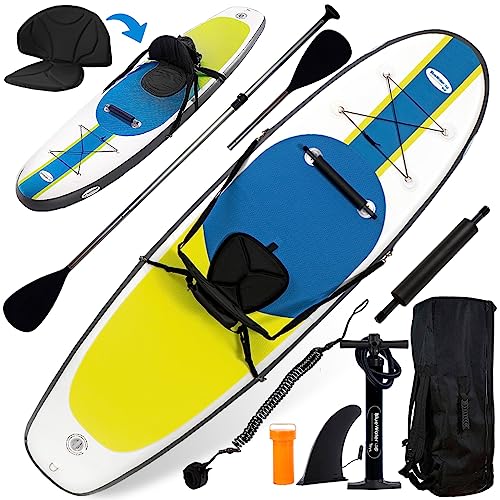
- Size10 ft x 32 in x 6 in
- Materialmilitary grade PVC
- Deckhoneycomb EVA, fully UV resistant
- Paddleconvertible floating paddle, SUP to kayak blade
- Includedpump, backpack, coil leash, seat
- Warrantyone year
Best for: One person who wants both modes without owning two paddles
The convertible paddle is the feature people underrate. Kayak mode needs a second blade, and boards that include a seat but not a double bladed paddle leave you paddling one side like a canoe.
At ten feet this is a solo craft and a compact one, which suits a small car and a single paddler more than a family.
UV resistance on the deck is worth the mention. Sun kills cheap EVA faster than water does, and boards that live on a roof rack age quickly.
Strengths
- The convertible paddle is the neatest solution here, one shaft, two configurations
- Honeycomb EVA and full UV resistance hold up to sun better than plain foam
- Floating paddle, which is the one you drop when you sit down
- Complete kit with a real warranty behind it
Weaknesses
- Ten feet by 32 inches is small once a seat and gear are aboard
- Single rider board, no realistic passenger space

- Size12 ft x 35 in
- Capacity450 lb
- Finsfive removable, three centre and two side
- Conversionkayak kit with seat and footrest
- Mountsaction camera and phone mount
- Includedadjustable paddle with kayak kit, double action pump, shoulder strap
- Warrantythree years
Best for: Covering distance seated rather than pottering about
Seated paddling exposes tracking. Sitting low with a double blade, a short board wanders, and you spend the trip correcting instead of moving.
Twelve feet fixes that, and the footrest is the detail that separates a proper kayak conversion from a cushion strapped to D-rings. Without something to brace against, your legs have nowhere to go.
The three fin plus two side fin arrangement is genuinely useful on a long board: run all five for straight lakes, pull the sides for shallow rivers. Our fin guide covers when each setup helps.
Strengths
- Twelve feet tracks far better than the ten footers when you are sitting
- Footrest included, which almost no seat kit has and which decides comfort
- Five fins let you tune for lakes or moving water
- Three year warranty on a two hundred and eighty dollar board
Weaknesses
- Twelve feet is a lot of board to store and carry
- Thirty five inches wide makes it slow if you mostly stand
- Size11 ft 6 in x 34 in x 6 in
- Capacity420 lb
- Fishingrod holder and kayak seat included
- D-rings14, front and rear bungees
- Handlestwo front safety handles
- Extrascamera mount, phone bag
- Includedleash, hand pump, three fins, adjustable paddle
Best for: Fishing from a board rather than a kayak
Fishing is the main reason people buy a seat, because standing and casting for three hours is not restful and a board is far easier to launch than a kayak.
The seat plus rod holder combination is what you are paying for. Retrofitting both to a plain board costs about eighty dollars and never fits as well.
Add an anchor before your first trip. Drifting while you cast is the fastest way to lose an afternoon, and our anchor guide covers the small ones that suit a board.
Strengths
- Rod holder and seat come together, which is the whole point
- Fourteen D-rings take a crate, a cooler and a dry bag
- Front safety handles help a passenger or a heavy tackle box stay put
- Two hundred and sixty dollars for a complete fishing setup
Weaknesses
- 420 lb is the lowest capacity of the fishing boards here
- Single bladed paddle only, so seated paddling is inefficient
Flypark 10'8 x 35 Fishing Inflatable Paddle Board
Best short fishing board- Size10 ft 8 in x 35 in x 6 in
- Capacity430 lb
- Fishingtwo rod holder bases, 30 in ruler, kayak seat
- Weight19.8 lb bundle
- Handlesthree
- Fins9 in centre and two 7 in side, tool free
- Paddlefour piece aluminium, converts to double blade
Best for: Fishing small water where a long board is a nuisance
Short and wide is the right shape for a pond or a slow river, where you turn constantly and never paddle far in a straight line.
The convertible paddle puts this ahead of the MYBOAT for anyone who plans to actually travel seated rather than just sit while fishing.
Nineteen pounds including the bundle is the reason it gets used. A fishing setup that takes two carries stays home on marginal days.
Strengths
- Converts to a double bladed paddle, unlike most boards at this price
- Two rod holder bases rather than one
- The deck ruler is a small thing anglers actually use
- Under twenty pounds, so it is a one trip carry
Weaknesses
- Ten foot eight tracks worse than the twelve footers when seated
- Thirty five inches wide is slow to paddle standing

- Size11 ft 6 in x 35 in x 6 in
- Capacity550 lb
- Materialmilitary grade PVC, non-slip EVA deck
- Seatremovable inflatable seat
- Includedsingle action hand pump, ankle leash, repair kit, paddle
- Storageheavy duty backpack for board and accessories
Best for: A big stable platform where the seat is a bonus rather than the point
Capacity is what makes a seated board work with a passenger, because a seated rider and a standing paddler both sit heavy in the middle.
An inflatable seat is a genuinely different product from the folding kayak type: softer, warmer and higher, but it needs securing properly or it shifts under you.
Swap the single action pump for a double action or electric pump if you paddle often. That single accessory decides how many trips you make.
Strengths
- 550 lb is the highest capacity here, so a passenger is realistic
- Inflatable seat is more comfortable than the folding fabric type
- Everything packs into one backpack
- Two hundred dollars for a board this size
Weaknesses
- Single action pump makes filling a 6 inch board slow work
- Inflatable seats need their own topping up and can slide
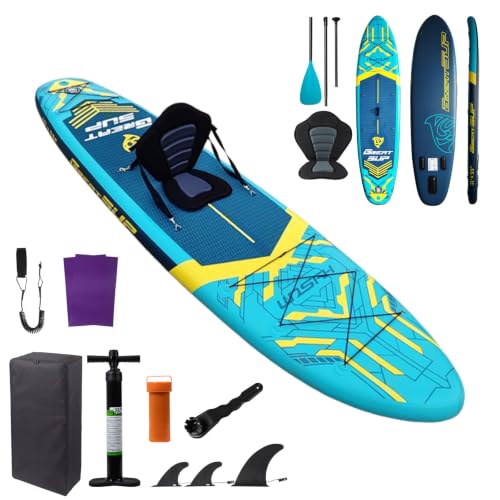
- Size11 ft x 33 in
- Capacity485 lb
- Constructiondual layer PVC with drop stitch
- Seatpremium removable kayak seat
- Paddleadjustable, sized 8 to 10 inches above rider height
- Storageheavy duty backpack for board and accessories
Best for: A first board where sitting down is part of the plan
Thirty three inches is the width most beginners should be looking at. Wider feels safer standing still and paddles noticeably worse the moment you want to go somewhere.
Dual layer PVC is the specification worth checking at this price, because single layer boards flex under a seated rider whose weight is concentrated in one spot.
If this is your first board, our beginner board guide covers what else matters before you spend more.
Strengths
- Dual layer PVC at this price is unusual and it shows in stiffness
- 485 lb capacity is generous for an 11 foot board
- Thirty three inches is the sweet spot, stable without being sluggish
- Under a hundred and eighty dollars complete
Weaknesses
- Unbranded, so support depends on the seller
- Single bladed paddle, so seated paddling is one sided work
- Materialultra light double wall PVC, 35 percent lighter than similar boards
- Weightaround 17 lb
- Paddlethree section detachable double ended paddle
- Seatkayak seat for sitting or standing use
- Decknon-slip EVA
- Includedfull beginner accessory set
Best for: Trying seated paddling without spending real money
The double ended paddle is what makes this worth listing. A seat without a kayak blade is a rest stop, not a second mode of transport.
At seventeen pounds it is the easiest board here to carry, which for a lot of people matters more than any specification.
Inflate it properly and it feels like a much dearer board. Under pressure, light construction is exactly where it disappoints, and the cheap pump is the usual reason people never get there.
Strengths
- A double ended paddle at this price, which the boards above often lack
- Seventeen pounds, the lightest package here
- Under a hundred and seventy dollars complete
- FunWater are an established seller with proper support
Weaknesses
- Light construction means it needs full pressure to feel firm
- Beginner accessories throughout, especially the pump
How to choose a paddle board with a seat
Check whether a double bladed paddle is included: Sitting down with a single blade means switching sides every three strokes and going nowhere. A true hybrid ships with a convertible or double ended paddle; a board that only includes a seat is asking you to spend another sixty dollars.
Look for a footrest or somewhere to brace: In a kayak your legs press against a bulkhead, and that bracing is where a lot of the power comes from. On a flat board with a seat and nothing to push against, your back does all the work and it aches within an hour.
Length matters more than width once you sit: Seated paddling puts your weight in one spot and your stroke low, which makes short boards wander. Twelve feet tracks far better than ten, and a decent centre fin matters more here than it does standing.
Fixed D-rings versus a rail system: Four D-rings put the seat in one position, chosen for somebody who is not you. Rail systems cost more and let you set the seat where your legs actually reach, which is the single biggest comfort difference between the boards here.
Add the seat weight to the capacity sum: A seat, a footrest and a fishing crate are twenty to thirty pounds before anyone gets on. On a 420 lb board carrying a rider and gear, that is the margin between a board that floats high and one that sits wet.
Frequently asked questions
Can I just add a seat to a normal paddle board?
Usually yes, if the board has four D-rings arranged in a rectangle around the standing area, which most all-rounders do. What you cannot retrofit is a double bladed paddle, a footrest or better tracking, so a cheap seat on a short board is comfortable but slow.Is a hybrid as good as a real kayak?
No, and it is not meant to be. A kayak is faster, drier and better in wind. A hybrid is far easier to store, carry and launch, and it lets you stand up, which no kayak does. Choose by which of those constraints is actually stopping you paddling.Inflatable seat or folding kayak seat?
Inflatable seats are warmer, higher and softer, but they slide if not strapped tightly and need their own inflating. Folding fabric seats with a rigid back sit lower and give better back support for long trips. For fishing, the higher inflatable type gives a better casting position.Does a seat affect stability?
It helps a lot. Your centre of gravity drops dramatically when you sit, so a seated board is far harder to fall off in wind and chop. Many people use the seat specifically for the rough return leg after paddling out standing.Bottom line
If you will genuinely use both modes, buy a real hybrid. The ISLE Switch 3.0 gives you a seat that adjusts to your legs, a light board and enough capacity for a passenger, and it is the one on this list that does not feel like a compromise in either configuration.
For fishing, the MYBOAT Bass Hunter is the sensible spend, since the rod holders and the seat arrive together and work. And if you are simply curious whether you would sit at all, the FunWater includes a double ended paddle for under a hundred and seventy dollars, which is the cheapest honest answer to the question.


