

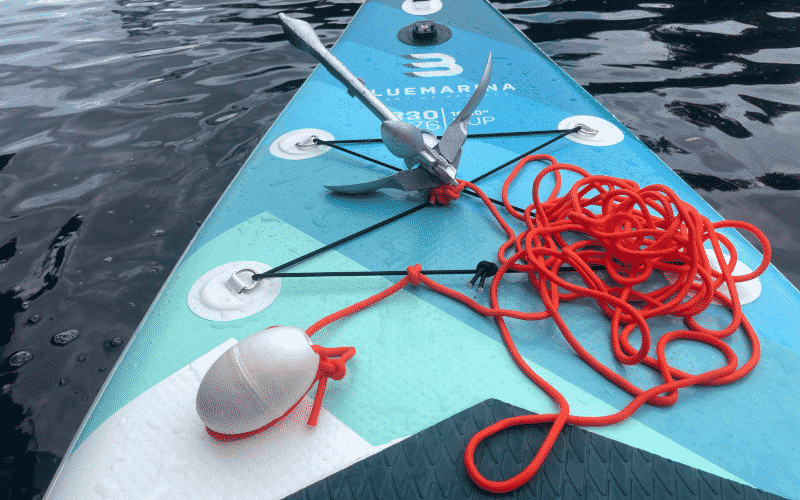
An anchor is the accessory that turns a paddle board into a platform. Without one, fishing, swimming or simply eating lunch means drifting the whole time you are not paddling.
Almost everything sold for this job is the same thing: a three and a half pound folding grapnel with four flukes, a length of rope and a buoy. What separates them is rope length, rope quality and whether the kit includes the small parts that make it usable.
The exceptions are worth knowing about. A sand bag anchor works where a grapnel would snag, and a screw-in stake holds a board in a foot of water on a sandbar better than any weight does.
We compared nine anchors on holding power, rope length, what comes in the kit and how small the thing packs down.


The best paddle board anchors at a glance
| Anchor | Weight | Rope | Standout feature |
|---|---|---|---|
| Kayak Anchor Kit, GreenTop pick | 3.5 lb cast iron | 25 ft braided | Complete kit with buoy, carabiner and padded bag |
| 3.5 lb Folding Anchor SystemLongest rope | 3.5 lb carbon steel | 40 ft marine grade | Multi-point shackle for rope or chain at either end |
| Calpalmy Folding Anchor KitBest value kit | 3.5 lb | 32 ft, 6 mm | Folds to 12 in, waterproof padded bag |
| Moclear Compact 1.5 lbBest for shallow water | 1.5 lb | 40 ft polyester core | Zip ties supplied for an anti-snag rig |
| Airhead Complete Grapnel SystemBest known brand | 3.5 lb | 25 ft marine grade | Padded nylon case, long standing design |
| SEACHOICE Folding GrapnelBest budget | 3.5 lb malleable iron | Not included | Heavily galvanised, locks open or closed |
| CALPALMY 2-in-1 Sand AnchorBest for sand | Up to 50 lb of sand | 12 ft braided | Doubles as a dry bag when empty |
| 17 in Stainless Screw-in AnchorBest for sandbars | Stainless rod | Not included | Screws into the bottom with a T-handle |
| Dreizack Anchor KitBest for kayak fishing | 3.5 lb carbon steel | 40 ft, 7 mm | Thicker rope and a reinforced carabiner |
The nine anchors in detail
- Weight3.5 lb cast iron
- Flukesfour, folding
- Rope25 ft braided polyethylene
- Buoyfloating, for visibility
- Hardwarestainless steel carabiner
- Storagepadded bag included
- Bottomssand, silt, rock and weed
Best for: Most paddlers, most of the time, on lakes and slow rivers
Three and a half pounds is the standard weight for a reason: it is heavy enough to set in most bottoms and light enough that hauling it up from the deck does not unbalance you.
The padded bag is the part people leave out of comparisons and then regret, since a bare grapnel loose on the deck will find your board's rails eventually.
Twenty five feet suits lakes and bays. If you paddle anywhere deeper, buy the version with the longer rope, because the rule of thumb is several times the water depth.
Strengths
- A complete kit, so nothing else needs buying
- Cast iron body rather than thin pressed steel
- Padded bag matters, because a bare anchor scratches a board
- Deploys in one motion once you have done it twice
Weaknesses
- Twenty five feet of rope limits you to shallower anchorages
- Thirty five dollars is at the upper end for a 3.5 lb grapnel

- Weight3.5 lb
- Materialcarbon steel, corrosion resistant
- Rope40 ft marine grade
- Attachmentmulti-point shackle at either end
- Bottomssand, mud, rock and weed
- Craftkayaks, boards, canoes, jet skis
- Coloursseveral
Best for: Deeper water, or anywhere you want a shallow rope angle
Rope length is the specification almost nobody checks and the one that decides whether the anchor holds, because it is the angle of the rope that sets the flukes.
A short rope pulls upward and the anchor skips. A long rope pulls sideways and it digs in, which is why forty feet is worth more than an extra pound of iron.
Being able to shackle the rope to either end is the useful part in rocky ground, where the trick is to make the anchor let go on purpose when it jams.
Strengths
- Forty feet of rope, fifteen more than the usual kit
- The multi-point shackle lets you rig it either way round
- Carbon steel with a corrosion resistant finish for salt water
- Enough rope to anchor properly in fifteen feet rather than just tether
Weaknesses
- Thirty seven dollars, the most expensive here
- More rope means more to coil and stow neatly

- Weight3.5 lb
- Flukesfour, folds to about 12 in
- Rope32 ft, 6 mm marine grade
- BuoyPVC flotation buoy
- Hardwarestainless steel snap hook
- Bagpadded waterproof nylon
- Bottomsmud, weed, sand and rock
Best for: A complete kit without paying for a brand name
This is the kit most people should buy if the top pick is out of stock, because it has the same four fluke anchor with more rope and a lower price.
Rope diameter is worth a thought. Thin cord cuts into your hands when the anchor is stuck, and six millimetres is about the minimum comfortable size.
Stow it in the front bungee rather than behind you, so retrieving it does not mean turning around on the board. A dry bag under the same bungee keeps the deck tidy.
Strengths
- Thirty two feet of rope for twenty five dollars
- Six millimetre rope is thick enough to haul without gloves
- Padded waterproof bag included at this price
- Folds to a size that fits in a deck bag
Weaknesses
- Snap hook rather than a screw gate carabiner
- Twelve inches folded is still a solid lump on a small board
- Weight1.5 lb, with a 3.5 lb option
- Depthsuits water up to about 20 ft
- Rope40 ft, polyester core, 1,936 lb breaking strength
- Includedbuoy, D shackle, locking carabiner, 50 zip ties, bag
- Rigzip tie weak link for anti-snag setup
- Craftboards, kayaks, canoes, dinghies
Best for: Shallow lakes, SUP yoga and anyone who dislikes carrying weight
The weak link idea is the reason to look at this kit closely. Tie the rope to the top eye with a zip tie and to the bottom as a backup, and a snagged anchor breaks the tie and comes out backwards instead of staying on the bottom.
A pound and a half is enough to hold a board in still water while you swim or practise SUP yoga, which is what most people actually use an anchor for.
It is not enough in wind. If you fish, or you paddle anywhere with a breeze that gets up in the afternoon, buy the 3.5 lb version of the same kit.
Strengths
- A pound and a half is a genuine difference on a board deck
- The strongest rope specification here at 1,936 lb
- Zip ties included specifically for a weak link rig, which is thoughtful
- Locking carabiner rather than a snap hook
Weaknesses
- 1.5 lb will drag in wind or current, and the maker says so
- Only rated to about twenty feet of depth

- Weight3.3 lb, four flukes, folding
- Rope25 ft marine grade
- Casepadded nylon storage case
- Bottomsmud, sand, gravel and rock
- Craftboats, canoes, inflatables, float tubes and PWC
- Sizefits under most boat seats
Best for: Buyers who would rather have a known marine brand than the cheapest option
There is a version of this anchor under a dozen brand names, and Airhead is the one that has been on the shelf longest, which counts for something on a part that has to hold your board.
The padded case is the whole reason to buy a system rather than a bare anchor, because a four fluke grapnel is essentially a grappling hook designed to catch on things.
Add a buoy separately for a few dollars. Marking where the anchor sits is what stops another paddler running over your rope.
Strengths
- A design that has been sold for years, so it is a known quantity
- Padded case included
- Compact enough to live permanently in a hatch or a deck bag
- Holds in gravel as well as mud and sand
Weaknesses
- Twenty five feet of rope for twenty nine dollars is unremarkable
- No buoy in the package, unlike several cheaper kits

- Weight3.5 lb
- Materialmalleable iron
- Finishheavy galvanising
- Lockinglocks open or closed
- Ropenot included
- Craftsmall watercraft and dinghies
- Storagefolds flat
Best for: Anyone who already owns rope, or wants to choose their own
Buying the anchor and the rope separately is often the better deal, because the rope in a cheap kit is the part most likely to disappoint.
Malleable iron and heavy galvanising is a proper marine specification rather than a painted steel casting, which is what you get at this price under other names.
Budget about fifteen dollars for forty feet of decent rope, a buoy and a carabiner. That still lands under most complete kits and you choose the components.
Strengths
- Under seventeen dollars for the anchor itself
- Heavy galvanising rather than paint, so it survives salt water
- Malleable iron, which bends rather than snaps under load
- Locks in the open position, so the flukes stay set
Weaknesses
- No rope, buoy, carabiner or bag, so budget for those
- Bare iron on a deck will mark a board without a bag
- Capacityup to 50 lb of sand
- Materialmarine grade PVC with welded seams
- Openingwide roll top, bottom dump strap
- Rope12 ft braided, high visibility
- Buoyfloating, bright yellow
- Second usedry bag when empty
- Craftboards, kayaks, jet skis, floating mats
Best for: Beaches and sandbars where a metal anchor would be useless
A grapnel is the wrong tool on a sand beach. It drags, it fills with sand and it will not set in anything soft, which is where a weight bag makes more sense.
The clever part is that it weighs almost nothing until you use it, so it costs you no carrying effort on the way to the water.
The dry bag second use is real rather than marketing. Empty it, rinse it and it holds a towel and a change of clothes for the paddle back.
Strengths
- Fifty pounds of holding weight that you do not have to carry to the beach
- Empties in seconds thanks to the bottom dump strap
- Doubles as a dry bag, so it earns its deck space
- Nineteen dollars, cheaper than most grapnels
Weaknesses
- Only useful where there is sand or gravel to fill it with
- Twelve feet of rope makes it a beach tool, not a deep water anchor

- Length17 in, 430 mm
- Material304 stainless steel
- Designhelical propeller thread for grip
- Handleremovable T-handle
- Useshallow water, sandbars and beaches
- Corrosionseawater resistant
- Craftkayaks, canoes, small boats
Best for: Shallow water hangouts where boards need tying up rather than anchoring
On a sandbar in two feet of water, a screw stake beats every anchor here. It holds against a breeze that would drag a 3.5 lb grapnel across the bottom.
This is the piece of kit that makes a group stop work, since several boards can be tied to one stake instead of everyone holding on to each other.
It is useless in deep water, so treat it as an addition to a grapnel rather than an alternative to one.
Strengths
- Screws in, so it holds far better than its weight suggests
- 304 stainless survives salt water indefinitely
- The T-handle comes off, leaving nothing to trip over
- Ideal for tying two or three boards together in a group
Weaknesses
- Only works in soft ground you can reach by hand
- No rope supplied, and it needs a short line and a clip

- Weight3.5 lb marine grade carbon steel
- Finishprecision sprayed against rust
- Rope40 ft, 7 mm marine rope
- Buoywhite PVC ball
- Hardwarereinforced stainless carabiner
- Folded size12 in x 3 in
- Bagthickened nylon storage bag
Best for: Fishing from a board, where the anchor gets used every session
An anchor used once a summer and an anchor used every trip are different purchases, and fishing is what turns it into the latter.
Thick rope is the thing that matters when you are pulling an anchor up repeatedly with cold wet hands, and seven millimetres is noticeably better than five.
An anchor trolley is the natural next step, since it lets you swing the board bow into the wind instead of sitting side on. Keep your paddle clipped down while you rig it.
Strengths
- Seven millimetre rope, the thickest here, and easy on the hands
- Forty feet of it, which covers most fishing depths
- Reinforced carabiner rather than a light snap hook
- No installation, it opens and locks in one movement
Weaknesses
- Thirty dollars and no trolley hardware despite the name
- Carbon steel needs rinsing after salt water use
How to choose a paddle board anchor
Rope length beats anchor weight: A 3.5 lb grapnel on twenty five feet of rope in fifteen feet of water will drag, because the pull is upward. The same anchor on forty feet holds, because the pull is sideways. Aim for at least three times the depth you paddle in.
Match the anchor to the bottom: Four flukes grip rock, weed and gravel well and mud reasonably. Clean sand is where they are weakest, and that is exactly where a sand bag or a screw stake works. If you paddle one place all summer, buy for that place.
Rig a weak link: Tie the rope to the bottom of the anchor shaft, run it up alongside, and secure it to the top eye with a zip tie or light cord. A stuck anchor then breaks the tie and pulls out backwards instead of costing you the anchor, the rope and possibly your balance.
Never tie the anchor to yourself: The rope goes to a D-ring, not to a wrist or a waist, and it should be reachable so you can release it fast. In any current, an anchored board that swings side on can be pulled under, which is the reason a quick release matters more than holding power.
Buy the bag: A folded grapnel is a hook with four points, sliding around on an inflatable deck. Kits with padded bags cost a few dollars more and remove the one way this accessory can damage the board it is fitted to. If the worst happens, our repair kit guide covers the fix.
Frequently asked questions
How heavy should a paddle board anchor be?
Three and a half pounds is the standard and suits most situations, from lakes to sheltered coast. A 1.5 lb anchor is enough in still shallow water and is much less to carry. Going heavier rarely helps on a board, because more rope is what improves holding, not more weight.Where do I attach the anchor on a paddle board?
To a D-ring, usually the one at the tail or the nose rather than the side. Anchoring from the side turns the board broadside to wind and current, which is unstable. Many paddlers fit an anchor trolley so the attachment point can be moved without reaching over the rail.Can I anchor a paddle board in a river?
With great care, and often the answer is no. Moving water pushes hard against an anchored board, and a board pinned side on can flip and trap a paddler. If you do it, anchor from the bow or stern only, keep a knife or a quick release within reach, and never in fast current.Do I need a buoy on the anchor line?
It is not essential but it is cheap and useful. A buoy marks where your line is so that other water users avoid it, and if you have to release the anchor in a hurry, a buoyed line floats and can be recovered afterwards rather than lost.Bottom line
For general use, the 3.5 lb green kit is the complete answer at a fair price, and the padded bag alone justifies choosing a kit over a bare anchor. If you paddle anywhere deeper than about ten feet, take the forty foot rope version instead, because rope length does more for holding than anything else on this page.
The specialists are worth owning alongside rather than instead. A sand bag costs nineteen dollars, weighs nothing until it is filled, and holds on beaches where a grapnel simply skates, and a stainless stake turns a shallow sandbar into somewhere a group can actually stop.


