

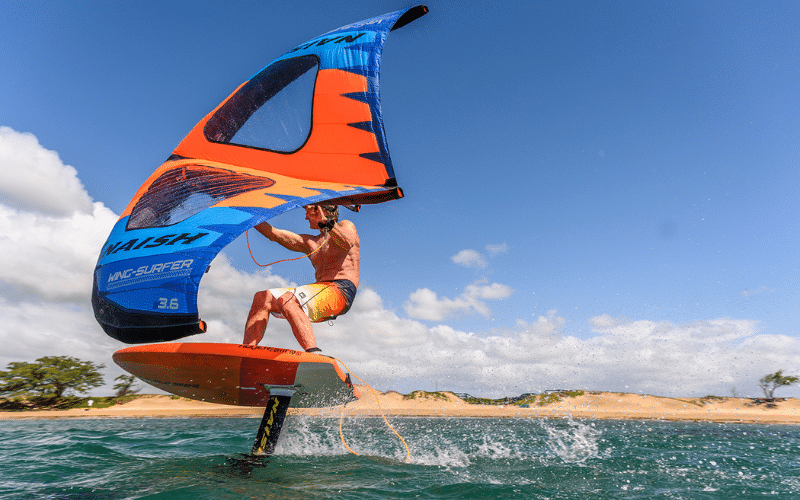
A wing is a handheld inflatable sail. You hold it, the wind pulls, and the board underneath does the rest.
On a paddle board it works as a downwind assist: you hold the wing on the way out and paddle home, or the other way round. On a foil board it lifts you clear of the water entirely.
Wings are sized in square metres. Four is the everyday size for an adult in decent wind, five for lighter wind or a heavier rider, six when the wind is barely there.
We compared nine, from a 359 dollar wing to a 1,629 dollar board, foil and wing package.


The best foil wings at a glance
| Product | Size | Type | Standout feature |
|---|---|---|---|
| XUXIAO Wing Foil SailTop pick | 4, 5 or 6 sq m | Wing only | Double air chamber with a TPU window |
| ZMZDDM Inflatable WingBest handle | Wing with window | Wing only | One-piece ergonomic handle bar |
| lilishangmao SUP WingBest value | 4, 5 or 6 sq m | Wing only | Four reinforced handles and dual PVC windows |
| Inflatable Wingsurfer KiteSimplest setup | Wing with window | Wing only | No lines, bar or harness at all |
| WYBYYDS WingMost size options | 4, 5 or 6 sq m | Wing only | Sizes published with exact dimensions |
| 145L Inflatable Foil BoardBest board for a wing | 145 L | Board with foil | Military-grade PVC with a bolt-on foil |
| Spatium 145L Wingfoil PackageBest complete kit | 145 L with 5 sq m wing | Board, foil and wing | F200 foil matched to the board |
| Lucid Ice 120L PackageBest for progression | 120 L with 5 sq m wing | Board, foil and wing | F1060 foil with a 106 cm span |
| Spatium CW11 HydrofoilBest foil upgrade | 110 cm span, 80 cm mast | Hydrofoil only | Detachable aluminium alloy foil set |
The nine wings and foil packages in detail
- Sizes4 sq m at 350 x 200 cm, 5 sq m at 377 x 206 cm, 6 sq m at 386 x 212 cm
- Buildpolyester reinforced with TPU
- Chambersdouble
- Windowtransparent TPU panel
- Valvelarge diameter for fast inflation
- Kitwing, backpack, hand pump and leash
- Pricearound 389 dollars
Best for: A first wing for use with a paddle board or a foil board
The double chamber is the specification that matters most on a cheap wing. A single chamber wing that punctures goes limp instantly, usually while you are holding it downwind of the shore.
Two chambers means the leading edge and the strut hold air separately, and one failing still leaves a wing you can carry back.
Start at 4 sq m if you weigh around eighty kilos and paddle in real wind. Go up a size for light wind rather than down for gusts. Wear a buoyancy aid from the first session.
Strengths
- A double chamber, so a leak in the strut does not collapse the whole wing
- Published dimensions for all three sizes, which most listings hide
- A large valve, and inflating a wing by hand is otherwise slow work
- A leash included, without which the wing simply leaves
Weaknesses
- Polyester rather than the ripstop nylon used by premium brands
- No boom, so hand position is fixed by the handles

- Canopywear-resistant polyester with TPU film
- Handleone-piece ergonomic bar
- Windowopen window design
- Valvemultiple protection inflation and deflation valve
- Usewater, land, snow and skateboards
- Kitbackpack and pump included
- Pricearound 377 dollars
Best for: Riders who want a fixed bar rather than soft handles
A one-piece handle is the closest thing to a boom on a budget wing, and it changes how quickly you can sheet in and out.
Soft handles let the wing twist under load. A bar keeps the canopy where you put it, which is what a beginner needs while the technique is still guesswork.
The land use is not a gimmick either. Learning to fly the wing on a beach before adding a board removes most of the frustration.
Strengths
- A one-piece handle gives far more precise control than separate soft grips
- The TPU film over the polyester is what stops abrasion at the leading edge
- A protected valve, which is where cheap wings leak first
- Usable on land and snow, which extends the season
Weaknesses
- A rigid handle is bulkier to pack than soft handles
- One canopy size only, so no light wind option
- Sizes4, 5 and 6 sq m
- Canopywear-resistant Oxford fabric
- Windowstwo large PVC panels
- Handles4 reinforced
- Valveone-way with a hand pump included
- Kitwing, pump and backpack
- Pricearound 359 dollars
Best for: Wing foiling on a budget, with room to change hand position
Hand position is how you control power on a wing, and four handles gives you far more range than the usual two.
Moving the front hand forward depowers the wing. Moving it back loads it up. With only two handles you get one setting.
Two windows is the other practical advantage. Wings block your view forward at exactly the moment you are moving fastest.
Strengths
- Four handles let you move your grip as the wind and your speed change
- Two windows give a genuinely useful view of what is ahead
- Oxford fabric is tough, which matters when a wing gets dragged over shingle
- The cheapest wing here by some margin
Weaknesses
- Heavier than a TPU-reinforced canopy
- A single chamber design, so treat punctures seriously
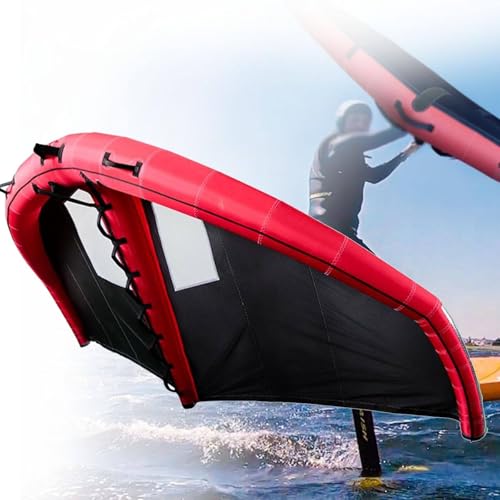
- Canopypolyester
- Windowyes, for forward visibility
- Riggingnone, no lines, bar or harness
- Kitstorage bag and surf leash
- UseSUP, surfboard, foil board, land boards
- Pricearound 426 dollars
Best for: Anyone coming to wings from kitesurfing who wants the opposite of rigging
The reason wings took over is setup time. A kite needs lines laid out, a bar, a harness and a beach with space. A wing needs a pump and two minutes.
That also means you can bail out at any moment. Let go, the wing flags on its leash, and you are back to a normal paddle board.
On a plain inflatable board a wing will not lift you out of the water, but it will pull you along a lake far faster than paddling.
Strengths
- Nothing to rig, which is the entire appeal of wings over kites
- A leash in the box, so the wing stays with you when you drop it
- Works on a plain paddle board, not only on a foil
- Packs into a bag small enough for hand luggage
Weaknesses
- Most expensive of the wing-only options here
- A basic polyester canopy without TPU reinforcement
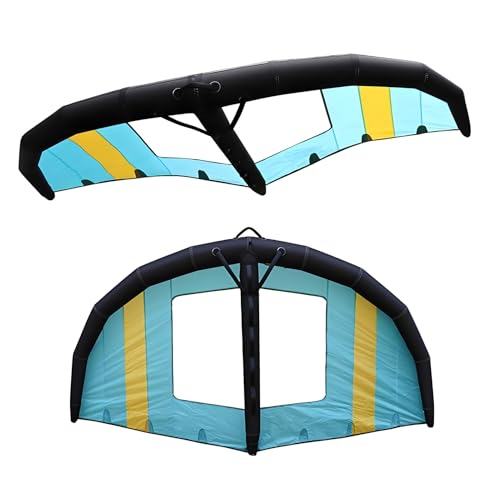
- Sizes4, 5 and 6 sq m, with 3 sq m listed at 1750 x 290 mm
- Buildreinforced core with a travel bag
- Windowyes
- Usesea, lakes, snow and open fields
- Rider levelbeginner to experienced
- Pricearound 380 dollars
Best for: Building a quiver of two sizes rather than owning one wing
Nobody rides one wing size all season. The wind decides, and a 4 sq m in light air is just a bag you carry to the beach.
The usual first pair is a 4 and a 6, which covers almost everything an average rider will go out in.
Check the variant before ordering. Multi-size listings are where the wrong size arrives most often.
Strengths
- A published size range wide enough to cover most wind conditions
- Folds into the included travel bag
- Usable on snow and land, which few wings state explicitly
- Priced low enough to buy two sizes for the price of one premium wing
Weaknesses
- Vague material description compared with the XUXIAO listing
- Sizes ship as separate variants, so check which one you are ordering

- Volume145 L
- Materialmilitary-grade PVC
- Decksoft non-slip EVA pads
- Foilfront wing, rear wing and mast bolted on, fully detachable
- Kitpump, travel backpack and coiled ankle leash
- Colourdark grey
- Pricearound 829 dollars
Best for: Learning to foil with a wing you already own
Volume is what lets a beginner stand up before there is any lift, and 145 litres is generous enough for most adults to balance while sheeting in.
Learning to foil means falling repeatedly onto something with a metal mast attached. An inflatable deck is considerably kinder than a carbon one.
Once you can foil consistently, less volume becomes better. That is a next-season problem, not a first-season one.
Strengths
- 145 L of volume floats a heavier rider standing still, which is how you learn
- An inflatable foil board survives the falls that destroy a hard one
- The foil unbolts, so the board also works as a plain floaty board
- A complete accessory set rather than board only
Weaknesses
- Sold without a wing, so budget another 350 dollars
- Inflatable foil boards flex more than hard boards at speed
- Volume145 L
- Wing5 sq m KVS inflatable wing
- FoilF200, front wing 92 x 26.3 x 11.9 cm
- Boardmilitary-grade PVC inflatable
- Kitboard, foil, wing, backpack, pump and repair kit
- Levelbeginner
- Pricearound 1,239 dollars
Best for: Starting wing foiling from nothing without matching parts yourself
Matching a foil to a board and a wing to a rider is where most people go wrong buying separately, and it usually costs more than a package does.
A large front wing is what you want at the start. It generates lift at low speed, which is the only speed a beginner reaches.
Expect to change the foil before the board. That is normal progression and the reason the foil bolts on rather than being moulded in.
Strengths
- Board, foil and wing chosen to work together, which is the hard part
- A large 92 cm front wing, which lifts early and forgives a slow start
- A 5 sq m wing, the right first size for most adults
- Everything in one purchase and one backpack
Weaknesses
- Twelve hundred dollars in one go
- Entry level components you will eventually replace individually

- Volume120 L
- Wing5 sq m inflatable surf wing
- FoilF1060, chord 20 cm and span 106 cm
- Boardreinforced military-grade PVC
- Kitboard, foil, wing, backpack, pump and repair kit
- Levelbeginner to intermediate
- Pricearound 1,629 dollars
Best for: A rider who expects to progress quickly and does not want to rebuy
Volume is a beginner crutch that becomes a handicap. A high volume board wants to plane and skip once you are up on the foil.
Dropping to 120 litres makes the first two sessions harder and the following twenty better, which is worth it if you intend to stick with it.
The narrower foil follows the same logic. Less span means less lift at low speed and far more control once you are flying.
Strengths
- 120 L is a more useful long-term volume than 145 L once you can foil
- A narrower 106 cm foil span, which is faster and more manoeuvrable
- Reinforced PVC construction on the board
- A complete matched kit like the Spatium, one step further on
Weaknesses
- The most expensive package here
- 120 L is harder to balance on at the very start

- Mast80 cm
- Front wingchord 24.6 cm, span 110 cm
- Materialaluminium alloy
- Assemblyfully detachable
- Usewing foiling, towing and pumping
- Levelintermediate to advanced
- Pricearound 589 dollars
Best for: Replacing a starter foil without changing the board
Mast length decides how much chop you can ride through. A short starter mast ventilates constantly the moment the water is not flat.
Eighty centimetres keeps the wing deep enough to stay attached, which is the difference between flying and repeatedly crashing.
Check the mounting track on your board first. Plate and track standards vary, and a foil that does not bolt on is an expensive ornament.
Strengths
- An 80 cm mast, long enough to stay in clean water in chop
- Aluminium alloy is far cheaper than carbon and nearly as stiff at this size
- Detachable, so it travels and stores flat
- Works for towing and pumping as well as wing foiling
Weaknesses
- Not a beginner foil, and the listing says so
- You must check the track fit on your board before buying
How to choose a foil wing
Size the wing to your weight and your wind: Four square metres suits an average adult in fifteen to twenty knots, five is the usual first wing, and six is for light air. Riders eventually own two sizes, because no single wing covers a whole season.
Look for a double chamber: The leading edge and the strut inflating separately is the difference between a puncture that ends the session and one that ends the swim. On a wing you may be holding half a kilometre offshore, that matters.
Handles decide control: A rigid handle or a boom gives precision. Four soft handles give range. Two soft handles give you neither, and it is the most common shortcut on cheap wings.
Match the foil to your stage, not your ambition: A big low-aspect front wing lifts early and forgives everything, which is what a beginner needs. A narrow high-aspect wing is faster and punishes mistakes. Buying the fast one first simply delays learning.
Treat it as a wind sport, with wind sport rules: Wing foiling takes you downwind fast and brings you back slowly, and a hydrofoil is a set of blades under your board. Wear an impact vest and a helmet while you are learning, and never go out in offshore wind.
Frequently asked questions
Can I use a wing with a normal paddle board?
Yes, and it is a good way to learn to fly the wing. You will not foil, but a wing pulls a board along a lake far faster than paddling and teaches you the handling before a foil is involved. A wide, stable board is easier for this than a narrow touring one.What wing size should I start with?
Five square metres for an average adult. It has enough power to get going in moderate wind without being unmanageable in a gust. Add a four for windier days once you know what you are doing.How long does it take to learn to foil?
Flying the wing takes an afternoon. Getting up on the foil takes a few sessions. Riding consistently without touching down takes most people ten to twenty hours on the water, which is why board volume matters so much at the start.Is wing foiling dangerous?
The foil is sharp and moving, and that is the real hazard rather than the wind. A helmet and an impact vest are standard for a reason, and keeping other water users well clear while you are learning is not optional.Bottom line
The XUXIAO wing is the pick because it publishes real dimensions for all three sizes and builds the canopy in two separate chambers, which is the one construction feature that decides how a cheap wing fails.
If you are starting from nothing, the Spatium 145L package removes the matching problem entirely. And if you already have a board and simply want to try a wing on it, the lilishangmao at 359 dollars is the cheapest sensible way in.


