


Hand pumping an inflatable board to 15 PSI takes about ten minutes and leaves you tired before you have touched the water. That is the entire argument for an electric pump.
The important split is how the pump is powered. A 12 volt pump runs off the car and costs half as much. A battery pump works at a lake you walked to, and costs the difference.
Beyond that, look for two-stage inflation, an accurate auto shut-off and a deflate function. Two stages means a high volume first phase to fill the board and a high pressure second phase to finish it.
We compared nine pumps on power source, speed to 15 PSI, accuracy and how many boards they manage on one charge.


The best electric paddle board pumps at a glance
| Pump | Power | Max pressure | Standout feature |
|---|---|---|---|
| Hydrohero SUP PumpTop pick | Battery, USB-C | 20 PSI | 12 PSI in five minutes at 2.5 lb |
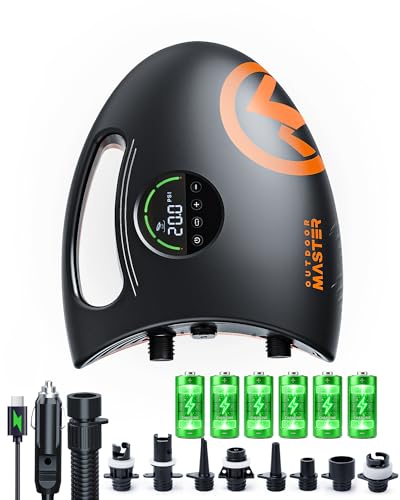
| OutdoorMaster Shark 2SBest premium | 88.8 Wh battery or 12 V | 20 PSI | Six boards on one charge |
| 13500 mAh Rechargeable PumpBest battery | Battery, USB-C | 20 PSI | Active cooling for continuous use |
| Gicle 22PSI SUP PumpBest display | 59.2 Wh battery | 22 PSI | 0.01 PSI precision on a 4.5 in screen |
| 50PSI Rechargeable PumpMost versatile | 12000 mAh battery | 50 PSI | Also inflates car tyres |
| Dual Stage Car PumpBest dual power | Battery or 12 V DC | 20 PSI | Battery and car socket in one unit |
| Swonder Digital Air PumpBest car pump | 12 V DC only | 20 PSI | Seven nozzles and three gaskets |
| SereneLife Electric PumpBest value | 12 V DC only | 20 PSI | Dual stage with an LCD preset |
| ETENWOLF S4Best budget | 12 V DC only | 20 PSI | 600 L/min turbo boost for thirty dollars |
The nine picks in detail
- Powerrechargeable battery, Type-C
- Max pressure20 PSI
- Speed10.5 ft board to 12 PSI in 5 minutes
- Weight2.51 lb
- Size7.4 x 6.3 x 3.4 in
- Stages400 L/min then 100 L/min
- ChargingQC3.0 30 W
- DisplayLED with three modes
Best for: Almost everyone, and especially anyone who launches away from the car
The combination that makes this the pick is speed and weight together. Plenty of pumps manage one or the other.
Two and a half pounds means it goes in the board bag alongside the board, which is where a pump has to live if you walk to the water.
Set your target pressure once and leave it. The auto shut-off is what stops people over-inflating a board on a hot day, which is how seams fail.
Strengths
- Five minutes to 12 PSI is genuinely quick for a battery pump
- Two and a half pounds, so it lives in the board bag rather than the boot
- Real dual stage, with published flow rates for both
- Auto shut-off at the preset value
Weaknesses
- Needs a QC3.0 charger to charge quickly
- One charge does not cover a whole family of boards
- Battery88.8 Wh rechargeable
- Capacityup to six boards per charge
- Max pressure20 PSI
- Speed10.6 ft board to 15 PSI in 8 min 40 s
- Deflation1 min 30 s
- Charging45 W Type-C, 2 hours, or 12 V DC
- Nozzleseight
- Functionsinflate and deflate
Best for: Families, clubs and anyone pumping more than one board at a time
Six boards on a charge is the specification worth paying for if you paddle with other people, because the alternative is one person hand pumping.
The 88.8 watt hour battery is deliberately just under the airline carry-on limit, so this is also the pump that can travel with you.
The deflate function is not a throwaway feature. Ninety seconds of suction rolls a board far tighter than you can by kneeling on it.
Strengths
- Six boards on a charge, which no other battery pump here approaches
- Charges over USB-C or from the car, so it never strands you
- Eight nozzles covers boards, kayaks, beds, tents and pools
- OutdoorMaster is an established brand with real support
Weaknesses
- A hundred and twenty six dollars
- Eight and a half minutes to 15 PSI is not the fastest here

- Battery13500 mAh
- Max pressure20 PSI
- Speed11 ft board to 15 PSI in 8 minutes
- Stage one360 L/min
- Stage twohigh pressure finish
- Coolingactive cooling system
- Nozzlessix
- ModesSUP, tent and kayak presets
Best for: Long days with several inflatables to fill
Overheating is the real failure mode of cheap electric pumps. They fill one board happily and then thermally cut out on the second.
An active cooling fan is what allows continuous use, and it is worth more than another twenty percent of flow rate.
The tent and kayak presets are useful if the pump is doing double duty for camping, since a tent wants a fraction of a board's pressure.
Strengths
- Active cooling, so it does not shut down halfway through the second board
- Preset modes rather than dialling in a number every time
- Eight minutes to 15 PSI on an eleven foot board
- Seventy three dollars for a cordless pump is good value
Weaknesses
- No car socket option, so a flat battery means a hand pump
- Six nozzles rather than the eight on the OutdoorMaster

- Battery59.2 Wh built in
- Capacityfour 10 ft boards per charge
- Max pressure22 PSI
- Precision0.01 PSI
- Screen4.5 in LCD
- Speed10.8 ft board in 5.5 minutes
- Charging36 W, two hours
- Nozzlesseven nylon
- ExtrasLED work light
Best for: Boards rated above 20 PSI and paddlers who care about exact pressure
Most pumps stop at 20 PSI, which is fine for an all-round board and marginal for a stiff touring board that is rated higher.
Precision to 0.01 PSI is more than anyone needs, but a big readable screen genuinely is not. Squinting at a two-digit LED in sunshine gets old.
Four boards per charge and a two hour recharge makes it practical for a weekend without a car socket.
Strengths
- Twenty two PSI, so it can fill the stiffer racing and touring boards
- A 4.5 inch screen you can actually read in daylight
- Five and a half minutes is among the fastest here
- LED light for early starts and late finishes
Weaknesses
- 59.2 Wh is a smaller battery than the leaders
- Bright orange, if that matters to you

- Battery12000 mAh
- Capacityfour boards at 12 PSI per charge
- Max pressure50 PSI
- Stagesthree, 350 to 420 L/min then 70 L/min
- Weight2.9 lb
- Size6.88 x 3.54 x 6.88 in
- Coolingupgraded active cooling
- ExtrasLED screen and built-in light
- Alsocar tyres and inflatable boats
Best for: One pump for the board, the boat and the car
Fifty PSI is not about boards. No paddle board wants more than about twenty two, and pushing past that damages seams.
It is about everything else in the boot: car tyres, trailer tyres, a bike, a dinghy. If you want one pump in the car, this is the one.
The third inflation stage helps at the top end, where a two stage pump slows to a crawl above 12 PSI.
Strengths
- Fifty PSI covers car tyres, which no 20 PSI pump can touch
- Three stage inflation rather than two
- Active cooling for four boards back to back
- Under three pounds despite the higher pressure rating
Weaknesses
- Higher pressure capability does not make it faster on a board
- Eighty dollars for capability many paddlers will never use

- Power13500 mAh battery or 12 V DC
- Max pressure20 PSI
- Stage one360 L/min
- Stage two100 L/min
- Speed10 ft 6 board to 15 PSI in about 10 minutes
- Charge time4 to 5 hours
- Capacitythree boards at 15 PSI
- Noise67 decibels first stage
- ExtrasLCD, preset pressure and an LED light
Best for: Paddlers who want the car as a backup rather than the only option
Dual power is the arrangement that removes the one real anxiety about battery pumps, namely arriving at the water with a flat pump and a rolled board.
Sixty seven decibels is roughly conversation level, which is quiet for a pump. The second stage is louder, as it always is.
Charge it the night before anyway. A four hour charge time is not something you can fix in a lay-by.
Strengths
- Runs off the battery or straight from the car, so it never fails you
- Published noise figure, which almost nobody else gives
- Cooling and noise reduction built in
- Sixty three dollars for a dual power pump
Weaknesses
- Four to five hours to charge is slow
- Ten minutes to 15 PSI is mid-pack

- Power12 V DC only, no battery
- Range0.5 to 20 PSI
- Stagesintelligent dual stage
- Hose3.6 ft
- Nozzlesseven plus three gaskets
- Shut-offautomatic at the set value
- Warranty12 months
- Colourstwo
Best for: Paddlers who always launch within a cable's reach of the car
The honest question with any car pump is where you actually launch. If the answer is a car park beside the water, a battery is money spent on nothing.
Unlimited runtime is the underrated advantage. A car pump will fill four boards in a row without thinking about heat or charge.
Check the valve gasket that comes with your board. The three included gaskets exist because valve standards are not as standard as they should be.
Strengths
- Car power means unlimited runtime and no charging to remember
- Seven nozzles and three gaskets covers awkward valves
- Twelve month warranty with genuine support
- Sixty dollars
Weaknesses
- No battery at all, so it is useless away from the car
- A 3.6 ft hose plus the cable can be tight on a long vehicle

- Power12 V DC or car cigarette lighter
- Max pressure20 PSI
- Stagesdual, high volume then high pressure
- DisplayLCD with PSI preset
- Shut-offautomatic
- Functionsinflate and deflate
- Nozzlessix universal
- Extrasflexible hose and carry handle
Best for: A first electric pump on a budget, used from the car
This and the Swonder are the same proposition at five dollars apart, and the choice comes down to which is in stock and what colour you like.
Dual stage with a preset and auto shut-off is the specification that matters. Everything below that is a compressor with a hose.
It fills a budget board exactly as fast as it fills an expensive one, which is the nice thing about pumps.
Strengths
- Fifty five dollars for a proper dual stage pump with auto shut-off
- SereneLife is widely stocked, so spares and returns are easy
- Deflates as well as inflates
- Six nozzles covers boards, kayaks, boats and pool toys
Weaknesses
- Car power only
- Nothing here that the Swonder does not also do
- Power12 V DC car connector
- Max pressure20 PSI
- Turbo stage600 L/min
- UnitsBAR, PSI and KPA
- Nozzlesseven
- Protectionbuilt-in temperature cut-out
- Storagecable compartment and carry handle
- Functionsinflate and deflate
Best for: Anyone replacing a hand pump for the least possible money
Thirty dollars for a pump that reaches 20 PSI with auto shut-off is the kind of price that makes a hand pump hard to justify as anything but a backup.
Keep the hand pump anyway. Every electric pump eventually fails, usually at the water, and a board with no pump is a bag of PVC.
Expect it to want a rest between boards. The temperature protection is there for a reason at this price.
Strengths
- Thirty dollars, which is less than a decent hand pump
- 600 L/min turbo stage is the highest first-stage flow here
- Three pressure units, useful if your board is marked in bar
- The cable compartment stops the usual tangle in the boot
Weaknesses
- Car only, and the temperature cut-out will trigger on back to back boards
- The cheapest build here, so treat it gently
How to choose an electric paddle board pump
Battery or car socket: This is the whole decision. A 12 volt pump costs thirty to sixty dollars and needs the car within a hose and cable of the board. A battery pump costs seventy to a hundred and thirty and works on a beach you walked to. Be honest about where you launch.
Two stages are not optional: The first stage moves a lot of air at low pressure to fill the board, the second moves less air at high pressure to stiffen it. A single stage pump either takes forever or never reaches 15 PSI at all.
Match the maximum to your board: Most boards are rated 15 PSI with a 20 PSI ceiling, so a 20 PSI pump covers them. Stiff touring and race boards sometimes want 22, and pumps that advertise 50 PSI are aimed at car tyres, not at boards.
Count boards per charge, not milliamp hours: Battery capacity in mAh tells you nothing without the voltage. Manufacturers who state how many boards a charge fills, at what pressure, are the ones giving you a usable number. Two boards is a couple, six is a family.
Insist on auto shut-off and deflate: Auto shut-off stops you cooking a board in the sun at 20 PSI. The deflate function pulls the last air out so the board rolls small enough to fit the bag it came in, which hand pumps never manage.
Frequently asked questions
How long does an electric pump take to inflate a board?
Between five and ten minutes to 15 PSI for a ten to eleven foot board, depending on the pump. A hand pump takes about ten minutes of hard work for the same result, so the saving is effort rather than time on the faster models.What pressure should I inflate my paddle board to?
Whatever is printed beside the valve, which is usually 15 PSI. Under-inflating is the single most common reason a board feels unstable and slow, because the middle sags under your weight. Over-inflating in hot sun stresses the seams, which is why auto shut-off matters.Can I leave an electric pump running unattended?
With auto shut-off, yes, in the sense that it will stop at the set pressure. Stay nearby anyway. Nozzles work loose, hoses pop off, and a board left connected to a running pump on a hot day is the one situation where seams give way.Do I still need a hand pump?
Keep one in the car. Electric pumps fail, batteries go flat and car sockets blow fuses, and a hand pump is the difference between a slow start and a wasted trip. It also lets you top up a board mid-session without unpacking anything.Bottom line
For most paddlers the Hydrohero is the pump to buy, because it fills a board in five minutes, weighs two and a half pounds and does not care whether there is a car nearby. If more than one board goes in the car, the OutdoorMaster Shark 2S and its six boards per charge is worth the extra fifty dollars.
If you always launch beside the car, skip the battery entirely. The SereneLife and the Swonder do the same job for sixty dollars, and the ETENWOLF does it for thirty, which leaves the difference for something that actually improves the paddling.


