

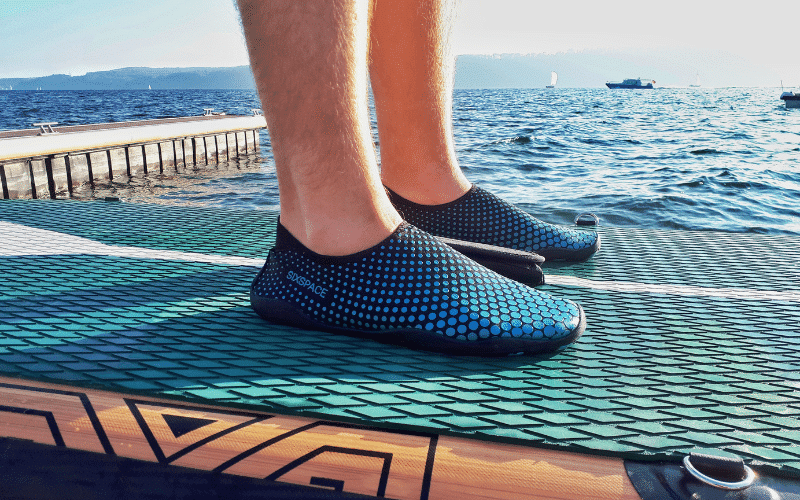
Almost nobody paddles in shoes. The footwear question is really about the ten metres before and after: the slipway covered in barnacles, the rocky shore, the cold water in April.
That splits the category cleanly in two. Thin aqua socks protect the sole of your foot against sharp things and weigh nothing. Neoprene boots keep your feet warm and add a real sole underneath.
The mistake is buying a five dollar sock for a rocky launch, or a 5 mm dive boot for a summer beach. Both work perfectly for the job they were made for and badly for the other.
We compared ten options for paddle boarding, from a ten dollar aqua sock to a 5 mm Cressi boot, and sorted them by what you are standing on and how cold the water is.


The best paddle boarding shoes at a glance
| Shoe | Type | Warmth | Standout features |
|---|---|---|---|
| Cressi Minorca Long 3mmTop pick | Tall neoprene boot | 3 mm | Anti-slip sole, rubber heel and toe cap, zip closure |
| SIMARI Water ShoesBest warm weather shoe | Mesh water shoe | None | Natural rubber sole, 360 degree drainage, elastic lock laces |
| OMGear 3mm Water SocksBest value in neoprene | High cut neoprene sock | 3 mm | Glued and blind stitched, reinforced sole, adjustable strap |
| Cressi Isla 5mm BootsWarmest | Tall neoprene boot | 5 mm | Hard rubber sole, heel shaped for fin straps, also in 7 mm |
| Phantom Aquatics 3mm Dive BootsBest zip and sole | High cut neoprene boot | 3 mm | Nylon-2 neoprene, glued and sewn seams, YKK #10 zip, hard sole |
| Racqua Water ShoesMost barefoot feel | Minimal water shoe | None | Wide toe box, zero heel lift, low profile grip outsole, drainage holes |
| XUKER 3mm Neoprene Water SocksBest sand proof pair | Neoprene sock | 3 mm | 90 percent neoprene, tougher anti-slip sole, flat seams |
| OMGear Low Cut Aqua SocksBest barefoot feeling | Low cut sock | Thin | 83 percent nylon and 17 percent spandex, elastic band welt, flatlock seams |
| SIMARI Aqua SocksCheapest | Aqua sock | None | Rubber sole, foldable, elastic quick dry fabric |
| HISEA Neoprene Slip-On BootsBest for muddy launches | Ankle rain boot | 5 mm | Waterproof neoprene and rubber, deep lug self-cleaning outsole |
The ten options in detail
- Typetall neoprene boot
- Thickness3 mm
- Soleanti-slip, with rubber heel and toe cap
- Closureside zip
- Materialsuper elastic nylon lined neoprene
Best for: Cold water, rocky launches, and anyone who wants one pair for everything
If you buy one thing for your feet, buy this. A tall 3 mm boot handles cold water, sharp launches and long walks over rock, which no thin sock does.
The rubber heel and toe cap is what separates a boot from a sock. Those are the two points that wear through first, and reinforcing them is the difference between two seasons and five.
The zip matters more than it sounds. Pulling a tall neoprene boot onto a wet foot without one is a genuine struggle on a cold morning, and pairs well with the rest of your cold water kit.
Strengths
- Tall cut keeps water and gravel out, unlike a low sock
- Rubber heel and toe cap survives being dragged over rock
- 3 mm is warm enough for spring and autumn without being clumsy
- Zip means you can actually get them on with wet feet
Weaknesses
- Forty three dollars
- Too warm for a hot summer day
- Typemesh water shoe
- Solenatural rubber with deep treads
- Drainage360 degree through sole and insole
- Lacesadjustable elastic lock laces
- Uppersoft air mesh, sock-like fit
Best for: Summer, rocky shores and any launch you have to walk to
An aqua sock protects you from sharp things but slides on wet weed. This has a real treaded rubber sole, which is what you want on a slipway or a rock shelf.
Drainage is the second reason to pick it. Shoes without holes hold half a litre of water and stay heavy and cold for the whole session.
The lock laces matter if you launch in any current. Pull-on shoes come off in moving water and then float away, which is how most water shoes are lost.
Strengths
- Deep treaded rubber sole that grips wet rock and moss properly
- Drainage holes mean they empty instead of squelching for an hour
- Lock laces hold them on in current, unlike a pull-on sock
- Seventeen dollars
Weaknesses
- No warmth at all
- Mesh lets small stones and sand in
- Typehigh cut neoprene sock
- Thickness3 mm
- Neoprenesoft, laminated with four way stretch nylon
- Solereinforced rubber print, abrasion and tear resistant
- Seamsglued and blind stitched, flatlock
Best for: Cool water where you want warmth without the bulk of a boot
This is the middle answer between a sock and a boot: real 3 mm neoprene for warmth, blind stitched so it does not flush, but slim enough to feel normal on the board.
The adjustable strap is what stops the classic failure of high cut socks, which is the top rolling down and filling with water.
Understand the limit. The sole is a printed rubber coating rather than a moulded sole, so it protects against sand and gravel, not against barnacles.
Strengths
- Glued and blind stitched at seventeen dollars, which is a boot specification
- High cut with an adjustable strap, so it stays put
- Reinforced printed sole handles gravel and sand
- Far less bulky than a dive boot
Weaknesses
- No hard sole, so sharp rock is still felt
- Not warm enough for winter

- Typetall neoprene boot
- Thickness5 mm, also available in 7 mm
- Solehard rubber
- Heelshaped to hold open heel fin straps
- Materialsuper elastic neoprene
Best for: Winter paddling and genuinely cold water
Once the water is properly cold, 3 mm stops being enough, and this is the step up. Five millimetres of neoprene with a hard sole underneath.
The trade is feel. You lose a lot of contact with the board, and on a warm day your feet will be uncomfortably hot within twenty minutes.
Buy them as a winter specific pair rather than as your only boots. That is the way most people end up using them.
Strengths
- 5 mm is real winter warmth, well beyond what a 3 mm boot gives
- Hard rubber sole, so you can walk anywhere in them
- Shaped heel keeps fin straps from slipping if you also dive
- Cressi build quality throughout
Weaknesses
- Fifty five dollars
- Bulky and stiff, and much too warm for anything but cold water

- Typehigh cut neoprene boot
- Thickness3 mm
- MaterialNylon-2 neoprene for flexibility
- Seamsglued and sewn
- ZipYKK #10 heavy duty
- Solehard sole for walking
Best for: Paddlers who want a boot that lasts, and who dive as well
Zips are the weak point of every neoprene boot. They corrode, they jam with sand, and once one fails the boot is finished. A YKK #10 is a real upgrade.
The rest is a solid 3 mm boot: glued and sewn seams, hard sole, flexible nylon lined neoprene.
Against the Cressi Minorca it comes down to preference. Cressi has the reinforced toe and heel, this has the better zip.
Strengths
- A YKK zip rather than a generic one, which is where cheap boots fail
- Glued and sewn seams keep water out properly
- Nylon-2 neoprene is flexible enough not to fight your ankle
- Hard sole handles rock and slipways
Weaknesses
- Forty dollars
- High cut takes a moment longer to get on and off

- Typeminimal water shoe
- Toe boxwide, barefoot shaped
- Dropzero heel lift
- Outsolelow profile ultra-grip
- Drainageholes in each sole
- Weightvery light
Best for: Paddlers who dislike the disconnected feel of thick soles
Balance on a board comes from your feet, and a thick cushioned sole takes information away. This is a minimal shoe built to leave that intact.
The wide toe box is the useful bit. Your toes can spread and grip, which is exactly what they do when you paddle barefoot.
It is a compromise on protection. On sand, mud and smooth rock it is excellent, on barnacles it is not enough.
Strengths
- Wide toe box lets your toes spread, which improves balance on a board
- Zero drop and low profile, so you still feel the deck
- Grippy outsole despite the thin profile
- Drains through the sole rather than staying full
Weaknesses
- Thin sole transmits sharp rock
- Twenty three dollars for a minimal shoe
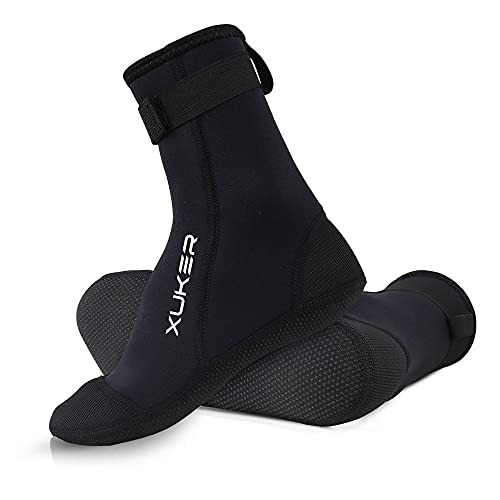
- Typeneoprene sock
- Thickness3 mm
- Material90 percent neoprene, 10 percent nylon
- Soletougher than standard anti-slip coating
- Seamsflat seams with smooth skin openings
- Fitergonomic, no wrinkling on the instep
Best for: Sandy beaches and warm shallow water
Sand in a water shoe is genuinely miserable, and smooth skin openings at the ankle are the feature that keeps it out.
The manufacturer says plainly that they are not fully waterproof, which is honest. Neoprene socks work by warming the thin layer of water inside.
For a summer beach with hot sand and shells they are close to ideal, and light enough to live permanently in the dry bag.
Strengths
- Smooth skin openings keep sand and most water out
- Tougher sole coating than typical neoprene socks
- Ergonomic shape avoids the wrinkles that cause hot spots
- Eighteen dollars
Weaknesses
- Flat seams let more water in than blind stitching
- The brand is clear that these are not fully waterproof

- Typelow cut sock
- Material83 percent nylon, 17 percent spandex with neoprene
- Weltelastic band rather than a strap
- Seamsflatlock stitching
- Feelclose to bare feet
Best for: Warm water where you want protection but not the feeling of shoes
Low cut socks solve one specific problem: shoes that feel like shoes. These are barely there, which is the point.
The elastic band welt is more comfortable than a hook and loop strap, and there is nothing to catch on the deck pad.
Do not expect them to keep sand out, since the low cut means it comes straight over the top. Warm shallow water is their territory.
Strengths
- The closest thing to bare feet with any protection at all
- Elastic band welt instead of a bulky strap
- Flatlock stitching, stronger than single needle seams
- Sixteen dollars
Weaknesses
- Low cut, so sand comes in over the top
- Minimal warmth and minimal sole protection

- Typeaqua sock
- Solerubber, more protective than plain beach socks
- Fabricbreathable quick dry elastic
- Packingfolds flat
- Sizesmen and women
Best for: A first pair, or a spare in the bag
Ten dollars, folds into a pocket, and stops you cutting your foot open on a shell. On that basis alone it is worth owning a pair.
The sole is thin, so treat it as protection against small sharp things rather than against a rocky shore.
Buy a pair as a spare even if you have boots. They live in the bag and cost nothing to keep there.
Strengths
- Ten dollars for a shoe with an actual rubber sole
- Folds flat, so a pair lives in the bag permanently
- Quick drying and lightweight
- Enough protection for sand, shells and hot ground
Weaknesses
- Thin sole, no protection against sharp rock
- No warmth

- Typeankle height rain boot
- Material5 mm neoprene with rubber overlays
- Waterproofingfully waterproof
- Outsoledeep lug, self-cleaning
- Entrypull-on tab, slip-on
Best for: Muddy river banks and cold weather launching where you want dry feet
Some launches are mud rather than sand or rock. Neoprene socks are useless there and a proper wellington is the honest answer.
Self-cleaning deep lugs are the reason to prefer these to a normal boot. Mud drops out of the tread instead of packing into a flat slippery block.
These are for getting to and from the water, not for standing on the board. Change into them afterwards and enjoy dry feet on the drive home.
Strengths
- Genuinely waterproof rather than warm-when-wet
- Deep self-cleaning lugs handle mud that defeats water shoes
- 5 mm neoprene upper is warm and flexible
- Slip on and off in a second
Weaknesses
- Not a paddling shoe, they stay in the car once you launch
- If one floods it stays full
How to choose paddle boarding footwear
Start with the shore, not the water: Sand needs nothing more than a ten dollar sock. Gravel and shells need a rubber sole. Barnacled rock and concrete slipways need a moulded sole with real tread, which only the water shoes and the dive boots here have.
Then the temperature: Below about fifteen degrees you want neoprene, and 3 mm covers spring and autumn. Five millimetres is winter only, because the stiffness costs you a lot of feel on the board. Above twenty degrees, skip neoprene entirely and take a draining water shoe.
Drainage or seal, not both: A water shoe should drain, so look for holes in the sole. A neoprene sock or boot should seal, so look for glued and blind stitched seams and smooth skin openings. A shoe that does neither collects water and stays cold, which is the worst of both worlds, and it is the single detail that separates a real water shoe from a trainer that happens to be sold for the beach.
How it stays on: Pull-on socks come off in current and in surf. If you launch anywhere with moving water, choose lock laces, a strap or a zip. A shoe lost off the back of the board is gone.
Feel on the board: You balance with your feet, so the thinner the sole the better you paddle. Thick boots are warm and secure but they mute the board completely, which is why most people paddle barefoot in summer and only put boots on for the cold half of the year.
Frequently asked questions
Do I need shoes to paddle board at all?
On the board, usually not, and barefoot gives you the best balance and grip on the deck pad. Shoes are for the shore: sharp rock, hot sand, barnacles on a slipway, and cold water. If your launch is a soft sandy beach in summer, you can skip them entirely.Aqua socks or neoprene boots?
Aqua socks are for protection in warm water and cost ten to twenty dollars. Neoprene boots are for warmth and for rough ground, and cost thirty to fifty five. If the water is cold or the shore is rocky, buy the boot. Otherwise the sock does everything you need.What neoprene thickness do I need?
Three millimetres covers most paddling from spring to autumn. Five millimetres is for winter and genuinely cold water, at the cost of stiffness and lost feel on the board. Seven millimetres exists for diving and is more than any paddler needs.Will water shoes slip on the deck pad?
A good deck pad grips almost anything, but a wet smooth sole is still less secure than a bare foot or a textured neoprene sole. If you paddle in shoes regularly, choose a sole with texture rather than a flat rubber one, and rinse the sand off before you step on, since grit between the sole and the pad is what actually causes slips.Bottom line
For cold water and rough launches the Cressi Minorca is the right buy: 3 mm, reinforced at the toe and heel, with a zip that makes it usable on a wet foot. In summer, the SIMARI water shoe with its treaded sole and drainage holes covers the same ground for seventeen dollars and does not cook your feet.
If you only want one cheap thing, a ten dollar pair of aqua socks folded into the bag will save you a cut foot at some point. Whatever you choose, take it off before you step onto the board unless the water is cold, since bare feet on the deck pad remain the best connection you can have.


