

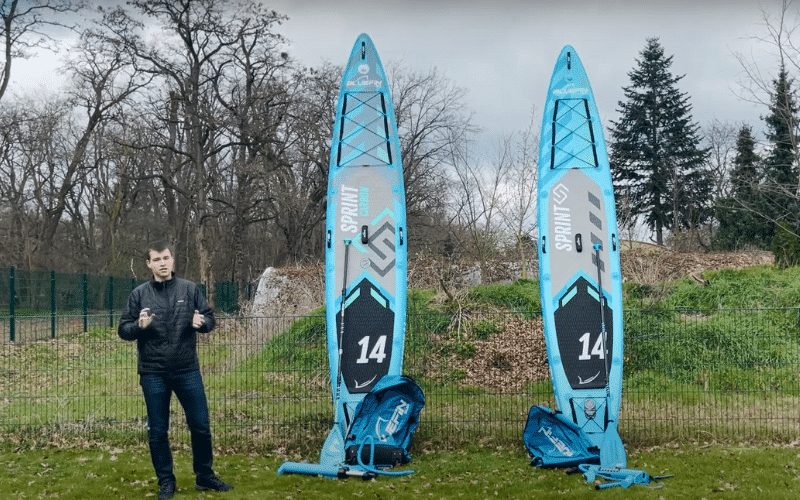
There is no professional grade in paddle boarding the way there is in cameras or power tools. What the word means in practice is a board built to standards that a cheap one is not.
Three things separate them. Welded or heat-sealed rails instead of glued ones, woven drop stitch instead of knitted, and a fused double layer skin instead of a single one.
All three do the same job: they stop the board flexing. A stiff board turns your stroke into distance, and a soft one turns it into a bend in the middle.
We compared nine boards that are built to that standard, from a five hundred dollar touring hull to a thousand dollar flagship.


The best professional paddle boards at a glance
| Board | Size | Construction | Standout feature |
|---|---|---|---|
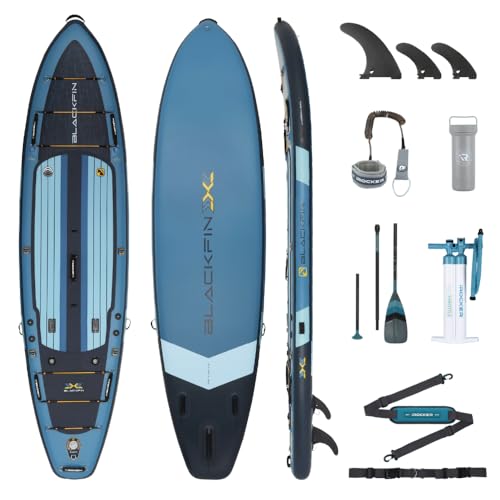
| iROCKER Blackfin Model XL 7.0Top pick | Blackfin XL platform | Welded seams, carbon rail | 20 D-rings and 8 action mounts |
| Zray R1 Rapid RaceBest for racing | 12 ft 5 x 30 in | Double layer outer skin | 352 lb capacity on a narrow hull |
| NIXY Monterey G5Best expedition board | 11 ft 6 x 34 x 6 in | Welded seams, fused dual layer | Built for loaded multi-day paddling |
| NIXY Newport G5Best all-rounder | 10 ft 6 x 32 x 6 in | Welded seams | Hybrid paddle and Typhoon pump included |
| Atoll ArchipelagoWidest premium board | 11 ft x 32 in | Double layer PVC | Fixed tri fin and a 2 year warranty |
| THURSO SURF Expedition 11 ft 6Best value | 11 ft 6 x 30 x 4.7 in | Woven drop stitch, welded rails | 21 lb and a low centre of gravity |
| THURSO SURF Waterwalker 132Best all-around premium | 11 ft x 32 x 6 in | Woven drop stitch, welded rails | 22 lb with 15 D-rings |
| Freein 14 ft Team SUPBest for groups | 14 ft x 60 in x 6 in | Reinforced drop stitch | An 860 lb capacity |
| Niphean 12 ft 6 TouringCheapest woven core | 12 ft 6 | Woven drop stitch | 20.4 lb and a 3 year warranty |
The nine picks in detail
- Seamswelded across the whole line, not just top models
- Railcarbon rail for extra stiffness
- Handleremovable centre handle
- MountMAGTITE magnetic puck
- Action mountseight
- D-rings20
- Skill levelall
Best for: One board that does everything at the highest build standard
Welded seams matter because glue is where inflatables fail, usually in year three and usually at the rail.
The carbon rail is the other half. It stiffens the edge of the board, which is where flex starts on any long hull.
If you want the same construction in a smaller package, the Model X in our intermediate guide is the shorter version.
Strengths
- Welded seams as standard rather than reserved for a flagship
- A carbon rail, which is the single most effective anti-flex measure
- Twenty D-rings and eight mounts, enough for fishing, camping or cameras
- The removable handle dries fully instead of trapping water
Weaknesses
- Nine hundred and ninety nine dollars
- The XL is a lot of board for a lighter paddler
- Size12 ft 5 x 30 in
- Capacity352 lb
- Skinpremium double layer outer
- Deckslip resistant stripe EVA traction pad
- Includedadjustable paddle, closing belt, pump, backpack, repair kit
- Age14 and up
- Useracing and fast touring
Best for: Paddlers who want speed rather than stability
Speed on a paddle board comes from waterline length and from not being wide, and this board takes both seriously.
Thirty inches feels alarming after an all-around board, and takes a few sessions before it feels normal.
It is the right board for anyone entering local races or paddling for fitness rather than for the view.
Strengths
- Thirty inches wide, which is genuinely narrow for an inflatable
- Double layer skin, resistant to the scuffs a race board collects
- Twelve and a half feet of waterline, which is where the speed comes from
- Under a thousand dollars for a race hull
Weaknesses
- Narrow enough to be hard work in chop
- 352 lb is a low capacity if you carry gear

- Size11 ft 6 x 34 x 6 in
- Seamswelded
- Corewoven drop stitch
- Skindual layer fused PVC
- Useexpedition and touring, calm and rough water
- Origindesigned in Southern California
- Weightlight for the class
Best for: Multi-day paddling with gear strapped down
Expedition means carrying weight, and a loaded board sits deeper and flexes more, which is why construction matters more here than on a day board.
Thirty four inches is deliberately wide. With forty pounds of dry bags on the nose you want the extra platform.
Pair it with proper dry bags rather than strapping loose kit under the bungees.
Strengths
- Fused dual layer PVC, which is one construction step above laminated
- Thirty four inches wide, so it stays stable fully loaded
- Welded seams on an expedition board, which is where they matter most
- NIXY supports its boards properly
Weaknesses
- Seven hundred dollars
- Thirty four inches costs you speed against the touring hulls

- Size10 ft 6 x 32 x 6 in
- Seamswelded
- PackageG4 Typhoon hand pump, G4 3-piece hybrid paddle, G4 backpack, coiled leash
- Useall conditions
- Weightlight and portable
- Skill levelbeginner to experienced
- Setupquick inflation and takedown
Best for: A premium board at a normal all-around size
This is the board for someone who wants the construction of a premium brand without the length and price of a touring hull.
Ten six by thirty two suits paddlers between roughly a hundred and forty and two hundred pounds, which is most of the market.
The included pump matters more than people expect, because a slow pump is what stops a board getting used on a busy morning.
Strengths
- Welded seams at six hundred and fifty dollars
- A hybrid paddle rather than plain aluminium
- Ten feet six by thirty two inches, the size that suits most people
- The Typhoon pump is genuinely quicker than a generic one
Weaknesses
- Not the cheapest way to get an all-around board
- The G5 is a refresh rather than a redesign
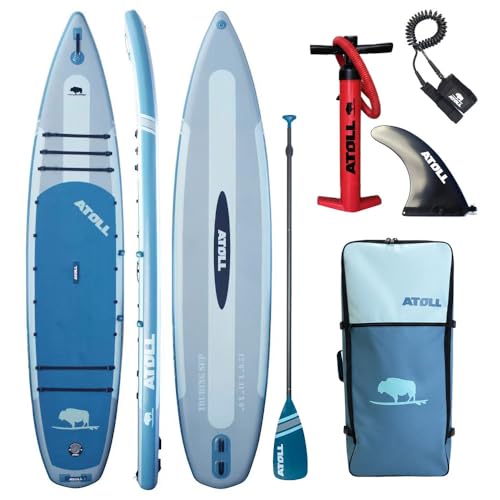
- Size11 ft x 32 in
- Constructiondouble layer PVC reinforced drop stitch
- Finsfixed tri fin, universal US box compatible
- Paddle3rd generation adjustable, 2 lb 2 oz
- D-rings15
- Warranty2 years
- Claim50 percent stronger than the competition
Best for: Stability without dropping to a budget build
Atoll builds heavy and warrants it for two years, which is a fair trade for anyone who is hard on equipment.
The fixed tri fin is the design decision worth knowing about. Nothing to lose and better tracking, at the cost of a bulkier packed board.
Their compact Enclave sits alongside this one in the range, and the paddle is the same on both.
Strengths
- A 2 lb paddle included, lighter than most sold separately
- Fixed tri fin, which tracks noticeably better than a single fin
- Two year warranty, longer than most premium brands offer
- Fifteen D-rings for a seat, gear or a passenger
Weaknesses
- Seven hundred dollars
- Fixed fins mean it cannot roll as tightly
- Size11 ft 6 x 30 x 4.7 in
- Weight21 lb
- Corewoven drop stitch with fusion PVC coating
- Railsheat welded
- Rider range130 to around 210 lb
- D-rings15
- Includedcentre fin, two side fins, coiled leash, repair kit, board only
Best for: Touring performance at half the flagship price
This is the best construction per dollar in the list, and the reason is that THURSO sells it without the accessory bundle.
The thinner 4.7 inch profile is a real design choice rather than cost cutting. It sits lower, so a light paddler feels steadier.
Add a good carbon paddle and you have a five hundred dollar board that paddles like an eight hundred dollar one.
Strengths
- Woven drop stitch and welded rails at five hundred dollars
- Twenty one pounds, 20 percent lighter than knitted core boards
- A 4.7 inch thickness, which lowers the centre of gravity usefully
- Thirty inches wide, so it actually glides
Weaknesses
- Board only, so budget for a paddle and pump
- Thin boards are less forgiving of over-inflation
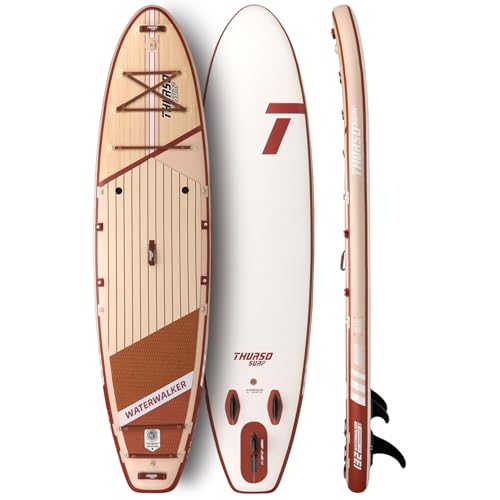
- Size11 ft x 32 x 6 in
- Weight22 lb
- Corewoven drop stitch, fusion PVC coating
- Railsheat welded
- Rider range160 to 210 lb
- D-rings15
- Bungeeswider and thicker at nose and tail
- Includedfins, coiled leash, repair kit
Best for: A premium build in the standard all-around shape
The Waterwalker is the board to buy if the Expedition's thirty inch width sounds like more than you want.
Woven drop stitch is the specification that carries across both, and it is the one that makes the board feel like a hard board underfoot.
Front and rear bungees are worth more than the spec sheet suggests when you carry a cooler and a dry bag on the same trip.
Strengths
- Same construction as the Expedition in a more forgiving shape
- Twenty two pounds for an eleven foot board
- Nose and tail bungees, so gear rides at both ends
- Three fin setup included
Weaknesses
- Board only, no paddle or pump
- Eleven by thirty two is a familiar size at a premium price
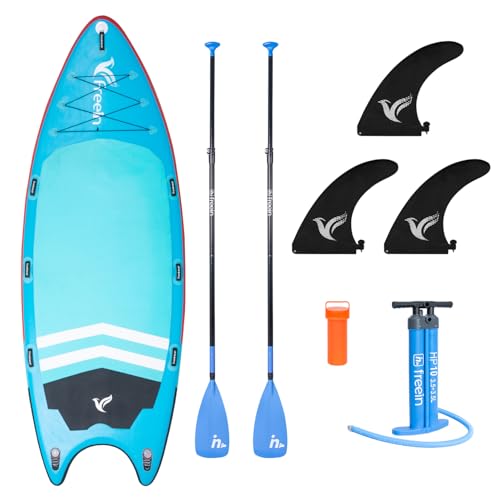
- Size14 ft x 60 in x 6 in
- Capacity860 lb
- Constructionreinforced drop stitch
- Decksoft non-slip pad
- Valvesdouble, for fast inflation and deflation
- Included2 adjustable paddles, hand pump, removable fins, bag, repair kit
- Usegroups, families and clubs
Best for: Clubs, rentals and anyone who paddles as a group
This is not a performance board and does not pretend to be. It is a floating platform for four to six people.
The double valve is the detail that makes it practical. A single valve on this volume would take twenty minutes of pumping.
Buy an electric pump at the same time. On a board this size a hand pump stops being a workout and becomes a reason not to go out.
Strengths
- An 860 lb capacity, more than four times a normal board
- Five feet wide, so nobody falls off
- Two paddles included as standard
- Double valves halve the inflation time
Weaknesses
- A hand pump on a 14 foot board is a serious job
- Almost impossible to paddle alone

- Length12 ft 6
- Hullstreamlined touring nose with a V-hull
- Corewoven drop stitch, up to 160 percent stiffer
- Capacity550 lb
- Weight20.39 lb
- Warranty3 years
- Includedpaddle, pump, leash and full accessory kit
Best for: Touring performance on a budget
Woven drop stitch at this price is why this board is on the list at all, because it is the specification that separates the premium boards above from generic ones.
A V-hull nose cuts chop rather than slapping through it, which is the difference you feel on a long paddle into wind.
Treat it as the entry point to real touring rather than as competition for the THURSO, and it makes a great deal of sense.
Strengths
- Woven drop stitch at two hundred and ninety dollars
- Twenty pounds on a twelve and a half foot board
- A 550 lb capacity, which is unusual on a touring hull
- Three year warranty
Weaknesses
- Niphean is a newer brand without a long track record
- Full kit, so the paddle is a budget one
How to choose a professional paddle board
Look for welded or heat-sealed rails: Glued rails are where inflatables come apart, usually after a few seasons of heat and UV. Welded seams cost more to manufacture and are the clearest single marker that a board is built to last rather than to a price.
Ask whether the drop stitch is woven or knitted: Woven drop stitch fabric, the internal thread structure that lets an inflatable hull hold a flat shape, holds its shape better under pressure and lets a board be both lighter and stiffer. It is the reason a twenty one pound board can feel firmer than a twenty eight pound one.
Choose length by what you actually do: Ten to eleven feet for all-around paddling, eleven and a half to twelve and a half for touring and distance, twelve and a half upward for racing. Buying a race hull for casual paddling produces a board you fall off.
Count the fittings before the features: Fifteen to twenty D-rings, action mounts and nose and tail bungees decide whether the board takes a seat, a cooler, a camera and a dog. On a board you intend to keep for a decade, that flexibility is worth more than a colour scheme.
Budget separately for the paddle: Several boards here are sold without one, which is honest rather than mean. A carbon paddle at eighty to a hundred and twenty dollars improves your paddling more than the last three hundred dollars of board price does.
Frequently asked questions
Is a thousand dollar board really different from a two hundred dollar one?
Yes, and the difference is stiffness. A cheap board sags in the middle under your weight, so part of every stroke goes into bending it rather than moving it. A welded, woven core board stays flat, which you feel within the first hundred metres.Do professionals use inflatables or hard boards?
Competitive racers use hard boards, because a rigid carbon hull is still faster. Everyone else, including guides and instructors, mostly uses premium inflatables, because they survive being dropped on rocks and fit in a car.How long should a board like this last?
Ten years is realistic for a welded board that is rinsed, dried and stored out of direct sunlight. Glued boards more often fail at five to seven, and UV rather than use is what kills them.What pressure should I inflate to?
Follow the board, not a rule of thumb. Most premium boards want 15 to 18 PSI, and under-inflating a stiff board by two PSI throws away most of what you paid for. A gauge you trust is essential.Bottom line
The iROCKER Blackfin Model XL 7.0 is the pick because welded seams and a carbon rail are what the word professional should mean, and iROCKER puts them on every board in the line rather than on a halo model. It is a thousand dollars, and it will still be stiff in ten years.
The value case is the THURSO SURF Expedition. Woven drop stitch, heat welded rails and twenty one pounds for five hundred dollars, sold without a bundle you did not want. Add your own paddle and pump and you have the construction of the flagship boards for half the money.


