


The second board is a different purchase from the first. You already know you like paddling, you know what your beginner board does badly, and you are no longer buying stability at any cost.
What changes is construction. A first board is single layer PVC that flexes; a step-up board is dual layer, fused or welded, with reinforced rails, and it feels rigid underfoot in a way that is immediately obvious.
The other change is shape. Thirty two to thirty four inches instead of thirty six, a narrower tail, a better fin, and a board that actually goes where you point it.
We compared nine boards that sit between a starter iSUP and a specialist touring or race hull.


The best intermediate paddle boards at a glance
| Board | Size | Construction | Standout feature |
|---|---|---|---|
| Atoll EnclaveTop pick | 10 ft 6 compact | Dual layer PVC, 15 PSI | Fixed tri fin and a 2 year warranty |
| iROCKER Blackfin Model X 7.0Best premium | Blackfin 7.0 platform | Welded seams, carbon rail | Magnetic MAGTITE accessory mount |
| ISLE and Tommy Bahama SwitchMost versatile | 11 ft 6 x 35.5 in | Air-Tech Fusion Lite | Converts to a kayak with the ISLE-LINK system |
| Boardworks KrakenBest all-water | 11 ft | Dual Fusion Laminate | Carbon paddle and a roller bag included |
| Retrospec Weekender PlusBest bundle | 10 ft 6 | Dual layer AerGlide-Fusion | Kayak conversion kit in the box |
| Skatinger 11 ft 6 x 35 inBest big platform | 11 ft 6 x 35 in | Ultra-light all-round | 10 in US box fin |
| TIGERXBANG 11 ftBest equipped | 11 ft x 34 in | Anti-slip EVA deck | Cup holder, camera mount and kayak seat |
| UPWELL 11 ft x 34 inLightest | 11 ft x 34 in x 6 in | Ultralight double wall PVC | Only 20 lb |
| Highpi 11 ftBest value | 11 ft x 33 in | Dual layer military grade PVC | 3 year warranty at 170 dollars |
The nine picks in detail
- Constructiondouble layer PVC reinforced drop stitch
- Pressure15 PSI
- Finsfixed tri fin, US box compatible detachable
- Paddle3rd generation adjustable, 2 lb 2 oz
- D-rings15
- Warranty2 years
- Usetravel, yoga and all-around
Best for: A second board that will outlast the first by years
The jump from a beginner board is not about shape, it is about how much the board flexes when you push hard on one rail.
Dual layer PVC at fifteen PSI is what removes that flex, and it is why an expensive board feels quicker without being narrower.
The paddle deserves attention too. A two pound paddle against a four pound aluminium one is thousands of strokes of difference, which is why our paddle guide matters as much as the board.
Strengths
- Genuine dual layer PVC, which is the step up that matters
- A 2 lb paddle, light enough to notice over a long session
- Fixed tri fin tracks far better than a single removable fin
- Two year warranty from a specialist brand
Weaknesses
- Seven hundred dollars
- Ten feet six is short if you want distance
- Seamswelded, standard across the range
- Railcarbon rail for extra stiffness
- Handleremovable centre handle
- MountMAGTITE magnetic accessory puck
- Action mountseight
- D-rings20
- Skill levelall, with enhanced stability
Best for: Paddlers who want the stiffest inflatable available
Welded seams are the specification worth understanding. Glued seams are the usual failure point on inflatables, and welding removes both the adhesive and the failure.
The carbon rail does what the stringers on the Atoll do, one step further. On the water it feels like a board that does not care how hard you paddle.
The magnetic accessory puck is a small thing that works well, and it is far better than the usual cup holder screwed to a D-ring.
Strengths
- Welded seams rather than glued, which is a real construction upgrade
- A carbon rail, which is what stops any long board flexing
- Twenty D-rings and eight action mounts, so it takes any setup
- The removable handle dries properly and does not dig in when kneeling
Weaknesses
- Nine hundred dollars
- More mounting points than most paddlers will ever use

- Size11 ft 6 x 35.5 in x 6 in
- Capacity425 lb
- Weight23 lb inflated
- ConstructionAir-Tech Fusion Lite, tighter weave
- ConversionISLE-LINK webbing loops with stainless G-hooks
- Deckfull nose to tail traction pad
- Includedseat, paddle, pump and travel bag
Best for: Paddlers who want one board for standing and sitting
The hybrid idea is usually a seat strapped to a normal board, and it usually sits badly. The ISLE-LINK loops run the full length of the rails, which is why this one works.
It is the right board for mixed groups and for long days where standing the whole time is not realistic.
Give up the idea of speed. Thirty five inches wide is a platform, and that is the trade you are making.
Strengths
- The conversion is quick and properly engineered, not an afterthought
- Twenty three pounds for a board this size
- Full length traction pad, so kneeling and sitting are comfortable everywhere
- A 425 lb capacity, enough for two
Weaknesses
- Eight hundred and ninety five dollars
- Thirty five and a half inches is wide, so it is not a fast board
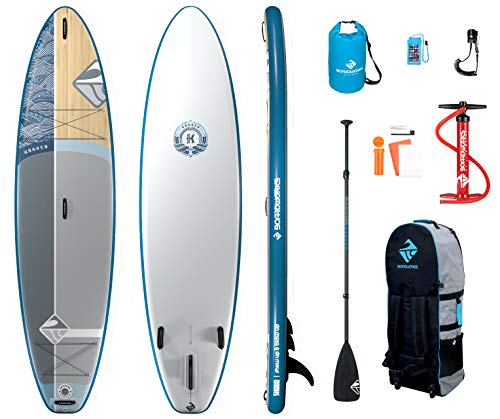
- Length11 ft
- ConstructionDual Fusion Laminate with liquid PVC coated drop stitch fibres
- Deckhoney fob embossed pad
- Paddle3-piece carbon fibre, adjustable
- FinFCS II quick fit
- Includedroller backpack, high pressure pump with gauge
- Usecruising, surfing and fishing
Best for: Paddlers who want one board for lakes, rivers and small surf
The included carbon paddle is worth two hundred dollars on its own, which changes how this board's price compares with the others.
The FCS II fin box is the other quiet advantage. It means the enormous world of surfboard fins fits, so you can tune the board rather than accept the one it came with.
All-water means what it says. It surfs small waves properly, which most wide inflatables cannot.
Strengths
- A carbon fibre paddle included, which nothing else here offers at this price
- FCS II fin box, the industry standard, so any surf fin fits
- Roller bag rather than a plain backpack
- Dual Fusion Laminate is proper performance construction
Weaknesses
- Five hundred and fifty dollars
- Boardworks are less widely stocked than the big brands

- Length10 ft 6
- Constructiondual layer PVC with AerGlide-Fusion
- Shaperounded nose and square tail
- Conversionkayak kit included
- Includedpump, backpack, paddle, fins, kayak seat, leash, repair kit and phone case
- Skillall levels
Best for: A step up in construction without a step up in price
This is the honest middle of the market: real dual layer construction, a proper bundle and a shape with some intent behind it.
A square tail releases water more cleanly than a rounded one, which is what makes a shorter board feel lively rather than sluggish.
Upgrade the paddle before anything else. The board is better than the stick that comes with it.
Strengths
- Dual layer PVC at four hundred dollars
- A genuinely complete bundle, including the kayak seat and phone case
- Square tail, which turns more sharply than the usual rounded one
- Retrospec is easy to buy and easy to return
Weaknesses
- Ten feet six is short for touring
- The included paddle is the usual aluminium type

- Size11 ft 6 x 35 in
- Capacity450 lb
- Fin10 in US box
- Backpack1680D heavy duty
- Handlesthree
- Bungee6-point front and 4-point rear
- Extrashoulder strap
- Weightultra-light for the size
Best for: Intermediates who want a stable platform for fishing, yoga or a passenger
Not every step up is towards speed. If your first board was too small for what you actually do, more platform is the upgrade.
The ten inch US box fin is the important detail, because it means you can fit a longer touring fin or a shorter surf one as you learn what you want.
Treat it as a stable second board rather than a performance one, in the same family as the boards in our dog-friendly guide.
Strengths
- A 10 inch US box fin, so it tracks properly and takes upgrades
- 1680D backpack rather than the usual thin one
- 450 lb capacity with three carry handles
- Two hundred and sixty dollars
Weaknesses
- Thirty five inches is wide for an intermediate board
- Single layer construction at this price

- Size11 ft x 34 in
- Capacity485 lb
- Deckanti-slip EVA
- Kayakadjustable seat, footrest and 4-piece dual blade paddle
- Storagefront bungees, paddle holders, cup holder and phone storage
- Mountfront action camera mount
- Finsthree detachable
Best for: Paddlers who want every fitting without paying premium prices
The footrest is the part other kayak conversions leave out, and it is what makes sitting for an hour possible rather than merely available.
Everything here is a fitting rather than a construction upgrade, so buy it for convenience and not for stiffness.
At two hundred dollars with a full kayak setup it undercuts buying a seat and paddle separately.
Strengths
- A footrest as well as a seat, which most kayak conversions omit
- Cup holder and phone storage built in rather than clipped on
- 485 lb capacity at 200 dollars
- Camera mount already fitted
Weaknesses
- Single layer construction
- Lots of fittings adds weight and clutter
UPWELL 11 ft x 34 in Inflatable Paddle Board with Kayak Seat
Lightest- Size11 ft x 34 in x 6 in
- Capacityaround 450 lb
- Weight20 lb
- Materialultralight double wall PVC, 25 percent lighter
- Paddle2-in-1 SUP and kayak
- Finsthree removable
- Includedcoiled leash, seat and full kit
Best for: Anyone who carries a board any real distance
Weight is the specification that decides how often a board actually gets used, and twenty pounds is the difference between a walk to the lake and a drive to the car park.
Double wall PVC at this weight is a real achievement, with the usual caveat that lighter fabric ages faster in the sun.
Store it rolled loosely and out of direct sunlight and it will keep its shape for years.
Strengths
- Twenty pounds, the lightest full size board here
- Double wall PVC despite the low weight
- 2-in-1 paddle switches between standing and sitting
- Two hundred dollars
Weaknesses
- Light construction gives up some long term rigidity
- Around 450 lb is a loose capacity claim
- Size11 ft x 33 in
- Constructiondual layer military grade PVC
- Decknon-slip EVA
- Warranty3 years
- Includedadjustable paddle, high pressure pump, leash and backpack
- Usesurfing, fishing and yoga
Best for: Getting the construction upgrade without the price upgrade
Dual layer construction at this price is the reason this board is here. It is the single specification that separates a first board from a second one.
Thirty three inches is the right width for someone who has learned to balance and now wants the board to move when they paddle it.
A three year warranty from a budget brand is worth reading carefully, but it is still three years more than most offer.
Strengths
- Dual layer PVC at a hundred and seventy dollars, which is unusual
- A three year warranty, longer than boards at four times the price
- Thirty three inches, narrow enough to feel like a step up
- Complete kit
Weaknesses
- Hand pump only
- Fewer fittings and mounts than the boards above
How to choose an intermediate paddle board
Construction first, shape second: The upgrade you feel is stiffness, and stiffness comes from dual layer, fused or welded PVC and reinforced rails. A single layer board in a fast shape still flexes under your feet, which cancels out the shape entirely.
Go narrower, but only one step: If your first board was thirty four or thirty six inches, thirty two or thirty three will feel quicker and still be stable. Dropping to thirty inches straight away usually means a board you enjoy less, not more.
Check the fin box: A US box or an FCS II box means you can fit a longer tracking fin, a shorter surf fin or a touring fin later. A proprietary slide-in fin means whatever the maker sells, if anything.
Upgrade the paddle at the same time: Board makers include a heavy aluminium paddle almost without exception. A carbon or fibreglass paddle is one to two pounds lighter, and over a two hour paddling session that is the biggest single improvement available.
Decide what the first board did wrong: Too slow, too wobbly, too small, too heavy to carry. Each of those points at a different board, and buying a generically better one without answering the question usually produces the same complaint again.
Frequently asked questions
When am I ready for an intermediate board?
When you can paddle in a straight line, turn with a step-back or a sweep, and stay upright in small chop without thinking about it. At that point the beginner board's width is costing you speed rather than buying you confidence.Is a dual layer board really worth the money?
Yes, and it is the only upgrade that is obvious on the first paddle. A dual layer board at 15 PSI does not sag in the middle, which means less effort per stroke and a board that still feels new after three seasons.Should I go for a touring board instead?
If you mostly paddle in a straight line for distance, yes. A twelve foot six touring hull is faster and tracks better than any all-around board, at the cost of stability and turning. See our touring guide if that is the direction.Do I need a hard board at this stage?
No. Modern dual layer inflatables are stiff enough for everything short of racing and surfing properly, and they are far easier to store and transport. A hard board is worth it only if you are set on surf performance or a race hull.Bottom line
The Atoll Enclave is the pick because it delivers the one thing a second board should: genuine dual layer construction at fifteen PSI, with a light paddle and a fin setup that tracks. If money is not the constraint, the iROCKER Blackfin Model X and its welded seams and carbon rail is as stiff as an inflatable gets.
At the other end, the Highpi is proof that dual layer construction no longer costs seven hundred dollars. For a hundred and seventy it gives you the upgrade that actually matters, and leaves the budget for a carbon paddle that will improve your paddling more than either board would.


