


Yoga on a board asks for the opposite of what a paddle board is usually designed to do.
Speed and tracking come from a narrow hull. Holding a warrior pose without swimming comes from width, a deck pad that runs the whole length, and handles that are not exactly where your hand wants to go.
That third one surprises people. A standard centre carry handle sits in the middle of the deck, which is precisely where your hands land in downward dog, and it ruins every session until you notice it.
We compared nine boards from a hundred and thirty dollars to six hundred, and judged them on deck coverage, width and how the board is laid out for a body rather than a paddler.


The best yoga paddle boards at a glance
| Board | Size | Weight | Standout feature |
|---|---|---|---|
| THURSO SURF TranquilityTop pick | 10 ft 8 in x 34 in x 6 in | 25.3 lb | Offset handles and a mat-like full deck pad |
| Retrospec Weekender YogiBest complete package | 10 ft 8 in, extra wide | 19.7 lb | Widened nose and tail, full accessory kit |
| SOLSTICE Sol FitBest for pure fitness | 7 ft 10 in pad | Very light | Doubles as a floating fitness mat, five anchor points |
| Aqua Marina Monster 12 ftBest for paddling too | 12 ft | Mid weight | Sand-ripple EVA deck and a long waterline |
| Skatinger 11'6 x 35Best wide platform | 11 ft 6 in x 35 in | 450 lb capacity | 10 in US box fin and central D-rings |
| Flyroc 11' x 35 Yoga SUPBest deck coverage | 11 ft x 35 in x 6 in | 430 lb capacity | 100 percent EVA coverage and five handles |
| Flypark 11' x 35Best light wide board | 11 ft x 35 in x 6 in | 19.8 lb bundle | Marine grade PVC with UV resistance |
| FBSPORT 11' Yoga BoardBest value | 11 ft x 33 in | 350 lb capacity | Wide stance board with a full kit under a hundred and fifty |
| DAMA Yoga and PetsBest budget | 33 in extra wide | Ultra light PVC | Extra nose foam and a fitted camera mount |
The nine boards in detail
- Size10 ft 8 in x 34 in x 6 in
- Weight25.3 lb
- Deckextra large non-slip EVA with a soft mat feel
- Handlesoffset, clear of the pose area
- Constructionwoven drop stitch, fusion PVC, heat welded rails
- Weight saving20 percent lighter than knitted drop stitch
- Fittings11 D-rings, wide front and rear bungees
- Includedboard, three fins, coiled leash, repair kit
Best for: Anyone whose main use for the board is yoga, not paddling
Stiffness matters more for yoga than for paddling. A board that flexes underfoot when you stand still becomes unpredictable the moment your weight is on two hands.
Woven drop stitch is the reason this feels different from a two hundred dollar board at the same pressure, and it is the whole justification for the price.
Buy it knowing the pump and paddle are separate. That is deliberate, since people buying a board at this level usually own both already.
Strengths
- Offset handles, the single detail that separates a yoga board from a wide board
- Woven drop stitch is stiffer at the same pressure, so it flexes less under a pose
- Heat welded rails rather than glued, which is where cheap boards fail
- The deck pad genuinely feels like a mat rather than grip tape
Weaknesses
- Six hundred dollars, and the paddle and pump are extra
- Ten foot eight is short if you also want to cover distance
- Size10 ft 8 in, widened nose and tail
- Weight19.7 lb
- Decksoft enhanced traction pad, spacious
- ConstructionAerGlide-Lite, puncture resistant
- Includeddual action pump, rucksack, three piece adjustable paddle, fins, safety leash
- Shapedesigned specifically for yoga rather than adapted
Best for: A first yoga board where you want everything in one box
Poses move your weight to the ends of the board, which is exactly where a normal board narrows and tips.
Widening the nose and tail is the cheap fix for that and it works, which is why dedicated yoga shapes look blunt compared with all-rounders.
The included dual action pump matters more than it sounds. Getting to full pressure is what makes a board feel firm, and single action pumps quietly stop people getting there.
Strengths
- Widened nose and tail keep the board stable when you move off centre
- Under twenty pounds, so carrying it does not undo the calm
- Dual action pump included, unlike the THURSO
- Three hundred and twenty dollars complete
Weaknesses
- Lighter construction flexes more than woven drop stitch
- Deck pad is grippy rather than mat-soft

- Pad size7 ft 10 in
- Anchorsfive reinforced neoprene attachment points
- Surfacenon-slip yoga mat texture
- Pressure15 PSI for a rigid feel
- Storagedeflates, folds and packs into the included bag
- Usefloating fitness mat or a short paddle board
Best for: Yoga and workouts first, paddling as an afterthought
This is a different product from the rest of the list. It is a mat that floats, not a board that tolerates yoga.
The five anchor points are the giveaway. It expects to be tethered to a dock or a buoy, and it works best in a pool, a marina or a sheltered bay.
If you also want to paddle somewhere, buy a proper board. If you want the hardest core workout available on water, this is the honest answer.
Strengths
- Purpose built as a floating mat, so the surface is right
- Five anchor points let you tether it and stay put
- Packs down smaller than any board here
- Genuinely challenges your core, which is the point
Weaknesses
- Seven foot ten is too short to paddle any distance
- Needs anchoring or it drifts across the lake mid session

- Length12 ft
- SeriesAll-Around
- Deckmachine pressed EVA with sand-ripple grooving
- Coredouble wall drop stitch
- CargoRED STRAP bungee system
- Includedpaddle, pump, backpack, fin
Best for: One board for yoga on calm mornings and touring the rest of the time
Most people who buy a yoga board also want to go somewhere on it, and a ten foot eight board with a blunt nose is slow and tiring over distance.
The Monster is the compromise choice: long enough to tour, wide enough that yoga is possible on flat water.
Learn to work around the centre handle rather than fighting it. Shifting your hands four inches either side of it solves most of the problem, and the rest of the Aqua Marina range is covered separately.
Strengths
- Twelve feet paddles properly, which the short yoga boards do not
- Sand-ripple deck holds grip when wet, which most poses require
- Established brand with real spare part support
- Full package in one backpack
Weaknesses
- Standard centre handle sits where your hands go
- Deck pad does not run the full length
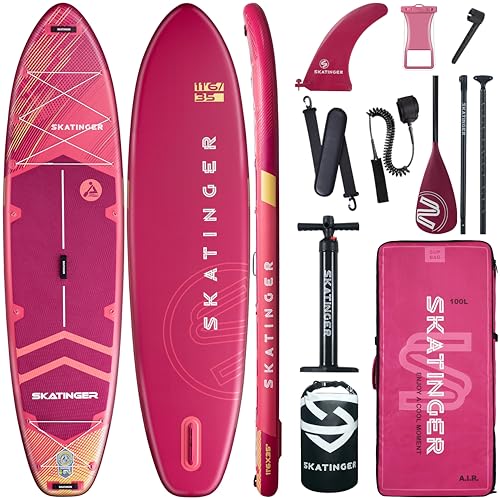
- Size11 ft 6 in x 35 in
- Capacity450 lb
- Fin10 in US box centre fin
- Handlesthree
- Backpack1680D heavy duty fabric
- Cargosix point front and four point rear bungee
- Extrasfour central D-rings for a kayak seat
Best for: Yoga plus a passenger, a dog or a child
Width is the crudest way to buy stability, and at thirty five inches it is also the most effective one.
The US box fin is worth noting because it is the standard fitting rather than a proprietary slot. That means a replacement is four dollars in a surf shop instead of a wait for the seller.
The central D-rings take a kayak seat, which is a useful second life for a board bought mainly for stretching.
Strengths
- Thirty five inches is as stable as inflatable boards get
- US box fin means you can swap in any aftermarket fin
- 450 lb capacity handles yoga with a second person aboard
- 1680D backpack rather than the usual thin nylon
Weaknesses
- Not a dedicated yoga shape, so the deck pad is partial
- Wide and long makes it slow to turn
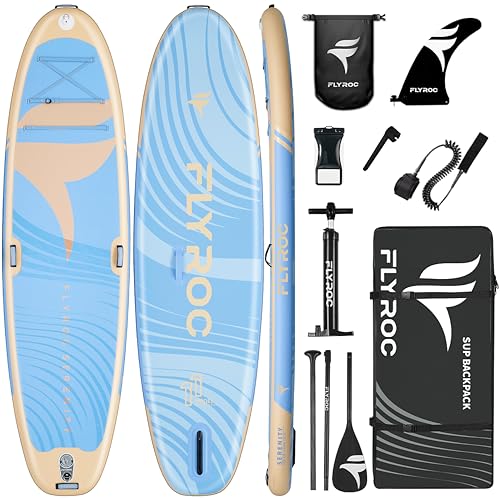
- Size11 ft x 35 in x 6 in
- Capacity430 lb
- Deck100 percent EVA coverage, up from the usual 60 percent
- Handlesfive, including two side handles
- Cargosix point DIY bungee system
- Includedsafety leash and accessory set
Best for: Yoga where you use the whole board, nose to tail
Sixty percent EVA coverage is the industry norm and it is fine for standing and paddling. It is useless the moment a hand or a knee lands on bare PVC at the nose.
Full coverage is the single upgrade that makes a general board usable for yoga, and it is rare below three hundred dollars.
The side handles are the other quiet win. Climbing back on after a fall is much easier with something to grab at the rail than at the centre.
Strengths
- Full deck coverage is the specification that matters most here
- Side handles help you get back on from the water
- Thirty five inches wide with 430 lb capacity
- Under two hundred dollars
Weaknesses
- Unfamiliar brand with limited support history
- Five handles means one of them is probably in your way

- Size11 ft x 35 in x 6 in
- Capacity430 lb
- Weight19.8 lb bundle
- Materialmarine grade PVC, sand, saltwater and UV resistant
- Fins9 in centre and two 7 in side, tool free
- Handlesthree
- Paddlethree piece adjustable aluminium
Best for: A wide stable board that one person can still carry easily
Wide boards are usually heavy boards, and weight is the reason a lot of equipment stops being used after the first summer.
Twenty pounds including the bundle means one trip from the car, which quietly decides how often you go.
UV resistance is the specification most cheap boards skip and the one that kills them. Even so, store it in the shade, and preferably on a wall rack rather than leaning in a corner.
Strengths
- Under twenty pounds for the whole bundle, which is remarkable at this width
- UV resistant PVC, so it survives being left out between sessions
- Tool free fins, so setup takes seconds
- Two hundred dollars for a 35 inch board
Weaknesses
- Partial deck pad rather than full coverage
- Aluminium paddle is heavy compared to the board
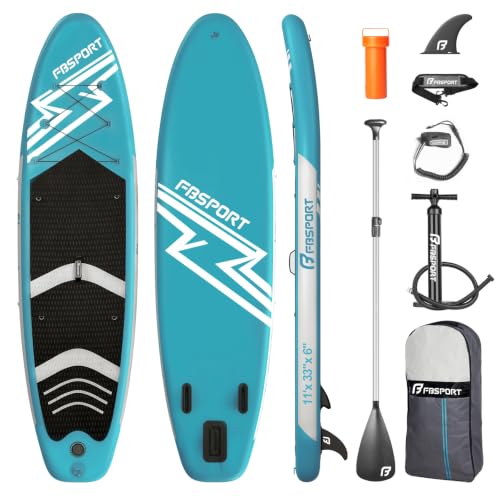
- Size11 ft x 33 in
- Capacity350 lb
- Pressure15 PSI
- Materialmilitary grade drop stitch
- Finsone removable large fin plus two fixed side fins
- Includedboard, alloy paddle, coiled leash, pump, carry bag
Best for: Trying board yoga without spending three hundred dollars
Thirty three inches is the width most yoga beginners actually need. The 35 inch boards are more forgiving standing still and noticeably more work to paddle anywhere.
Fixed side fins are a genuine trade-off rather than a fault: nothing to lose, but slightly more awkward to pack down flat.
At this price the pump is the weak point. Getting to a full 15 PSI is what makes the board feel firm under a pose, so consider an electric pump later.
Strengths
- Thirty three inches is stable without being sluggish to paddle
- Complete kit under a hundred and fifty dollars
- Fixed side fins cannot be lost, which suits beginners
- Well established seller with a long track record
Weaknesses
- 350 lb capacity is the lowest here
- Fixed side fins are a nuisance when rolling the board
- Width33 in extra wide
- Materialmilitary ultra light PVC drop stitch
- Deckadditional EVA at the nose
- Mountfitted action camera bracket
- Setup10 minutes to inflate, 5 to deflate
- Fittingssteel D-rings for towing and gear
Best for: A first yoga board, and one that tolerates a dog
Board yoga is a thing plenty of people try once and never repeat, and finding out for a hundred and thirty dollars is a reasonable way to answer the question.
The added nose foam is not marketing. It is the part of the deck your hands land on in half the standing poses, and most boards at any price leave it bare.
If a dog joins you, expect marks in the EVA whatever the listing says. Our dog board guide covers which decks survive claws best.
Strengths
- A hundred and thirty dollars, the cheapest here by a distance
- Extra nose foam is exactly what yoga needs and budget boards omit
- Camera mount fitted as standard
- Light enough for one person to carry comfortably
Weaknesses
- Cheapest construction here, so it needs full pressure to feel firm
- Pet friendly deck will still mark under claws over time
How to choose a yoga paddle board
Check where the handles are: A centre carry handle sits in the middle of the deck, which is where your hands go in most standing poses and where your spine goes lying down. Boards designed for yoga offset the handles or move them to the rails, and it is the clearest sign that a board was designed rather than relabelled.
Deck coverage, not just deck quality: The usual board pads about 60 percent of the deck, leaving bare PVC at the nose and tail. Yoga uses the whole board, so look for full coverage or at least extra foam at the nose.
Width buys forgiveness, length buys speed: Thirty three inches is the practical minimum and thirty five is very stable. Above that you gain little and lose a lot of glide, so if you also want to paddle, take the length rather than the extra inch of width.
Pressure decides how it feels underhand: A board at 12 PSI flexes under a plank in a way that feels alarming; the same board at 15 PSI feels solid. Whatever you buy, get it to its rated pressure, and treat the supplied pump as the first thing you will replace.
Bring an anchor for anything but a flat calm: Yoga is not compatible with drifting towards a jetty with your eyes closed. A small anchor or a tether to a mooring keeps you in one place, and it is the accessory that turns a nice idea into an actual practice.
Frequently asked questions
Do I really need a dedicated yoga board?
No, but the differences are real: full deck coverage, offset handles and a widened nose and tail. Any 33 inch or wider board works on flat water, and you will simply place your hands around the centre handle and accept a bare patch at the nose.How wide should a yoga paddle board be?
Thirty three inches for most people, thirty five if you are taller, heavier or nervous about balance. Below 32 inches the board reacts to every weight shift, and above 35 you are paddling a raft for very little extra stability.Should I anchor the board?
On anything other than a still pond, yes. Wind moves a wide board quickly and you will not notice with your eyes closed. A small folding anchor or a line to a dock costs about thirty dollars and makes the whole thing workable.Is an inflatable or a hard board better for yoga?
Inflatable, almost always. The surface is softer to land on, the board is thicker and floats higher, and the deck pad is more forgiving on knees and hands. Hard boards are faster to paddle and much less pleasant to fall on.Bottom line
If yoga is the reason you are buying a board, the THURSO Tranquility is the one built around that, from the offset handles to the mat-like deck, and its stiffer core is what keeps a pose feeling steady. For most people the Retrospec Weekender Yogi is the more sensible spend, since it is a dedicated yoga shape at half the weight of a normal wide board and it arrives with everything you need.
And if you are simply curious, the DAMA answers the question for a hundred and thirty dollars, with the nose foam that most cheap boards leave out. Whichever you choose, inflate it fully and bring something to stop it drifting.


