

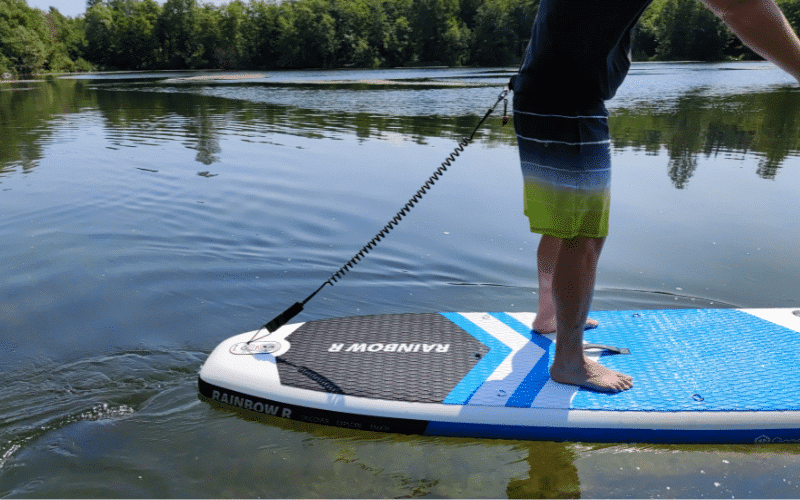
A leash keeps your board within reach when you fall, and on open water that board is your flotation and your ride home.
The reason to wear it at the waist rather than the ankle is moving water. A leash tied to your ankle in current can hold you under, and you cannot reach the cuff to release it.
A waist leash puts the release buckle at your hands. One pull and you are free of the board, which is the whole point of the design.
We compared nine, from a nine dollar belt and coil set to a sixty dollar rescue leash built for whitewater.

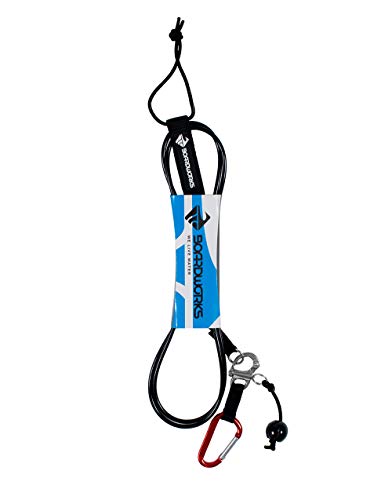

The best SUP waist leashes at a glance
| Leash | Release | Cord | Standout feature |
|---|---|---|---|
| NRS Quick-Release SUP LeashTop pick | Belt or PFD shackle | Coiled, stretches to 9 ft | Stainless D-ring so you choose the hardware |
| Boardworks Whitewater QRBest premium | Quick release | 11 ft urethane | Overmolded ends and a triple velcro rail saver |
| Bassadoro QR Waist BeltBest for rivers | Buckle at the waist | 10 ft TPU coil | Abrasion resistant cord that resists snagging |
| sporful QR Waist BeltBest mid-range | Pull buckle | 10 ft coil | Nylon and TPU blend with three belt loops |
| BPS Storm Coiled LeashBest cord | Quick-release tab | 10 ft coiled | Triple rail savers and double swivels |
| DimyFew Elastic Waist LeashBest for foil and surf | Belt buckle | 10 ft coiled | Strap-type connector, works on hydrofoils |
| ORiver SUP Waist LeashBest belt alone | Buckle at the waist | Use your own coil | Back loops take any existing ankle cuff |
| kowaku Waist Belt LeashBest belt build | Fast-detach buckle | Use your own coil | 2.5 in 900D nylon, trimmable to length |
| QR Belt with 10 ft TPU CoilBest value | Push-button clasp | 10 ft TPU coil | Neoprene waist pad at 9 dollars |
The nine picks in detail
- Cordcoiled, stretches to 9 ft
- Swivelstwo in-line
- Hardwarestainless steel D-ring at the leash end
- PFD usecarabiner through the leash D-ring and the belt D-ring of a rescue PFD
- Board attachmenthook-and-loop through a D-ring on inflatables
- Hard boardslanyard included for the leash plug
- BrandNRS
Best for: Anyone who paddles moving water or wears a rescue PFD
The difference between a quick release and a rescue release is where the load goes. A rescue PFD belt releases under tension, and a plastic buckle at your hip may not.
Attaching to the PFD belt means the pull tab sits exactly where your hand goes in a panic, and it is a tab you have already practised finding.
Pair it with the right vest. Our life vest guide covers which models have a releasable belt.
Strengths
- Designed around a rescue PFD belt, which is how release should actually work
- A stainless D-ring, so you pick your own attachment hardware
- Two in-line swivels, which is what stops a coil kinking
- NRS build quality, tested by whitewater guides
Weaknesses
- Sixty dollars, several times the price of a basic waist leash
- Needs a rescue PFD with a belt to reach its full potential
- Length11 ft
- Cordsolid urethane
- Swivelsstainless steel, corrosion resistant
- Cuffneoprene padded hook and loop with a pull tab
- Endsovermolded for extra strength
- Rail savertriple velcro wrap
- Usewhitewater and open water
Best for: Paddlers who load a leash hard and often
Leashes fail at the joins, not in the middle of the cord, which is why overmolded ends matter more than the thickness number in the title.
The triple rail saver is the other detail worth paying for. A single narrow saver concentrates load on one point of the board fitting.
Buy it as the cord and pair it with a waist belt such as the ORiver if you want a waist setup with premium hardware.
Strengths
- Overmolded ends, which is where cheap leashes tear apart
- Stainless swivels that survive salt water for years
- A triple velcro rail saver spreads load over the board fitting
- A padded cuff with a pull tab, so release is one motion
Weaknesses
- Fifty dollars
- The cuff is a leg cuff, so a separate waist belt is needed for waist mounting

- Releasequick-release buckle for instant detachment
- Fitthree belt loops for adjustment
- Cord10 ft coiled TPU, abrasion resistant
- Dragcoil stays close to the body
- Includedfoot rope to prevent loss
- Webbingpremium nylon with an ergonomic strap
- Useriver paddling, touring and canals
Best for: Rivers, canals and anywhere with rocks and weed
River paddling is where a waist leash stops being a preference and becomes the safety equipment, because a leash caught on a branch in current is the classic accident.
A tight coil is not a comfort feature in that setting. A cord trailing in the water is the thing that hooks on submerged obstacles.
Practise the release on flat water before you need it. The buckle has to be muscle memory.
Strengths
- Abrasion resistant cord, which matters on rock and gravel
- The coil stays high and does not snag submerged branches
- Three belt loops means it fits over a wetsuit as well as skin
- Around thirty dollars for a complete setup
Weaknesses
- A plastic buckle rather than rescue-grade hardware
- Nylon webbing takes longer to dry than neoprene

- Releasepull the buckle to detach
- Fitthree belt loops, most waist sizes
- Cord10 ft coiled
- Materialnylon and TPU blend
- Includedfoot rope to prevent loss
- Usersadults and teens
- Weightlightweight
Best for: A first proper waist leash for open water
This is the sensible middle of the market. It does the job properly without the price of a rescue leash you may never need.
Fit matters more than people expect. A belt that rides up sits above your reach and the release is no longer instant.
Wear it with the buckle at the front, always. A belt spun round so the buckle is at your back defeats the whole design.
Strengths
- A complete belt and coil set at under thirty dollars
- The nylon and TPU blend is tougher than plain TPU on its own
- Three belt loops for a genuine fit rather than a rough one
- Light enough that you stop noticing it
Weaknesses
- Nothing here is rescue-rated hardware
- The foot rope backup suggests the buckle can open unintentionally

- Length10 ft coiled
- Cuffpadded neoprene with a key pocket and a quick-release tab
- Swivelsdouble, no tangling
- Rail saverstriple
- Coiltight, so it does not drag or snag
- Guaranteereplacement guarantee from the brand
- ColourKoru dark blue
Best for: Replacing a cord to pair with a waist belt you already own
Swivels are the part that decides whether a coiled leash lasts a season or turns into a twisted rope by August.
The key pocket in the cuff solves the problem of what to do with a car key when you paddle alone, which is otherwise a real nuisance.
Clip the cuff through the back loops of a belt like the ORiver and you have a waist setup with better hardware than most complete sets.
Strengths
- Double swivels, the single best predictor of a leash that stays untangled
- A key pocket in the cuff, which is genuinely useful
- Triple rail savers spread the load at the board end
- Twenty three dollars for premium hardware
Weaknesses
- Sold as an ankle leash, so you supply the waist belt
- The cuff adds bulk if you clip it to a belt loop

- Lengthextends to 10 ft
- Coilstays compact and out of the water
- Beltadjustable, dark colour
- Connectorstrap-type attachment hardware
- Usestand up paddling, surf and hydrofoil
- Movementunrestricted while paddling
- Colourblack
Best for: Surf and foil sessions where an ankle leash gets in the way
Foiling changes the leash question. A cord in the water near a foil mast is a hazard the ankle setup makes worse.
An elastic belt is the right answer for surf too, because a rigid webbing belt digs in every time you go over the front.
Check the board end connector fits your leash plug before your first session. Strap connectors vary more than they should.
Strengths
- Explicitly rated for hydrofoil use, which most SUP leashes are not
- The coil rides high and clear of the water
- An elastic belt moves with you rather than digging in
- Twenty three dollars for the pair
Weaknesses
- The product description is vague about materials
- No rescue-grade release hardware

- Releasebuckle at the waist, single pull
- Compatibilityback loops take any existing ankle cuff
- Fitsoft polyester strap, waists up to 36 in
- Bucklehigh strength PE, saltwater and UV resistant
- UseSUP, kayak and surf
- Typebelt only, bring your own coil
- Pricearound 18 dollars
Best for: Converting the leash you already have to a waist setup
Most people already own a leash. What they lack is the belt, and buying a whole new set to get one is wasteful.
The back loops take a standard neoprene cuff, which is how nearly every leash on the market terminates.
Check the waist range honestly. Thirty six inches is measured over clothing, not over a winter touring layer.
Strengths
- Turns any ankle leash into a waist leash, which saves buying twice
- A PE buckle that resists salt and sun rather than going brittle
- Comfortable enough to wear over a wetsuit or bare skin
- Eighteen dollars
Weaknesses
- Fits waists up to 36 in only
- No cord included, so it is not a complete solution

- Length140 cm
- Width5 cm belt, 2.5 in strap
- Material900D nylon with reinforced stitching
- Releasefast-detach buckle
- Adjustmentextra strap can be trimmed
- Loaddistributes tension evenly
- Compatibilitystandard paddleboard tether setups
Best for: A belt that will outlast several cords
Belt webbing is where the cheapest sets save money, and thin webbing under a loaded leash folds into a cord that cuts.
Nine hundred denier is the specification to look for, and it is unusual at eleven dollars.
Cut the tail only after several sessions. What feels right over bare skin is too short over a wetsuit.
Strengths
- 900D nylon, a genuinely heavy webbing for the price
- Trimmable, so the loose tail does not flap for years
- Two and a half inch width spreads load instead of cutting in
- Eleven dollars
Weaknesses
- Belt only, no cord included
- Trimming the strap means the fit is permanent
- Beltadjustable to 44.5 in circumference
- Releasepush-button quick release clasp
- CordTPU spring coil, stretches to 10 ft
- Paddingneoprene waist pad, 44.5 x 2.0 x 0.2 in
- SuitsSUP, surfboards, longboards, fish boards and skimboards
- Conditionsflat water and small to medium waves
- Coil diameter0.24 in
Best for: A first waist leash, or a spare for a guest board
At nine dollars the comparison is not against the NRS, it is against paddling with no leash at all, which is what a lot of people do.
The neoprene pad is the surprise inclusion. That pad is the difference between a belt you wear and one you leave in the bag.
Keep it for flat water and small waves. In real surf or current, spend the money on hardware built for load. Match the length to your board, as covered in our board guide.
Strengths
- A complete belt and coil set for under ten dollars
- A neoprene pad, which several thirty dollar sets leave out
- Fits waists to 44.5 in, the widest range here
- A push-button clasp is faster than a pull buckle
Weaknesses
- TPU alone is less abrasion resistant than a nylon blend
- Not intended for large surf
How to choose a SUP waist leash
Put the release where your hand goes: The entire argument for a waist leash is that you can reach the buckle while being pulled by the board. Wear the buckle at the front and practise finding it with your eyes shut before you rely on it.
Match the cord to the water: A coiled cord stays out of the water and is right for flat water, touring and rivers. A straight cord is what surfers use, because a coil under wave load snaps back at you. Choose the coil unless you are actually surfing.
Count the swivels: Two swivels, one at each end, is what keeps a coiled leash from turning into a twisted rope. This is the specification cheap leashes drop first and it decides how the leash feels in month six.
Length equal to the board, or slightly more: A leash shorter than the board pulls it back onto you when you fall. Ten feet suits most boards up to about eleven feet, and longer touring boards want eleven or twelve.
Understand what a leash cannot do: It keeps your board close, it is not a buoyancy aid and it will not help you in a rip current beyond keeping the board within reach. A leash plus a PFD is the combination that actually works.
Frequently asked questions
Is a waist leash safer than an ankle leash?
In moving water, clearly yes, because you can reach the release. On flat lake water the difference is small, and many paddlers use an ankle leash without problems. On any river, in current or in tidal water, wear the leash at the waist.Should I wear a leash at all in a river?
Only a quick-release one, worn at the waist. A fixed leash in current is a genuine drowning hazard, because the board catches the flow and holds you down. Some whitewater paddlers choose no leash over a fixed leash for exactly that reason.Coiled or straight cord?
Coiled for paddling, straight for surf. A coil stays out of the water so it does not drag or snag, but under wave load it stretches and recoils hard. If you are riding waves, use a straight cord of the correct length.How long does a leash last?
Two to four seasons of regular use. Urethane hardens with UV, and the failure point is the join at the cuff or the rail saver. Check both ends for cracking at the start of each season and replace the cord rather than the whole set.Bottom line
The NRS is the pick because it is the only leash here designed around the way a release actually has to work, which is a shackle on the belt of a rescue PFD where your hand can find it under load.
If you already own a leash, the ORiver belt at eighteen dollars converts it to a waist setup for a fraction of the price of a new one. And if you currently paddle with nothing, the nine dollar belt and coil is a better purchase than anything else on this page, because the leash you own beats the leash you meant to buy.


