


A race board is defined by two numbers: length and width. Fourteen feet is the standard racing class, twelve feet six is the shorter one, and the width tells you how hard the board will be to stand on.
Twenty eight inches is a fast touring width that most competent paddlers can handle. Twenty five is a step beyond that. Twenty three inches is a genuine race hull and it will put you in the water while you learn it.
Everything else follows from the shape. A pointed displacement nose, a raised tail kick pad for step-back turns, a single long fin and a deck that grips when you sprint.
We compared eight race boards and the one paddle upgrade that makes more difference than any of them.


The best race paddle boards at a glance
| Board | Size | Construction | Standout feature |
|---|---|---|---|
| Beyond Marina 14 ft EliteTop pick | 14 ft x 23 in | Woven core, welded rails | Carbon stringers on deck and bottom |
| Zray R2 Rapid DualBest premium | 14 ft x 28 in | Double layer outer skin | A 397 lb maximum weight |
| Beyond Marina 14 ft x 25 inBest 14 ft all-round | 14 ft x 25 in | Woven core, welded rails | Twin 8.85 in stringers |
| FunWater 14 ft RaceBest kit | 14 ft x 26 in | V-cutting nose | A 750 g four-piece carbon paddle included |
| Beyond Marina 12.5 ft x 25 inBest 12 ft 6 | 12 ft 6 x 25 in | Dual core, welded rail bands | Kayak-inspired slim tail |
| Beyond Marina 12.5 ft x 23 inNarrowest 12 ft 6 | 12 ft 6 x 23 in | Dual core, welded rail bands | 20 PSI with the included pump |
| SereneLife 14 ft Racing, upgraded kitBest complete package | 14 ft x 28 in | Single layer core, double layer sides | GoPro mount and full accessory kit |
| SereneLife 14 ft RacingBest value | 14 ft x 28 in | Single layer core, double layer sides | 13 PSI and a pointed nose at 255 dollars |
| Full Carbon 3-Piece SUP PaddleBest upgrade | 68 to 84 in | Full carbon shaft and blade | Anti-twist channel system |
The nine picks in detail
- Size14 ft x 23 in
- Corepremium woven drop stitch
- Railswelded
- Stiffeningcarbon stringers on the deck plus a carbon bottom stringer
- Finremovable US centre fin
- Includedadjustable paddle, dual-swivel coiled leash, phone pouch, repair kit, GoPro mount
- Forexperienced racers and endurance paddlers
Best for: Competitive paddlers who already know how to balance
A fourteen foot inflatable wants to bend in the middle, and stringers are the answer. Carbon ones on both surfaces make this hull behave like a hard board.
Width is the honest warning. If your current board is thirty two inches, twenty three will feel like standing on a plank for the first several sessions.
Everything in the kit is race specific, down to the dual-swivel leash that does not wrap round your ankle when you turn.
Strengths
- Twenty three inches, a real race width rather than a marketing one
- Carbon stringers top and bottom, which is what stops a 14 ft hull hinging
- Woven core and welded rails, the construction the premium brands use
- Seven hundred dollars for a hull that competes with far dearer boards
Weaknesses
- Twenty three inches is genuinely difficult in chop
- No use at all as a casual board
- Size14 ft x 28 in
- Capacity397 lb
- Skinpremium double layer outer
- Deckslip resistant stripe EVA traction pad
- Includedadjustable paddle, closing belt, pump, backpack, repair kit
- Age14 and up
- Useracing and fast distance
Best for: Heavier paddlers and anyone racing with gear aboard
Most race boards are built for a lean paddler and nothing else, and this one is not. The extra capacity means it still floats properly at race trim with a heavier rider.
Twenty eight inches is the width where a fast board stays usable in wind and small chop, which matters over a long course.
Zray's shorter R1 sits in our professional board guide if fourteen feet is more than you want to carry.
Strengths
- A 397 lb capacity, far above most race hulls
- Double layer skin, which shrugs off the knocks a race board takes
- Twenty eight inches, fast but still learnable
- Heavy duty build throughout
Weaknesses
- Twelve hundred dollars
- Twenty eight inches gives away speed to a 23 in hull

- Size14 ft x 25 in
- Corewoven drop stitch
- Railswelded
- Stiffeningtwo centre 8.85 in stringers
- Deck5 mm EVA crocodile diamond traction pad
- Tailraised kick pad for step-back turns
- IncludedUS centre fin, 3-piece paddle, dual-swivel coiled leash, phone pouch, repair kit
Best for: Racing and long distance without the 23 in penalty
This is the board most people who think they want the Elite should actually buy, because two extra inches of width is the difference between racing and swimming.
The kick pad is the feature casual boards never have. Racing means turning round buoys, and you cannot do that from the middle of the board.
Fourteen feet at twenty five inches is also an excellent long distance touring hull, which the narrower Elite is not.
Strengths
- Twenty five inches, the width most club racers actually settle on
- The same welded, woven construction as the Elite
- A raised tail pad, which makes step-back turns possible
- Five hundred dollars
Weaknesses
- Still far too narrow for casual paddling
- Twin stringers are stiff but not carbon

- Size14 ft x 26 in
- Nosesharp V-cutting displacement nose
- Fin9 in removable
- Tailraised traction kick pad
- Paddle4-piece carbon, 750 g, 40 percent lighter than aluminium
- Handlescentre carry plus rear towing handle
- Includeddeluxe backpack with side pockets and padded panel
Best for: A complete race setup in one purchase
The included carbon paddle changes the arithmetic completely, because a race board with an aluminium paddle is only half a race setup.
Seven hundred and fifty grams is proper race paddle weight, and over ten thousand strokes it is worth more than any hull refinement here.
A V-shaped displacement nose is what separates a race hull from a pointed all-around board, and this one has a real one.
Strengths
- A 750 g carbon paddle included, worth well over a hundred dollars alone
- Twenty six inches splits the difference between fast and manageable
- A rear towing handle, which is genuinely useful launching from shore
- Four hundred dollars for board and carbon paddle
Weaknesses
- Single fin only
- FunWater is a value brand rather than a race specialist
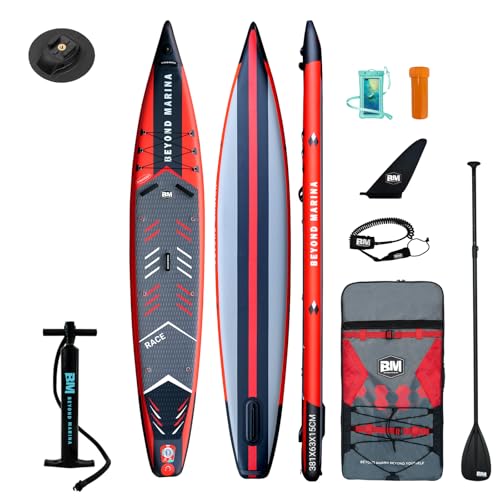
- Size12 ft 6 x 25 in
- Constructiondual core with welded rail bands
- Tailkayak-inspired slim tail
- Stiffeningtwin centre stringers
- Deck5 mm diamond and crocodile textured EVA with a standing tray
- Handlesfour, for launching, sprinting and portage
- Includeddual action pump to 20 PSI, adjustable paddle, backpack
- D-ringssix reinforced
Best for: The 12 ft 6 race class, or a shorter board to store
Twelve foot six is its own race class, and outside racing it is the length that fits in a normal car and a normal garage.
Twenty PSI is the specification worth noting. At that pressure a twelve six board barely flexes at all.
The four handles are a race detail: one for the beach start, one for sprint carries and one for portaging between waters.
Strengths
- Four handles, which sounds trivial until you portage a race board
- Twenty PSI inflation, higher than most inflatables manage
- A standing tray marked on the deck, so your feet find the same spot
- Twelve six is far easier to store and transport than fourteen
Weaknesses
- Shorter hulls give away speed on flat water
- Six D-rings is few if you also tour on it
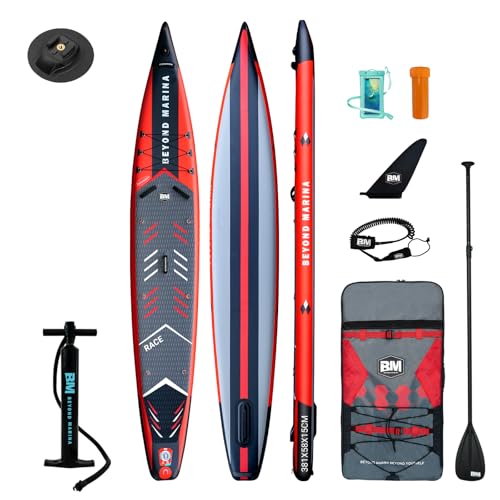
- Size12 ft 6 x 23 in
- Constructiondual core, Welding Tech rail bands
- Tailkayak-inspired slim tail
- Stiffeningtwin centre stringers
- MountFCS GoPro and phone mount
- Deck5 mm textured EVA with non-slip standing tray
- Includeddual action pump to 20 PSI, paddle, padded backpack
Best for: Sprint racing and technical courses
Short and narrow is the technical racing combination, quick to accelerate and quick to turn, and unforgiving of a lazy stance.
If you race courses with buoys rather than straight lines, this shape rewards you more than a fourteen footer does.
Start on flat water with no wind. Twenty three inches at twelve six is less forgiving than the same width at fourteen feet.
Strengths
- Twenty three inches on a shorter hull, which turns far quicker than a 14 ft
- Three hundred and thirty dollars, the cheapest true race width here
- The FCS mount takes a camera or a phone properly
- Same 20 PSI construction as the wider version
Weaknesses
- The hardest board here to stand on
- Short and narrow means very little carrying capacity
- Size14 ft x 28 in
- Nosepointed racing nose
- Pressure13 PSI
- Constructionsingle layer drop stitch core with double layer sides
- Included3-piece aluminium paddle, safety leash, removable fin, repair kit, GoPro mount, backpack
- SupportUSA-based servicing
- Uselong distance racing
Best for: A first race board with everything in the box
Thirteen PSI on a fourteen foot board is the limitation to understand, because a long hull at low pressure gives back some of what its length earns.
For a first race board that matters less than it sounds. You are learning the stance and the stroke, not shaving seconds.
Replace the aluminium paddle early. It is the cheapest large improvement available on this board.
Strengths
- A complete kit, nothing else needed to start
- Twenty eight inches, the most forgiving race width
- SereneLife has real US support behind it
- Three hundred and twenty five dollars
Weaknesses
- Single layer core, so it is softer than the woven boards
- Thirteen PSI is low for a 14 ft hull
- Size14 ft x 28 in
- Nosepointed for glide
- Pressure13 PSI
- Constructionsingle layer core, double layer sides
- Finremovable
- Included3-piece aluminium paddle, leash, repair kit, GoPro mount, backpack
- Pumpdouble action hand pump
Best for: Finding out whether you like racing before spending real money
Racing is a commitment of training more than of money, and this board lets you find out which side of that you fall on for the price of a decent paddle.
The hull shape is right even if the construction is not premium, and hull shape is most of what makes a race board feel different.
If you stick with it, the money saved here buys the carbon paddle below, which is the better order to do it in.
Strengths
- Two hundred and fifty five dollars for a genuine 14 ft hull
- Double layer sides, where a race board scrapes
- Twenty eight inches, learnable in a couple of sessions
- Complete kit including a camera mount
Weaknesses
- The softest board here
- Aluminium paddle on a board about efficiency

- Constructionfull carbon handle, shaft and blade
- Adjustment68 to 84 in, for paddlers over 5 ft
- Setupunder 30 seconds
- Featureanti-twist channel system
- Buoyancyfloats
- Includednylon paddle bag with a waterproof lining
- Bladehydrodynamic profile
Best for: Anyone who bought a race board with an aluminium paddle
Over a fourteen kilometre race you take somewhere around six thousand strokes, and a pound of paddle weight is felt in every one of them.
The anti-twist channel is the detail that separates a good adjustable paddle from a cheap one, because a shaft that rotates under load wastes part of every stroke.
Buy this before upgrading from a two hundred and fifty dollar board to a five hundred dollar one. The improvement is larger and the cost is lower. Our paddle guide covers the alternatives.
Strengths
- Full carbon, not a carbon shaft with a plastic blade
- The anti-twist system removes the usual 3-piece wobble
- It floats, which no aluminium paddle does
- A paddle bag included
Weaknesses
- A hundred and sixty nine dollars
- Three pieces are never quite as stiff as a fixed shaft
How to choose a race paddle board
Pick the width you can actually stand on: Twenty eight inches suits most paddlers moving up from an all-around board, twenty five is a serious step, and twenty three is for people who train. A board you fall off is slower than a wider one you stay on, whatever the hull promises.
Fourteen feet or twelve feet six: These are the two established racing classes, so check what your local events run before choosing. Fourteen is faster on flat water and twelve six turns better and fits in a car more easily.
Look for stringers and welded rails: A long inflatable hinges in the middle unless something stops it. Carbon or reinforced stringers plus welded rails are what let a fourteen foot inflatable hold a straight line at 20 PSI.
Check for a tail kick pad: Racing means step-back turns, and you cannot make them from a flat deck. A raised, textured pad at the tail tells you the board was designed by someone who has actually raced.
Spend on the paddle before the hull: A seven hundred gram carbon paddle against a two kilogram aluminium one is the single largest improvement available in the sport, and it costs a fraction of the difference between a good board and a great one.
Frequently asked questions
Can an inflatable really race against a hard board?
In its own class, yes, and inflatable race divisions exist at most events. Against a carbon hard board on flat water, no. A rigid hull is still faster, and always will be.How much faster is a race board?
On flat water expect roughly one to two kilometres per hour more than an all-around board at the same effort, which is a large margin over a ten kilometre course. Most of that comes from waterline length and reduced width.What pressure should a race board run?
As high as the board allows, usually 18 to 20 PSI. Under-inflating a race hull by even two PSI reintroduces exactly the flex the stringers were added to prevent.Do I need a special fin?
A single long race fin is standard, and it tracks far better than a three fin setup. On weedy water, a swept-back weed fin saves you stopping to clear the fin every few hundred metres.Bottom line
The Beyond Marina 14 ft Elite is the pick for anyone actually racing. Carbon stringers on both surfaces, welded rails and a genuine twenty three inch width, at a price that undercuts the specialist race brands by a wide margin.
Most people should buy the 25 inch version instead, or start with the SereneLife at two hundred and fifty five dollars and put the difference into the carbon paddle. Racing rewards a light paddle and consistent training long before it rewards two inches less width.


