

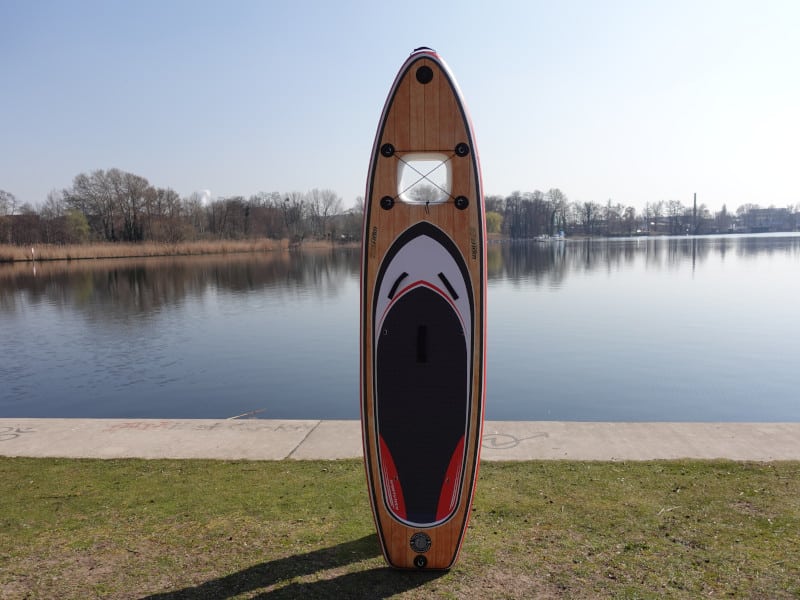
A viewing window is a clear panel set into the deck of the board, so you look straight down through the hull at whatever is underneath you.
In clear water over a reef, a wreck or a weed bed it is genuinely worth having. In green lake water it is a novelty, and you should know which one you are buying for.
The category is small. Only a handful of makers build a window into an inflatable, and beyond those there are clear hulled kayaks and simple viewers that do the same job for far less.
We compared nine ways to see under your board, from a hundred and seventy dollar inflatable to a fully transparent hard board.



The best window paddle boards at a glance
| Product | Type | Size | Standout feature |
|---|---|---|---|
| Hydro-Force PanoramaTop pick | Inflatable SUP | 11 ft 2 x 35 in | Touring shape with a built-in window |
| Hydro-Force Breeze PanoramaBest window design | Inflatable SUP | 10 ft | Window with a sealable cover |
| SereneLife 10 ft 6 Window SUPBest value | Inflatable SUP | 10 ft 6 x 32 in | 13 PSI, GoPro mount, full kit |
| SereneLife Window SUP, youthBest for families | Inflatable SUP | 10 ft 6 x 32 in | Same hull, youth and adult kit |
| Everich Clear Polycarbonate SUPFully transparent | Hard board | 10 ft | The whole hull is clear, not a panel |
| Aktivety Clear KayakBest clear kayak | Inflatable kayak | 1 or 2 person | Transparent hull for 200 dollars |
| Clear Touring Kayak, 2 adultBest hard clear hull | Hard kayak | 340 x 90 cm | Polycarbonate hull, 100 percent see-through |
| Reef Tourer Viewing BucketCheapest way | Viewer | Handheld | Fits a phone inside for filming |
| Nuova Rade Aqua ScopeBest viewer | Viewer | 33.5 x 51 cm | Tempered glass bottom, splits into three parts |
The nine picks in detail
- Inflated size11 ft 2 x 35 in x 6 in
- Typelong touring shape
- MaterialTritech, UV resistant marine grade
- Constructiondrop stitch
- Windowbuilt into the deck
- Decklarge non-slip traction pad
- Includedpaddle, hand pump, backpack, coiled leash, centre fin, repair kit
Best for: Paddlers who want a proper board that happens to have a window
The mistake with window boards is buying a poor board because it has a clever feature, and this is the one that avoids it.
Length and width matter more than the window does, because you need to stand still and look down without wobbling.
Bestway's Hydro-Force line is widely stocked and easy to get parts for, which is not true of the boutique clear boards.
Strengths
- A genuine touring shape, so it is worth paddling even with the window ignored
- Thirty five inches wide, which is stable enough to stand still and look down
- Tritech UV resistant material rather than plain PVC
- A complete set at under five hundred dollars
Weaknesses
- Eleven feet two is a lot of board to carry
- Only a single centre fin

- Inflated size3.05 m x 84 cm
- Windowbuilt in, with a sealable cover
- Constructiondrop stitch
- Decknon-slip traction pad
- Paddleadjustable, converts to a double bladed oar
- Includedhand pump, backpack, coiled leash, fin, repair kit
- Useflat water and small waves
Best for: Paddlers who want the window only when the water is worth looking at
The cover is the detail worth understanding. On murky water a window is simply a bright spot you keep looking at, and closing it off removes the distraction.
It also protects the panel, which is the part most likely to scratch and cloud over a few seasons.
The convertible paddle makes sense here, because looking down works far better sitting than standing.
Strengths
- The window cover is the one feature everything else here lacks
- A paddle that converts to a kayak oar, so it doubles as a sit-down board
- Ten feet is far easier to handle than the 11 ft 2 Panorama
- Same Hydro-Force build
Weaknesses
- More expensive than the longer Panorama
- Ten feet tracks less well over distance
- Size10 ft 6 x 32 in
- Windowbuilt-in viewing panel
- Pressure13 PSI
- Constructionsingle layer drop stitch core, double welded seams
- Finsthree bottom fins
- MountGoPro mount included
- Included3-piece aluminium paddle, leash, fin, repair kit, backpack
Best for: Trying a window board without spending five hundred dollars
This is the board that makes the category affordable, and it is the one to buy if the window is the whole point rather than a bonus.
Thirteen PSI on a single layer board is a firm enough platform for standing still and watching, which is the use case.
The camera mount is well judged, because filming through the window is what most people do after the first ten minutes.
Strengths
- A hundred and seventy dollars, less than a third of the Hydro-Force
- Three fins, which tracks better than the single fin boards above
- GoPro mount fitted, which is what most window buyers want anyway
- Double welded seams
Weaknesses
- Single layer construction, so it flexes more
- Aluminium paddle
- Size10 ft 6 x 32 in
- Windowbuilt-in viewing panel
- Pressure13 PSI
- Decknon-slip EVA pad
- Constructiondouble welded seams
- Finsthree removable
- Includedadjustable paddle, leash, repair kit, mount, backpack
- Usersyouth and adults
Best for: One board shared between a parent and an older child
Children are the real audience for a window, and they will happily lie on the deck watching the bottom go past for an hour.
Because it is the same hull as the cheaper listing, choose between them on colour and kit rather than performance.
Pair it with a properly sized buoyancy aid before anyone under twelve gets on it.
Strengths
- The same hull as the pick above, in a kit aimed at mixed users
- Thirty two inches wide, stable for a child to kneel and look down
- Three fins for straight tracking
- Under two hundred dollars
Weaknesses
- Twenty five dollars more for essentially the same board
- Same single layer construction

- Length10 ft
- Materialpolycarbonate
- Typehard board, not inflatable
- Transparencythe entire hull
- Storageneeds rack or roof space
- Weightheavy for the size
- Usecalm clear water
Best for: Rental operators and anyone who wants the photograph
This is the version people picture when they hear about clear boards, and it is priced accordingly.
It makes commercial sense for a rental operation on clear water, and very little sense for a private buyer with a garage and a car roof.
Clear hulls also scratch, and a scratched polycarbonate deck goes cloudy in a way a scratched PVC one does not.
Strengths
- The whole board is clear, so there is no small panel to look through
- Polycarbonate is far tougher than acrylic
- Nothing else looks like it on the water
- A hard board, so it is completely rigid
Weaknesses
- Two thousand two hundred dollars
- Heavy, fragile at the edges and impossible to pack down

- Typeinflatable kayak
- Seats1 or 2, adjustable
- Hulltransparent
- Included2 paddles, 2 seats, double action pump, carry bag, tracking fin
- Setupinflates in minutes, packs into a trunk
- Usecalm lakes and scenic touring
- Pricearound 200 dollars
Best for: Seeing under the water while sitting rather than standing
Sitting is the better position for looking down, and a clear kayak gives you far more viewing area than any deck panel.
At two hundred dollars it undercuts every window board here while showing more of the water.
Keep it out of the sun when not in use. Clear PVC yellows quickly, and once it does the whole point is gone.
Strengths
- Two hundred dollars for a transparent hull, which is remarkable
- Packs down, unlike every hard clear boat
- Solo or tandem seating from the same kit
- Tracking fin included
Weaknesses
- A kayak, not a paddle board
- Clear PVC clouds faster than the coloured kind
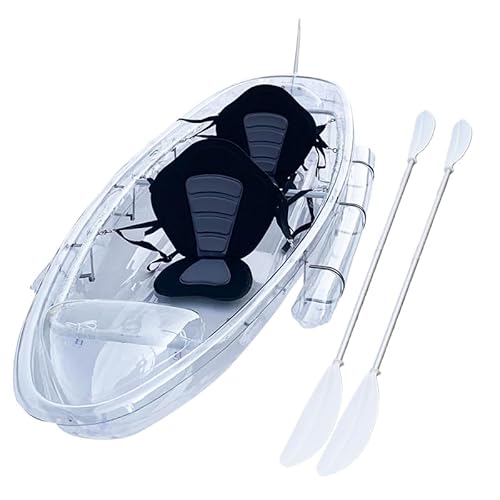
- Hullpolycarbonate
- Frame and paddlesaluminium
- Size340 x 90 x 35 cm
- Weight61.7 lb
- Includedframe with beam, 2 paddles, 2 seats, 2 flotation bags
- Transparencyvisible from inside and out
- Usecreeks, rivers, lakes, bays and springs, not open ocean
Best for: Springs and clear rivers where the whole point is looking down
On a Florida spring or a clear alpine lake this is a different experience from a window panel, because the whole floor is the window.
Polycarbonate holds its clarity far better than the clear PVC on the inflatable, which is most of what the extra money buys.
Take the maker at their word about the ocean. It is a flat water boat.
Strengths
- Polycarbonate rather than PVC, so it stays clear for years
- Two proper foam seats and flotation bags included
- The clearest view of anything here
- Breaks down onto a frame for transport
Weaknesses
- Fourteen hundred dollars
- Sixty two pounds and explicitly not for the ocean
- Typehandheld aquascope
- Lenspolycarbonate
- Extrafits a phone or camera inside for filming
- Agesuitable from 3 and up
- Handlestwo, with holes for a rope
- Usefrom a board, a kayak, a dock or the shallows
- Pricearound 30 dollars
Best for: Anyone who already owns a board
Before buying a board around a window, be honest about how often you would use it. A thirty dollar bucket answers that question for the price of lunch.
It also works better than a deck panel, because you can point it at what you want to see rather than at whatever is directly below.
Tie it on. It floats, but it drifts faster than you can paddle after it.
Strengths
- Thirty dollars against several hundred for a window hull
- Works from any board, kayak or dock
- A phone fits inside, so you can film through it
- Nothing to store and nothing to scratch
Weaknesses
- One person looks at a time
- You have to stop paddling and lean over

- Bodyhigh quality PVC
- Lenstempered glass bottom
- Gripsurrounding grip and soft rubber eyepiece
- Size33.5 cm diameter, 51 cm tall
- Assemblysplits into three pieces
- Usesea, lake and river, checking anchors and traps
- Pricearound 90 dollars
Best for: Serious looking rather than casual glancing
The extra length is what makes this the better viewer, because it reaches below the ripples that ruin the view through a shallower scope.
Tempered glass is the other reason. Plastic lenses cloud within a season of sand and salt.
Use it seated or from a kayak. Standing on a board with a fifty centimetre tube over the side is not a stable position.
Strengths
- Tempered glass, which stays clear where plastic scratches
- A rubber eyepiece, so no glare and no wet face
- Splits into three parts for storage
- Long enough to get well below the surface chop
Weaknesses
- Ninety dollars against thirty for the bucket
- Too long to use comfortably from a standing paddle board
How to choose a window paddle board
Judge the water before the board: A window only works in clear water with a visible bottom, so it is worth having in springs, clear lakes and tropical shallows and worthless in most rivers and green lakes. Check how clear your local water actually is before you pay a premium for the feature.
Buy the board first and the window second: The window adds nothing on the ninety percent of the paddle where you are moving. A board that is too narrow, too short or too soft is a bad board regardless of what is set into the deck, so use the same criteria you would apply to any all-around board.
Prefer a covered window: The panel is the part that scratches, and a scratched window goes milky and stays that way. A cover protects it in transport and blocks the glare on days when there is nothing to see.
Consider a viewer instead: A thirty to ninety dollar aquascope gives a better, steadier and more directable view than any deck panel, works from the board you already own, and costs nothing to store. Buy the board for paddling and the viewer for looking.
Sit down to look: Standing over a window means looking at your own feet and losing your balance while you lean. A board that takes a kayak seat, or a convertible paddle, makes the window far more usable than any amount of extra panel area.
Frequently asked questions
Can you actually see anything through a SUP window?
In clear water in bright light, yes, down to a few metres. In anything murky, or in flat overcast light, you are looking at a lighter patch of the same water. The feature depends far more on where you paddle than on which board you buy.Does the window make the board weaker?
It is the least rigid part of the deck and the most likely to scratch, but on a properly built board it does not compromise the structure. It does mean you should avoid dragging the board deck-down over sand and gravel.Are fully clear boards worth the money?
For a rental business on clear water, often yes. For a private buyer, rarely. They cost several times what a window board does, cannot be packed down and go cloudy with normal wear.Is a clear kayak better than a window board?
For looking down, yes, because you are seated and the viewing area is far larger. For paddling, no. If the underwater view is the priority, the kayak is the honest answer.Bottom line
The Hydro-Force Panorama is the pick because it is a good touring board that happens to have a window, rather than a mediocre board sold on one feature. If you paddle where the water is clear enough for it to matter, it will not disappoint on either count.
Everyone else should think harder before paying the premium. The SereneLife at a hundred and seventy dollars makes the experiment cheap, and a thirty dollar Reef Tourer bucket used from the board you already own will show you more of the bottom than any panel set into a deck.


