

Weight capacity is the most misunderstood number in paddle boarding. It is not the point at which the board sinks. It is the point at which it stops performing, and that happens a long way before it goes under.
A board loaded near its limit sits low, pushes water instead of gliding and flexes in the middle. That flex is what makes a heavier paddler feel unstable, not the width.
The rule that works is simple: pick a board rated at least a hundred pounds above your loaded weight, and prefer twelve feet over eleven if you can carry it.
We compared nine boards rated from 450 to 500 pounds, on capacity, width, construction and how much board there is under the water.


The best paddle boards for heavy riders at a glance
| Board | Size | Capacity | Standout feature |
|---|---|---|---|
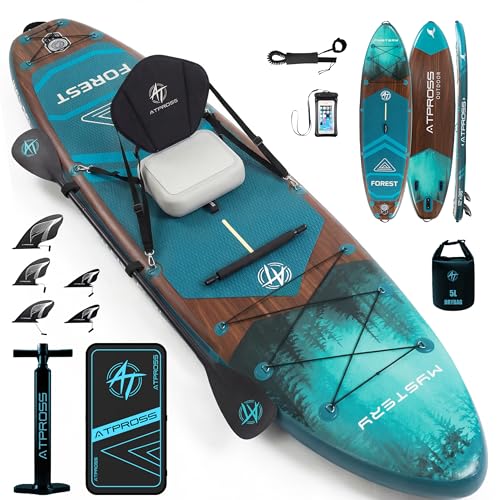
| ATPROSS 12 ft x 36 inTop pick | 12 ft x 36 in x 6 in | 500 lb | Widest deck here, with a padded seat |
| Atoll OutriderBest premium | 12 ft x 34 in x 6 in | 400 lb | Dual layer MSL PVC with rail stringers |
| UPWELL 12 ft x 36 inLightest big board | 12 ft x 36 in x 6 in | Around 500 lb | Only 23 lb for a 36 inch board |
| ZLX 11 ft 6 x 35 inBest value | 11 ft 6 x 35 in | Not stated | StabilTrac fin and a 3 year plan |
| CETANA 11 ft 6 x 35 inBest accessories | 11 ft 6 x 35 in x 6 in | 450 lb | 1680D backpack and 15 D-rings |
| SOLAVERO 11 ft x 33 inHighest capacity per dollar | 11 ft x 33 in | 500 lb | 500 lb for 156 dollars |
| iTAOSTAR Lead 12 ft x 35 inBest fin setup | 12 ft x 35 in | 450 lb | Five fins and a kayak conversion kit |
| Flyroc 11 ft 6 x 35 inBest construction | 11 ft 6 x 35 in x 6 in | 450 lb | Dual layer sidewall with UV protection |
| Hiwave 11 ft 6 x 35 inBest budget | 11 ft 6 x 35 in x 6 in | 450 lb | 450 lb at the lowest price here |
The nine picks in detail
- Size12 ft x 36 in x 6 in
- Capacity500 lb
- Constructiondouble layer PVC with reinforced sidewall
- Seatergonomic inflatable with high density cushioning
- Finsthree large plus two small, detachable
- Includedfull accessory kit
- Warranty1 year
Best for: Paddlers over about 220 pounds who want margin rather than a limit
Length matters more than width for a heavier paddler, because a longer board spreads the load over more water and sags less in the middle.
Twelve by thirty six is about as much displacement as an inflatable board offers, and the difference underfoot at two hundred and fifty pounds is obvious.
Inflate it properly, to the pressure printed by the valve. An under-inflated board is where nearly all the reported instability comes from, and an electric pump removes that variable.
Strengths
- Twelve feet by thirty six inches is the most board here for the money
- Five hundred pounds of capacity, which leaves real headroom
- Double layer PVC, so it stays rigid rather than sagging
- A proper seat, so you can rest without going ashore
Weaknesses
- Thirty six inches is slow and wide to paddle
- Twelve feet is awkward to store and carry
- Size12 ft x 34 in x 6 in
- Weight28 lb
- Capacity400 lb
- Constructiondual layer MSL fused PVC with reinforced rail stringers
- Mounts3 action mounts and 2 Scotty plates
- Fin8 in touring fin
- Handlesfour built in
- Includedpaddle, 10 ft coil leash, backpack, hand pump
- Warranty2 years
Best for: Anyone who wants a board that will still be rigid in five years
Fused construction bonds the two PVC layers with heat rather than glue, which is lighter, stiffer and considerably more expensive to make.
Rail stringers are the other half. They are the reinforcement along the edges that stops a twelve foot board bending in the middle under load.
The four hundred pound rating is honest rather than low. Cheaper boards quote numbers that assume flat water and no gear.
Strengths
- MSL fused construction is a genuine step up from glued dual layer
- Rail stringers, which is what stops a long board flexing
- Twelve feet with a touring fin, so it actually goes somewhere
- Two year warranty from an established brand
Weaknesses
- Seven hundred dollars
- Four hundred pound capacity is lower than the cheaper boards claim

- Size12 ft x 36 in x 6 in
- Capacityaround 500 lb
- Weight23 lb
- Materialultralight double wall PVC, 25 percent lighter than comparable boards
- Paddle2-in-1 SUP and kayak
- Finsthree removable
- Includedcoiled leash, seat and full kit
Best for: Big board stability without the big board carry
A twelve foot board is usually a two-person carry at thirty pounds or more, and twenty three pounds is the difference between using it and leaving it in the garage.
The kayak seat is more useful to a heavier paddler than it sounds, because sitting down drops your centre of gravity and rests your legs.
Lighter fabric does mean a slightly softer board over the years. Keep it out of the sun and store it rolled loosely rather than compressed.
Strengths
- Twenty three pounds for a twelve by thirty six board is genuinely light
- Around five hundred pounds of capacity
- The 2-in-1 paddle turns it into a kayak when you tire
- Included kayak seat
Weaknesses
- Lighter PVC is a trade against long term rigidity
- Capacity is quoted loosely rather than as a firm figure

- Size11 ft 6 x 35 in
- Decknon-slip pad
- FinStabilTrac balance fin
- D-rings14 stainless steel
- Mountcamera mount
- Materialmilitary grade PVC with drop stitch
- Backpackincluded, 30 percent more compact
- Warranty3 year protection plan
Best for: A first board for a heavier paddler, without spending three hundred dollars
Tracking is the underrated problem for a heavier paddler. A loaded board sits deep, catches wind on the tail and wanders, and a bigger fin is the cheap fix.
Stainless D-rings rather than the usual plated ones is the sort of detail that shows up after two seasons in salt water.
The missing capacity figure is the one frustration. If you are over two hundred and thirty pounds, take the SOLAVERO or the ATPROSS with their stated numbers instead.
Strengths
- A three year plan, which almost nothing at this price offers
- Fourteen stainless D-rings rather than the usual six
- The larger balance fin genuinely reduces drift under load
- Two hundred and nine dollars
Weaknesses
- No stated weight capacity
- Eleven feet six rather than twelve

- Size11 ft 6 x 35 in x 6 in
- Capacity450 lb
- Handlesthree reinforced
- Backpack1680D upgraded
- Finscentre plus two side, removable
- Bungee6-point front and 4-point rear
- D-rings15, kayak seat compatible
- Use2 to 3 people
Best for: Buyers who care what the accessories are made of
The included backpack is where board makers cut costs, and a 1680D bag is one you will still be using in three years rather than replacing immediately.
Three carry handles matter here specifically. A wide board is awkward to lift and a second handle turns it into a two-person job that works.
If you add a seat later, the D-rings are in the right places. See our kayak seat guide for what fits.
Strengths
- A 1680D backpack rather than the usual thin bag
- Three carry handles, which matters with a heavy board
- Fifteen D-rings and kayak seat compatibility
- 450 lb stated capacity for 190 dollars
Weaknesses
- Eleven feet six is short for a very heavy load
- No seat included despite the D-rings for one

- Size11 ft x 33 in
- Capacity500 lb
- Materialthick high density PVC
- Finsthree removable
- Includedadjustable paddle, leash, pump and full kit
- Finishblack and white
- Supportdedicated customer service
Best for: The most stated capacity for the least money
Thirty three inches with a five hundred pound rating is an unusual combination, and it tells you the board relies on volume rather than width.
That works. A thick, well inflated eleven foot board carries a heavy paddler perfectly well, and it paddles faster than a thirty six inch barge.
It is the choice if you are heavy but confident on your feet, since the narrower deck is less forgiving than the twelve foot boards above.
Strengths
- Five hundred pounds for a hundred and fifty six dollars
- High density PVC that goes genuinely rigid at pressure
- Complete kit out of the box
- A clean design rather than the usual graphics
Weaknesses
- Thirty three inches is the narrowest board here
- Eleven feet gives less displacement than the twelve foot options

- Size12 ft x 35 in
- Capacity450 lb
- Finsfive removable, three centre and two side
- Kayakconversion kit included
- Seatincluded
- Mountsaction camera or phone
- Warranty3 years
- Guidebeginner guide included
Best for: Paddlers who want to tune the board to the water
Fin choice changes a loaded board more than most people expect. A single large centre fin tracks straight; three smaller ones turn more easily in wind.
Twelve by thirty five is the sweet spot between the fast eleven footers and the very wide boards that will not go anywhere.
The kayak conversion is genuinely useful on a long day, because sitting rests the legs without ending the session.
Strengths
- Five fins, so you can set it up for tracking or for turning
- Twelve feet by thirty five inches with a 450 lb rating
- Three year warranty
- Kayak conversion kit as well as the seat
Weaknesses
- Five fins is more configurability than most people will use
- Two hundred and eighty dollars

- Size11 ft 6 x 35 in x 6 in
- Capacity450 lb
- Materialmilitary grade PVC with dual layer sidewall
- ProtectionUV, anti-corrosion and impact resistant
- Included5 L dry bag and 100 L backpack
- Ridersup to 3 adults
- Colourgrey
Best for: Rough handling, rocky launches and hot sun
Sidewall construction is the specification that separates boards that stay stiff from boards that develop a banana shape after a season.
A dual layer sidewall on a single layer deck is the sensible compromise at this price, because the sidewall is what carries the bending load.
UV treatment matters if the board lives on a roof rack or a dock. Sunlight is what ages PVC, not water.
Strengths
- Dual layer sidewalls, which is where boards fold under load
- Explicit UV and anti-corrosion treatment
- A dry bag included rather than sold separately
- Two hundred dollars for dual layer construction
Weaknesses
- Eleven feet six, so less glide than the twelve foot boards
- The included dry bag is small at five litres
- Size11 ft 6 x 35 in x 6 in
- Capacity450 lb
- Width3 in wider than a standard board
- Inflation5 to 10 minutes with the hand pump
- Paddlefloating
- Storageextra large deck bungee
- Uselake, calm sea, river, yoga and light touring
Best for: Finding out whether paddling suits you before spending more
At this price you are buying width and capacity without the construction that keeps a board rigid over years, and for a first season that is a fair trade.
Inflate it fully every time. A single layer board at twelve PSI is stable; the same board at nine PSI is a hammock.
If it turns into a regular habit, the money is better spent on a longer board than on accessories for this one.
Strengths
- A hundred and fifty dollars for a stated 450 lb capacity
- Thirty five inches wide, the same as boards at twice the price
- Floating paddle included
- Big deck bungee for gear
Weaknesses
- Hand pump only
- Single layer construction, so it will flex more under a heavy load
How to choose a paddle board as a heavier rider
Add a hundred pounds of headroom: Take your weight, add the paddle, pump, cooler and anything else aboard, then choose a board rated at least a hundred pounds higher. At the stated limit a board sits low, drags and flexes, none of which is dangerous but all of which is unpleasant.
Volume beats width: A board's buoyancy comes from displacement, which is length times width times thickness. Six inches thick is the standard for a reason, and a twelve foot board carries a heavy paddler better than an eleven foot board of the same width.
Construction determines stiffness: Single layer PVC is fine at 180 pounds and flexes at 250. Dual layer, and especially fused dual layer with rail stringers, is what keeps a long board straight under load. It is the specification worth paying for.
Inflate to the printed pressure: Most reported instability is under-inflation. A board rated to 15 PSI at 10 PSI has lost most of its stiffness, and a heavy paddler feels that immediately. This is the single cheapest improvement available.
Take a bigger fin: A deeply loaded board catches wind and wanders. A larger centre fin, or a dedicated tracking fin, costs very little and fixes most of the steering effort on a long paddle.
Frequently asked questions
What happens if I exceed the weight capacity?
The board does not sink, it submerges. It sits below the waterline, water washes over the deck, it becomes slow and it flexes in the middle. That flex is what makes it feel unstable, so treat the rating as a performance ceiling rather than a safety limit.Is a wider board always more stable?
Up to a point. Thirty four to thirty six inches is noticeably steadier than thirty two, but past that you gain little and lose real speed, since a wide board pushes water rather than cutting through it. Length and thickness give a heavier paddler more than extra width does.Should I choose inflatable or hard for a heavy rider?
Inflatable, in nearly every case. A six inch inflatable has more volume than a comparable hard board and is far more forgiving of knocks. A hard board of equivalent capacity is long, expensive and difficult to store or transport.What pressure should I inflate to?
Whatever is printed beside the valve, usually 15 PSI. For a heavier paddler this matters more than for anyone else, because the missing stiffness at low pressure shows up as sag under your feet. Check it again after an hour in cold water, when pressure drops.Bottom line
The ATPROSS is the pick because it gives a heavier paddler what actually helps: twelve feet of length, thirty six inches of width, a five hundred pound rating and a seat, for three hundred and thirty dollars. If the board is going to be used weekly for years, the Atoll Outrider and its fused dual layer construction is where the money goes.
At the other end, the Hiwave at a hundred and fifty dollars is an honest way to find out whether the hobby sticks. Just inflate it fully, keep the load well under the rating, and expect to want a twelve foot board by the second season.


