

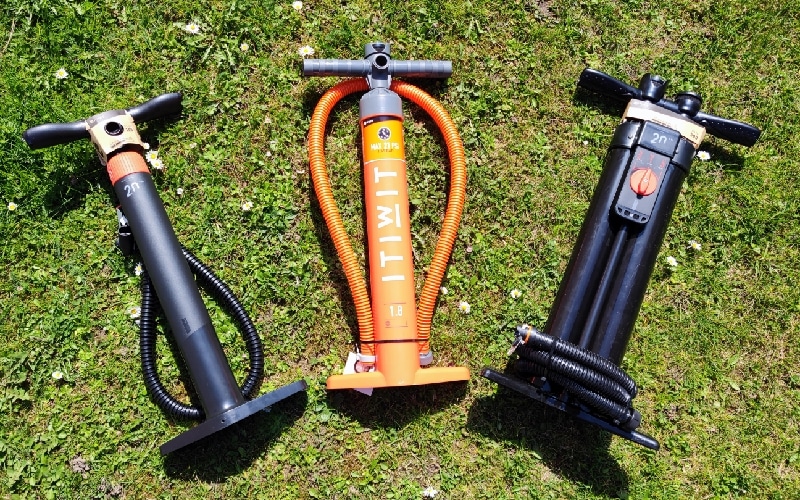
Inflating a board by hand takes about six minutes and leaves you warm before you have touched the water. Most people do it once with the pump that came in the box, and then start looking for something better.
There are two ways to improve it. A better hand pump halves the effort through a well designed dual action cylinder. An electric pump removes the effort completely and costs three times as much.
The number that matters is pressure. A board at 12 psi feels soft and bends under you. The same board at 15 psi is a different craft, and getting those last three psi by hand is where cheap pumps give up.
We compared nine pumps, four electric and five manual, and sorted them by how reliably each one reaches real riding pressure rather than by how fast it starts.


The best paddle board pumps at a glance
| Pump | Type | Max pressure | Standout features |
|---|---|---|---|
| OutdoorMaster Shark 3Top pick | Electric, 74 Wh battery | 20 psi | 3'50 inflation, four boards per charge, Type-C and 12V input, 8 nozzles |
| THURSO SURF Double ActionBest hand pump | Manual, dual action | 29 psi | Aluminium shaft, INF and DEF ports, 2.4 lb, removable handle extensions |
| ETENWOLF S4Best value electric | Electric, 12V car socket | 20 psi | Dual stage, 600 L/min turbo, 7 nozzles, bar, psi and kPa |
| OutdoorMaster Shark 2SLongest battery | Electric, 88.8 Wh battery | 20 psi | Six boards per charge, 8'40 inflation, deflate mode, 45W charging |
| Hydrohero Electric SUP PumpLightest electric | Electric, rechargeable | 20 psi | 2.51 lb, LED display, dual stage 400 then 100 L/min, three modes |
| NRS High-Pressure Super PumpBest built | Manual, double and single action | 30 psi gauge | Aluminium shaft, Leafield and Halkey-Roberts adapters, 25 in tall |
| NIXY SUP Hand PumpMost air per stroke | Manual, dual action | 29 psi | 4,000 cc per stroke cycle, one-piece build, 2.34 lb, fold-flat base |
| Goplus Double Action Hand PumpBest budget manual | Manual, dual action | 29 psi | Aluminium and PP body, built-in gauge, anti-slip handle |
| Gymax SUP Hand PumpBest foot plate | Manual, dual action | 29 psi | Large built-in pedal, 49 in hose, in and out ports |
The nine pumps in detail
- Typerechargeable electric, 74 Wh
- Speed10.6 ft board to 15 psi in 3 min 50 s
- Deflate1 min 20 s
- Capacityfour boards per charge
- Input45W Type-C, or 12V/15.8V DC from a car
- Extras8 nozzles, auto shut-off, cooling system
Best for: Anyone who paddles often enough to resent pumping
The case for an electric pump is not laziness. It is that you arrive at the water able to paddle rather than needing five minutes to stop sweating.
Under four minutes is genuinely fast for a rechargeable unit, and the cooling system matters because cheaper pumps cut out on the second board.
The deflate function is underrated. It flattens a board properly, which is the difference between a board that fits in its bag and one that does not.
Strengths
- Under four minutes to riding pressure, unattended
- Runs on its own battery and falls back to the car socket
- Auto shut-off at a set pressure, so you cannot over-inflate
- Deflates too, which halves packing time
Weaknesses
- A hundred and fifty three dollars
- Another thing to charge before a trip
- Typemanual, switchable double and single action
- Max pressure29 psi
- Weight2.4 lb
- BuildPP body with aluminium shaft
- Portsseparate INF and DEF
- Gaugeup to 29 psi with the recommended range marked
Best for: Paddlers who want a pump that just works and packs small
Dual action pumps push air on both the up and the down stroke, which fills the board quickly at low pressure. Above about 10 psi that becomes hard work, and switching to single action is what makes the top end possible.
Everything else is build quality. An aluminium shaft does not flex, and a gauge you can read while pumping is the difference between 12 and 15 psi.
At fifty dollars this is the sensible upgrade from the pump in the box, and it fits in the board backpack alongside a repair kit.
Strengths
- Switching to single action makes the last three psi manageable
- Aluminium shaft rather than plastic, which is where cheap pumps flex
- Gauge marks the recommended range, so you stop guessing
- Removable handle extensions make it pack flat
Weaknesses
- Still six minutes of work per board
- Single chamber, so bulk filling is slower than the NIXY
- Typeelectric, 12V DC car socket
- Max pressure20 psi
- Stage one600 L/min turbo boost from 0 to 1 psi
- Unitsbar, psi and kPa
- Nozzlesseven
- Extrascarry handle, cable storage, temperature protection
Best for: People who always launch within a cable's reach of the car
If you drive to the water and park within a few metres of it, a corded 12V pump does everything a battery pump does for a fifth of the price.
The dual stage design is the important part. A single stage pump either fills fast and stalls low, or reaches pressure very slowly.
Check the cable length against your usual parking. That single constraint is what decides between this and the Shark 3.
Strengths
- Thirty dollars, cheaper than most hand pumps
- Dual stage, so it moves volume fast and still reaches pressure
- Sets a target in psi and stops there
- Cable storage compartment, a small thing that stops tangles
Weaknesses
- No battery, so you need the car nearby
- Louder than the battery pumps
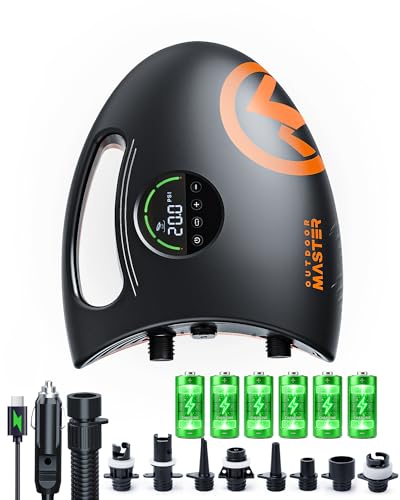
- Battery88.8 Wh rechargeable
- Capacityup to six boards per charge
- Speed10.6 ft board to 15 psi in 8 min 40 s
- Deflate1 min 30 s
- Input45W Type-C or 12V/15.8V DC
- Extras8 nozzles, auto shut-off
Best for: Groups, families and anyone inflating several boards per trip
This is the trade the two OutdoorMaster pumps present: a bigger battery and slower inflation, or a smaller battery and speed.
For a family with three boards, capacity wins. Six boards per charge means never thinking about it across a weekend.
For one person with one board, the Shark 3 is the better buy, because you will notice five extra minutes every single time.
Strengths
- Six boards on one charge, the most here
- Full battery independence, no car needed
- Auto shut-off and deflate as on the Shark 3
- Twenty seven dollars cheaper than the Shark 3
Weaknesses
- Eight forty per board, more than twice the Shark 3's time
- Heavier, because the battery is bigger

- Weight2.51 lb
- Size7.4 x 6.3 x 3.4 in
- Speed10.5 ft board to 12 psi in about 5 minutes
- Stages400 L/min then 100 L/min at pressure
- DisplayLED with real time pressure, three modes
- ChargingQC3.0 30W over Type-C
Best for: Paddlers who walk to the water and carry everything
Weight is the reason to choose this over the OutdoorMaster pumps. If your launch is a ten minute walk, two and a half pounds against a bigger battery unit is a real difference.
The screen is better than the usual preset dial, since you can watch pressure climb and stop where you want rather than trusting a click.
Note the quoted figure is 12 psi. Most boards ride better at 15, and that last stretch always takes longer than the marketing suggests.
Strengths
- Two and a half pounds, light enough to live in the board bag
- LED screen shows real time pressure rather than a preset only
- Three modes, so you can favour speed or pressure
- Fast charging over the same Type-C cable as your phone
Weaknesses
- Quoted to 12 psi, not 15, so allow more time for a firm board
- Ninety dollars
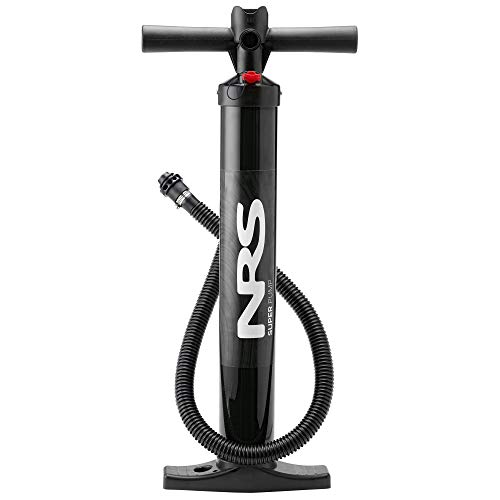
- Typecombination double and single action, inflates and deflates
- Gaugebuilt-in, 30 psi
- Housingpolypropylene with an aluminium shaft
- Size2.75 in diameter, 25 in tall
- AdaptersLeafield C7/D7 and Halkey-Roberts short and Summit 2
Best for: Rafters, kayakers and anyone with more than one kind of valve
NRS builds for whitewater outfitters, and this pump is sized accordingly. The tall cylinder moves more air per stroke than the compact travel pumps.
The adapters are the real argument. If you own a raft, a packraft or a kayak alongside the board, one pump covers all of them.
For a single inflatable board it is more pump than you need, and it will still be working in a decade.
Strengths
- Built like river gear, which is what NRS makes
- Leafield and Halkey-Roberts adapters cover rafts and kayaks, not just boards
- 30 psi gauge, with headroom above board pressures
- Tall cylinder means fewer strokes per board
Weaknesses
- Seventy three dollars, the priciest manual pump here
- Twenty five inches tall, so it does not pack as small

- Volumeup to 4,000 cc per stroke cycle
- Max pressure29 psi
- Buildone-piece with an integrated inner tube and handle
- Weight2.34 lb
- Basefolds flat
- Gaugecap mounted, readable while pumping
Best for: Hand pumping that you want over as quickly as possible
Every stroke of a hand pump is the same effort. What varies is how much air it moves, and moving four litres per cycle means noticeably fewer strokes.
The one-piece construction is the durability story. Most hand pumps develop leaks at the joints, and there are fewer here to fail.
You feel the volume as resistance once the board firms up. Switching to single action for the last stretch is the answer, as with every dual action pump.
Strengths
- 4,000 cc per cycle is the highest volume figure here
- One-piece build removes the joints where pumps leak air
- Lightest manual pump in this list at 2.34 lb
- Fold-flat base and removable handle for the backpack
Weaknesses
- Sixty nine dollars, expensive for a hand pump
- High volume means heavier strokes at the top end

- Max pressure29 psi
- Buildaluminium alloy and PP body with an ABS valve
- Actiondouble for volume, single for pressure
- Gaugebuilt-in
- Gripbold anti-slip handle
Best for: A spare pump, or a first upgrade on a tight budget
The mechanism in every dual action hand pump is the same. What you pay for above fifty dollars is materials, gauge accuracy and how well it packs.
This gets the mechanism and the gauge right and skips the refinements, which is a fair trade at the price.
It also makes a good second pump to leave in the car, so a forgotten pump never costs you a session.
Strengths
- Fifty dollars with the same dual action design as pricier pumps
- Aluminium alloy shaft rather than all plastic
- Readable built-in gauge
- Works with any board on the market
Weaknesses
- Finish is rougher than the THURSO or NIXY
- No handle extensions, so it packs less neatly

- Max pressure29 psi
- Actionswitchable double and single by a valve
- Baselarge built-in pedal for stability
- Hose49 in
- Portsout for inflation, in for deflation
- Gaugereal time pressure display
Best for: Pumping on soft sand or an uneven bank
Pumping on sand is a specific annoyance. The cylinder digs in, the pump leans and every stroke wastes effort keeping it upright.
A wide pedal fixes that, and the long hose means the board can lie where you want rather than next to the pump.
It costs you packed size. If you carry the pump far, one of the slim designs is the better choice.
Strengths
- The largest foot plate here, which stops the pump sinking or sliding
- 49 inch hose reaches the valve without moving the pump
- Deflation port as well as inflation
- Fifty dollars
Weaknesses
- Bulkier to pack because of the pedal
- Plainest build of the manual pumps
How to choose a paddle board pump
Pressure is the whole point: A board rides properly at 15 psi and feels like a lilo at 11. Every pump here can reach 20 psi or more on paper; what differs is how hard the last third is. Manual pumps need a single action mode to get there, and electric pumps need a second stage that keeps pushing at low volume.
Read the gauge, not the clock: Pressure in pounds per square inch is what your board's maximum is printed in, and it is the only meaningful stopping signal. Inflating for a set time is how boards end up soft in cold water and over-pressured in the sun.
Battery, car socket or arms: Battery pumps go anywhere and cost the most. A 12V pump does the same job for thirty dollars if you park near the water. A hand pump never runs out and never fails, which is why many people carry one even after buying an electric.
Check the nozzle fits your valve: Boards use a Halkey-Roberts style valve, and every pump here ships with adapters, but sets differ. If you also own a kayak, a raft or anything on a Schrader valve, count the adapters before you buy.
Deflation matters more than you expect: A board you cannot flatten will not go back in its bag. Pumps with a deflate port or mode save several minutes and a lot of kneeling at the end of every trip.
Frequently asked questions
What pressure should my board be?
Check the printed maximum near the valve, usually 15 psi, and inflate to it. Most boards feel noticeably stiffer between 12 and 15 psi, and that stiffness is what stops the middle sagging under your weight. Never exceed the printed figure, and let a little out if the board sits in strong sun.How long does hand pumping take?
Five to seven minutes for a typical board with a decent dual action pump, most of it in the last few psi. A poor pump can take twice as long and may not reach full pressure at all, which is the main reason people replace the pump that came in the box.Are electric pumps worth it?
If you paddle regularly, yes. The time saved is modest but the effort saved is not, and arriving at the water rested changes the session. If you paddle a few times a summer, a good hand pump is the better spend.Should I still carry a hand pump if I have an electric one?
Many people do. A battery pump that fails or arrives uncharged ends the day, and a hand pump weighs about a kilo. It is also the only way to top up pressure mid-trip after a long swim break.Bottom line
The OutdoorMaster Shark 3 is the pump to buy if you are on the water often. Under four minutes to full pressure, automatic shut-off and a deflate mode remove the least pleasant part of owning an inflatable board, and it works off its own battery or the car.
If that is more than you want to spend, the THURSO SURF hand pump at fifty dollars is a real upgrade on a box pump, and the thirty dollar ETENWOLF S4 gets you electric inflation as long as you park near the water. Whichever you pick, inflate to the printed maximum rather than to a feeling.


