

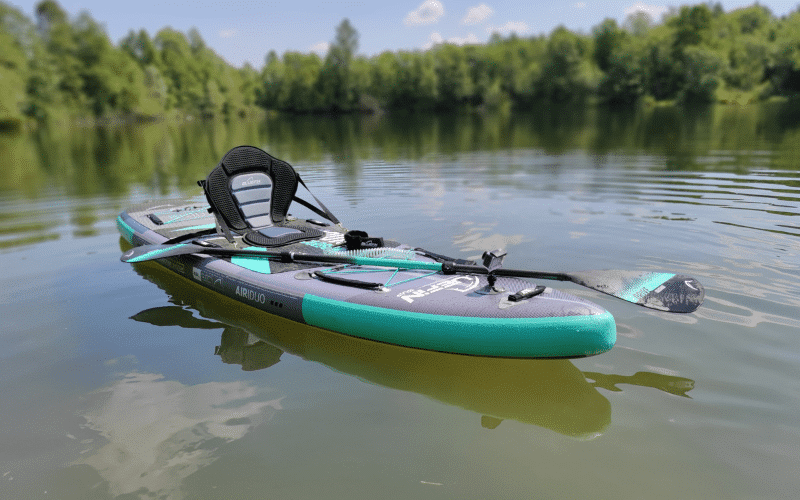
Almost every board package ships with a paddle, a pump, a leash and a bag. Almost every paddler replaces at least two of those within the first season.
That is not a scandal, it is arithmetic. A 200 dollar package cannot include a 100 dollar pump, so the pump in the box is the cheapest one that works.
The accessories on this page are the ones that change how often the board actually gets used: the pump that removes the ten minutes of hard work, the leash that makes solo paddling sensible, the seat that turns an afternoon into an outing.
Nine categories, one pick in each, from a 7 dollar leash to a 99 dollar electric pump.


The nine accessories at a glance
| Accessory | Category | Price class | Standout feature |
|---|---|---|---|
| OutdoorMaster WhaleTop pick | Electric pump | Around 99 dollars | Rechargeable, three boards per charge |
| BLUESTORM Cirro 16Most important buy | Belt pack PFD | Around 70 dollars | USCG approved with 16.5 lb of buoyancy |
| Abahub Coil SUP LeashBest value | Leash | Under 10 dollars | 5 mm TPU cord with a quick release tab |
| YVLEEN 4 Piece PaddleBest spare paddle | Paddle | Around 40 dollars | Splits into four pieces and converts to kayak use |
| MARCHWAY Dry BagBest dry bag | Dry bag | Around 19 dollars | Roll top in 5 to 40 litres, floats when sealed |
| Lamicall IP68 Phone PouchBest phone case | Phone pouch | Around 20 dollars | IP68 rated to 30 m, floats with the phone inside |
| Freein Drop-Stitch SeatBest seat | SUP seat | Around 50 dollars | Four inch inflatable base instead of a folding frame |
| Kolti Carry StrapBest carry strap | Carry strap | Around 15 dollars | Carries board and paddle together, hands free |
| MORXPLOR 25L Deck BagBest deck bag | Deck bag | Around 33 dollars | Roll top 500D PVC that straps to the D-rings |
The nine accessories in detail
- Pressureup to 16 psi
- Battery6000 mAh, three boards per charge
- Power12 V car socket or AC adapter
- Stages350 l per minute then 70 l per minute
- Displaydigital with real time pressure
- Nozzlesfull set including C7 and H3 valves
Best for: Anyone who paddles often enough to resent the hand pump
The hand pump is the reason boards stay in the garage. Ten minutes of work before you get wet is enough friction to turn a spontaneous hour on the water into a maybe next weekend.
Three boards per charge covers a family outing without a car socket in sight, and the digital display means the board actually reaches the pressure it was designed for rather than the pressure your arms gave up at.
If you want to compare the field before spending, our electric pump comparison covers the cheaper 12 V only models as well.
Strengths
- Runs off its own battery, so no car and no socket needed
- Two stage design fills fast then finishes hard
- Set the pressure and walk away
Weaknesses
- Ninety nine dollars is a third of a budget board
- Adds 3 kg to what you carry to the water
- ApprovalUSCG approved Type V with Type III performance
- Buoyancy16.5 lb when inflated
- Inflationmanual jerk cord with CO2 cylinder
- Fit30 to 52 in chest, universal
- Designminimalist belt pack
- ExtrasD-rings for accessories
Best for: Paddlers who will not wear a foam vest and therefore wear nothing
The best flotation device is the one you actually have on. Foam vests are hot and bulky, which is why so many of them travel bungeed to the nose of the board where they are no use at all.
A belt pack solves that by disappearing. It sits at the waist, weighs almost nothing, and inflates to the same buoyancy as a Type III foam vest when you pull the cord.
The manual inflation is the honest caveat. It requires a conscious wearer, which is fine for flat water and less fine in surf. Our buoyancy aid comparison covers the foam and automatic options too.
Strengths
- Coast Guard approved, which matters legally as well as practically
- Sits on the hip, so no heat and no shoulder bulk
- Universal fit covers most adults
Weaknesses
- Manual only, so it does nothing if you are unconscious
- CO2 cylinder needs replacing after every use
- Length10 ft coiled
- Cord5 mm TPU
- Swivelsanti corrosive steel
- Cuff2.4 in neoprene with double velcro
- Releasequick release pull tab
- Colourseight
Best for: Every paddler, on every board, every time
A board without a rider catches the wind and moves faster than a person can swim. That is the entire argument for a leash, and it applies on the calmest lake in the mildest weather.
Coiled rather than straight means the cord rides above the water instead of dragging behind you and snagging on weed.
One exception matters: on a river, an ankle leash can pin you to a snag. Use a quick release waist belt there, which our waist leash comparison covers in detail.
Strengths
- Seven dollars for the single most useful safety item
- Coiled so it stays off the deck and out of the water
- Quick release tab for moving water
Weaknesses
- Ankle leashes are wrong for rivers, use a waist leash there
- Cheap velcro wears out after a few seasons

- Sectionsfour
- Shaftaluminium alloy with reinforcing rib
- Lockingdouble ABS with 304 stainless screws
- Bladestwo, PP and fibreglass
- Modesingle blade or double bladed kayak
- Buoyancyfloating
Best for: A second paddle for a passenger, or a spare in the car
Every board package includes a paddle and almost none of them include two. The moment somebody else wants a turn, a second paddle stops being optional.
The four piece design is what makes it a genuinely useful spare. It lives in a rucksack or a boot without taking up the space a two piece paddle demands.
For your main paddle, weight is what you are buying, and the difference between aluminium and carbon shows up after an hour rather than after five minutes. Our paddle comparison goes through the shafts and blade shapes.
Strengths
- Splits into four, so it fits in a rucksack
- Converts to a double bladed kayak paddle
- Floats if you drop it
Weaknesses
- Aluminium is heavier than carbon over a long paddle
- Adjustment screws need rinsing after salt water

- Sizes5, 10, 20, 30 and 40 litres
- Closureroll top with a watertight seal
- Buildreinforced multi layer, tear resistant
- Buoyancyfloats when sealed and not overfilled
- Strapsshoulder strap on the small sizes
- Usepaddling, sailing, camping
Best for: Keeping keys, a phone and a change of clothes dry on any trip
A dry bag is the accessory people buy after the first soaked car key rather than before it. Twenty litres is the size that covers a towel, a jumper, a phone and lunch.
The floating claim only holds if you leave air in the bag and roll the top properly. Overfill it and it sinks like anything else.
Strap it under the bungees at the nose rather than carrying it, and check our dry bag comparison if you want a fully submersible one.
Strengths
- The 20 litre size covers a day out for two people
- Floats visibly if it goes overboard
- Cheap enough to own in two sizes
Weaknesses
- Roll top needs three folds to actually seal
- Not a submersible bag, it resists splashing and dunking

- RatingIP68, tested to 30 m
- Buoyancybuilt in sponge cushion, supports 14 oz
- Fitup to 8.5 in phones with a case on
- Windowclear camera panel
- Touchsoft PVC responsive layer
- Packtwo pouches
Best for: Anyone who wants their phone on the board rather than in the car
A phone on the water is a navigation tool, a camera and an emergency call, and it is worth twenty dollars to keep all three.
The IP68 rating is the number to look for. It means dust tight and tested under water at depth, rather than the vaguer water resistant claims on cheaper pouches.
Buoyancy is the feature that separates this from the crowd. Most pouches keep the water out and then sink quietly to the bottom. Our phone pouch comparison has more options.
Strengths
- Floats with the phone inside, which most pouches do not
- Camera window is clear enough for usable photos
- Two in the pack, so a passenger gets one
Weaknesses
- Touch response through PVC is never quite native
- Face recognition often fails through the window

- Height4 in inflatable drop stitch base
- Footprint18 by 18 in
- Strapstwo heavy duty adjustable
- Posture95 degree back support angle
- Storageintegrated rear pocket
- Fitsinflatable boards, kayaks and canoes
Best for: Anyone who wants to sit down halfway through the paddle
Standing for two hours is a workout. Sitting for the second half turns the same trip into something a beginner or a child will actually enjoy.
The drop stitch base is what makes this better than the folding fabric seats. Those sag into the deck and leave you sitting in whatever water is on the board, and this one holds you above it.
Check your board has D-rings roughly 18 in apart before ordering. Our seat comparison covers the strap patterns in more detail.
Strengths
- Drop stitch base gives a firm, flat platform rather than a sagging one
- Two straps instead of the usual six, so fitting takes a minute
- Packs flat once deflated
Weaknesses
- Fifty dollars is more than a folding fabric seat
- Needs D-rings in the right places on your board

- Contentsone padded shoulder strap and three nylon straps
- Materialnylon with high strength lock buckles
- Adjustmentquick length adjustment for board size and height
- Carryhands free, board and paddle together
- Fitspaddle boards, surfboards and kayaks
- Weightnegligible
Best for: Anyone whose parking is more than a hundred metres from the water
An inflated board is not heavy so much as awkward, and the standard centre handle only works if the walk is short and the wind is behind you.
A sling puts the board on your shoulder and leaves both hands free for the paddle, a bag and a child, which is the actual situation most people are in.
It is also the cheapest way to make a big board practical. If your carry is long and often, our carry strap comparison covers padded and trolley options.
Strengths
- Carries the board and the paddle in one sling
- Fifteen dollars against the aching arm alternative
- Folds into a jacket pocket when not in use
Weaknesses
- Wide boards still catch the wind on a long carry
- The shoulder pad is thin for very heavy boards

- Volume25 litres
- Fabric500D PVC, 0.5 mm thick
- Closureroll top
- Mountingfour adjustable velcro straps
- Carrytwo shoulder straps and a front handle
- Pocketsfront zip and two side pockets
Best for: Longer trips where gear needs to be reachable rather than sealed away
The difference between a dry bag and a deck bag is access. A dry bag protects what you are not using, and a deck bag holds what you want within reach: a bottle, a jacket, a snack, a camera.
Low profile matters more than it sounds. A tall bag on the nose catches wind and pushes the board off line all day.
Four velcro straps mean it fits boards with different D-ring layouts, which the fixed strap bags do not. Our bag comparison covers transport bags as well.
Strengths
- Sits low so it does not act as a sail
- Straps to the deck rather than sliding around under a bungee
- Doubles as a backpack once you are off the water
Weaknesses
- Twenty five litres is more than a short paddle needs
- Velcro straps collect sand
How to choose paddle board accessories
Buy safety before comfort: a leash and a buoyancy aid together cost less than a good paddle and matter more than everything else on this page combined. Everything after that is about making the trip pleasant rather than making it survivable.
Replace the pump before the paddle: the included paddle is usually adequate and the included pump is usually the reason the board stays rolled up. Electric pumps are the single accessory that measurably increases how often people paddle.
Check the fit against your board: seats need D-rings in the right places, deck bags need straps that reach, and fins need the right box type. Measure before ordering rather than after.
Own two dry bags, not one: a small one for keys, phone and wallet that goes everywhere, and a bigger one for clothes and towels that stays on the board. Trying to make one bag do both jobs means opening the sealed bag every time you want your keys.
Skip the bundles: accessory sets that promise ten items for thirty dollars contain nine things you will replace. One good item per category costs more upfront and less over three seasons.
Frequently asked questions
Which paddle board accessories are actually essential?
A leash and a buoyancy aid, both of which are legally required in some places and sensible everywhere. After that a pump, a paddle and a way to keep your phone and keys dry. Everything else on this page is comfort rather than necessity.Is an electric pump worth the money?
If you paddle more than a handful of times a season, yes. Hand pumping an inflatable board to 15 psi takes eight to twelve minutes of real effort, and that is the friction that keeps boards in garages. An electric pump turns setup into something you can do while unloading the car.Do I need a leash on flat water?
Yes. An empty board catches wind and drifts faster than most people can swim, and the flat calm water where nothing seems likely to happen is exactly where paddlers fall in unexpectedly. The exception is moving water, where an ankle leash is a hazard and a quick release waist belt is the right choice.What comes in a typical board package already?
Almost always a paddle, a hand pump, a leash, fins and a backpack, and often a repair kit and a phone pouch. The quality of each varies enormously, so treat the package as a starting point rather than a complete kit.Bottom line
Two accessories change the experience more than the rest put together: an electric pump, because it removes the work between arriving and paddling, and a belt pack buoyancy aid, because it is the safety gear people will genuinely keep on.
Add a seven dollar leash and a floating phone pouch and the board that came with a cheap package is suddenly a setup you will use every weekend.


