

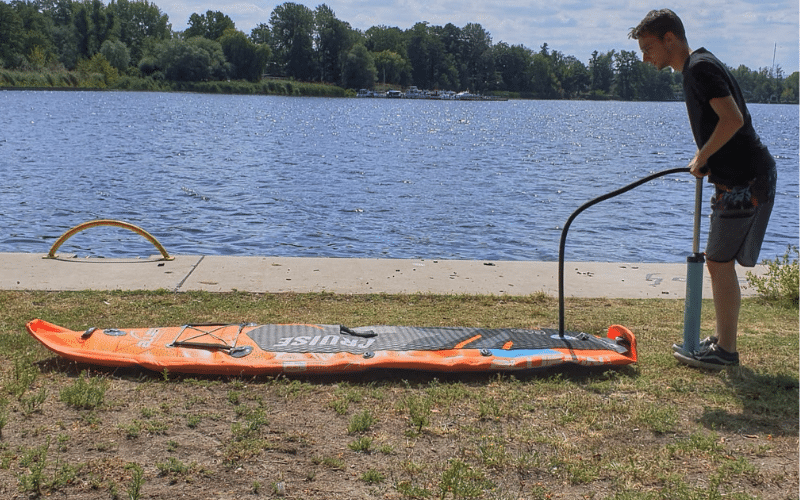
Almost every paddle board sold in Britain is inflatable, and for once the popular choice is also the right one. A hard board needs a roof rack, a garage and somewhere to store it that is not the hallway.
An inflatable rolls into a rucksack, travels in a car boot and survives being dropped on a slipway. What it gives up is stiffness, and stiffness is precisely what separates the boards on this page from each other.
The specifications that matter are the ones nobody puts in the title: how the rails are joined, how many layers of PVC are in the skin, and what pressure the board is meant to run at.
We compared nine inflatable boards on Amazon UK on construction, width, capacity and what is included, from a hundred and sixty pounds to eleven hundred.


The best inflatable paddle boards in the UK at a glance
| Board | Size | Capacity | Standout feature |
|---|---|---|---|
| Bluefin Cruise 10 ft 8Top pick | 10 ft 8 x 6 in | Adults and youth | ESL fused build with an oversized deck pad |
| Bluefin Cruise Carbon 12 ftBest premium | 12 ft | Adults | Carbon rails, dual air chambers, carbon paddle |
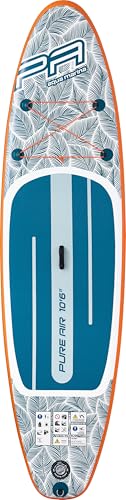
| Aqua Marina Pure Air 10 ft 6Best value brand | 10 ft 6 (320 cm) | Recreational | Honeycomb EVA pad and a slide in fin |
| FEATH-R-LITE 11 ftLightest board | 335 x 82 x 15 cm | 7.74 kg board weight | Machine fused seams instead of hand glued |
| NACATIN 12 ftBiggest platform | 12 ft x 36 in | 300 kg | 14 D-rings, kayak seat, double paddle |
| iTAOSTAR A02CPMost accessories | 12 ft x 35 in | 450 lb | Five fin setup and a full kayak conversion |
| AKSPORT 11 ftWidest deck | 11 ft x 34 in x 6 in | 200 kg | Kayak seat, camera mount, one year cover |
| HUIIKE 10 ftBest small package | 10 ft x 33 in x 5.9 in | 286 lb | Double sidewall layer, seat and footrest |
| SereneLife 10 ft 6Best budget | 10 ft 6 x 32 in | 350 lb | Three fins and a full kit at 160 pounds |
The nine inflatable boards in detail
- Size10 ft 8, 6 in thick
- Constructionpatented ESL fused build
- Decksupersized croco diamond grip pad
- Finupgraded US surf fin in a universal box
- Includedpaddle, leash, pump, bag, phone case, fins, cup holder
- BrandBritish
- Levelbeginner to experienced
Best for: The one inflatable most British paddlers should buy
Fused construction is the line worth reading twice. A glued rail is the part of an inflatable that lets go after a couple of summers left in the sun.
The Cruise is a plain all round shape and does not pretend otherwise. It is stable enough for a first session and stiff enough that you will not want to replace it.
We covered the board itself in our Bluefin Cruise review, and inflation times in how long the Cruise takes to inflate.
Strengths
- Fused rails rather than glued ones, which is the seam that normally fails
- A complete kit, so the listed price is the whole cost
- The deck pad runs almost the full length, which matters for dogs and gear
- A UK company that handles warranty claims directly
Weaknesses
- Four hundred pounds when the budget boards start at a hundred and sixty
- A 6 in thickness rather than the 8 in used by some family boards

- Size12 ft
- ConstructionESL fused PVC with carbon reinforced rails
- ChambersAIRDUO dual inflation chambers
- PaddleDrive carbon shaft, 975 g, 175 to 210 cm
- PumpSwift Pro Maxi double chamber
- Fins2 plus 1 smart lock system
- Bagpadded carbon carry bag
Best for: Long days and open water where flex becomes exhausting
Long inflatables have one structural problem: the longer the board, the more it bends in the middle. Carbon rails are the direct answer to that.
The dual chamber build is the part worth paying for on tidal water. A single puncture on a long crossing stops being an inconvenience and starts being a rescue.
Our Cruise Carbon review covers how the construction holds up over a season.
Strengths
- Twelve feet of waterline, so it glides between strokes instead of stalling
- Carbon reinforced rails remove most of the flex a long inflatable suffers
- Two air chambers is a genuine safety feature on open water
- The carbon paddle would cost well over a hundred pounds separately
Weaknesses
- Eleven hundred pounds, by far the most expensive board here
- Twelve feet is unwieldy on a narrow river and heavy to carry alone
- Size10 ft 6, 320 cm
- Shapeall around with a rounded nose
- Decklarge honeycomb grooved EVA pad
- Finslide in centre fin, no tools needed
- PrintECO-PRINT digital graphic process
- Storagefront bungee cord, stainless tail D-ring
- Includedadjustable aluminium paddle, dual action pump, leash, bag
Best for: A first board from a brand that will still exist next year
Aqua Marina is the biggest paddle board brand most people have never consciously chosen, and the Pure Air is where the range starts.
What the brand buys you is boring and valuable: consistent quality control, spare parts that exist and a warranty address in Europe rather than a marketplace handle.
The rest of the range is worth a look if this one is too small, and we ranked it in our Aqua Marina guide.
Strengths
- A real brand with European distribution at no name money
- The slide in fin needs no tools and nothing to lose in the car park
- Honeycomb EVA rather than the thin flat pads at this price
- Under a hundred and seventy pounds with the full kit
Weaknesses
- Single layer construction, so it flexes under heavier riders
- The aluminium paddle is basic even by budget standards
FEATH-R-LITE 11 ft Inflatable Stand Up Paddle Board
Lightest board- Size335 x 82 x 15 cm, 11 ft x 33 in x 6 in
- Board weight7.74 kg
- Seamsmachine fused rather than hand brushed glue
- Deck3 mm laser engraved EVA diamond pattern
- Gripfriction coefficient of 0.6 or better when wet
- Includedaluminium paddle, pump, fins, backpack, coil leash, dry bag
- Useflat water, river runs and small waves
Best for: Anyone who carries the board more than fifty metres
Weight is the specification people ignore at purchase and resent every time afterwards. A board that is awkward to carry gets paddled far less often.
Machine fused seams are the manufacturing detail that matters here. Hand glued rails vary with whoever was on the line that day, and that is where leaks start.
Getting a light board properly stiff needs a pump that reaches fifteen PSI without a fight, which is covered in our pump comparison.
Strengths
- Under eight kilos for an eleven foot board is genuinely unusual
- Machine fused seams at a hundred and seventy pounds is above its class
- The laser engraved pad grips properly when wet, not just in photos
- Eleven feet of length for the price of most ten foot six boards
Weaknesses
- A light board needs its full pressure or it feels soft underfoot
- No brand presence in the UK if something goes wrong later
- Size12 ft, 366 cm long and 36 in, 91 cm wide
- Capacityup to 300 kg
- Riderstwo adults, or an adult with children and a dog
- Attachment14 D-rings with front and rear bungees
- Kayak modeseat, footrest and a double blade paddle
- Includeddry bag, phone case, pump, backpack, leash, fin
- Usecruising, yoga, fishing and family days
Best for: Households that want one board everybody can share
Width buys stability more cheaply than any other specification, and thirty six inches means nobody has a bad first day on the water.
The trade is speed. A board this wide pushes water rather than cutting it, so distance paddling turns into a workout.
If two people will be on it regularly, our guide to tandem paddle boards covers how capacity figures translate into real loads.
Strengths
- Thirty six inches wide is closer to a pontoon than a board
- Three hundred kilos is the highest capacity on this page
- Fourteen D-rings takes a seat, a cooler and a fishing crate at once
- Two hundred and twenty pounds for a board this size is remarkable
Weaknesses
- Wide and slow, and hard work against any wind
- Twelve feet of rolled board is heavy to carry on your own

- Size12 ft long, 35 in wide
- Capacity450 lb
- Finsfive, three central plus two side
- Kayak modeinflatable seat with a foam footrest
- Paddlefourth generation dual rib blade with kayak conversion
- Included120 litre backpack, 10 litre dry bag, cup holder, whistle, flag, camera mount
- Usesolo, family and pets
Best for: People who would otherwise spend another hundred pounds on extras
Counting accessories is a poor way to judge a board, but it is a good way to judge value once you have decided the construction is acceptable.
The inflatable seat is the piece that gets used most. Sling seats sag after an hour, which is exactly when you want to sit down.
A dry bag in the box is worth having, though a proper roll top is better. Our dry bag guide explains what fails first.
Strengths
- The most complete accessory set on this page by a distance
- Five fins let you set it up for a river or a lake
- An inflatable seat rather than the usual thin sling
- Thirty five inches wide with 450 lb of capacity
Weaknesses
- A long list of accessories is not the same as a stiff board
- Twelve feet by thirty five inches is a lot of board to steer alone

- Size11 ft x 34 in x 6 in
- Capacity200 kg
- Kayak modeergonomic seat with a double blade paddle
- Paddlethree piece aluminium, adjustable 62.5 to 88 in
- Finsthree removable
- Extrascup holder, phone pouch, camera mount base, footrest
- Coverone year for punctures, seams and valves, 30 day returns
Best for: Beginners, yoga and anglers who want a stable platform
Thirty four inches is the point at which standing up stops being an event, which is why this width dominates the beginner and yoga end of the market.
The warranty wording is unusually specific. Naming punctures, seams and valves is a better sign than a vague one year promise.
If yoga is the plan, deck pad coverage matters more than length, as we set out in our wider inflatable board comparison.
Strengths
- Thirty four inches gives a very forgiving first session
- Two hundred kilos of capacity covers two riders plus gear
- The one year cover explicitly names punctures and seam leaks
- A complete kayak conversion rather than a seat on its own
Weaknesses
- Wide boards are slow, and this one is no exception
- Aluminium paddle and a hand pump, so budget for both later

- Size10 ft x 33 in x 5.9 in
- Capacity286 lb
- Constructionmilitary grade PVC coating with a double sidewall layer
- Kayak modeseat and footrest included
- Paddledual use aluminium
- Includedbackpack, leash, pump, three fins, carry strap, repair kit, 5 litre dry bag, phone case
- Extrasunique serial number per board
Best for: One adult, a small car and not much storage space
Short boards have gone out of fashion, which is a shame, because ten feet turns quickly and fits in the kind of car most people actually own.
The double sidewall is the useful detail at this price, since that is the seam carrying the load when you stand off centre.
Capacity is the limit to respect here. Add a paddler, a dog and a rucksack and this board is already at its rating.
Strengths
- Ten feet packs down smaller than everything else here
- A double sidewall layer at under two hundred pounds
- Kayak seat and footrest in the box rather than sold separately
- A 5 litre dry bag included, which most budget kits skip
Weaknesses
- Two hundred and eighty six pounds of capacity rules out a passenger
- Ten feet tracks less well than the longer boards on this list

- Size10 ft 6 x 32 in
- Capacity350 lb
- Materialdrop stitch reinforced engineered PVC
- Decknon slip EVA pad
- Finsthree on the underside
- Paddlethree piece aluminium
- Includedleash, removable fin, repair kit, backpack, double action pump
Best for: A first board bought before anyone knows whether the hobby sticks
There is a floor below which an inflatable stops being a board, and a hundred and sixty pounds with a proper EVA deck and a double action pump sits just above it.
Thirty two inches is enough for most adults to stand on comfortably, and 350 lb of capacity leaves room for a rucksack.
Treat the included leash as a starting point and check it before every session, since it is the one accessory that has to work when everything else has gone wrong.
Strengths
- A hundred and sixty pounds with the whole kit included
- Three hundred and fifty pounds of capacity on a modest board
- A double action pump rather than the single action ones at this price
- Thirty two inches is a real width rather than an optimistic claim
Weaknesses
- The lightest construction here, and it flexes accordingly
- SereneLife has no UK service presence to speak of
How to choose an inflatable paddle board
Read the seam, not the slogan: fused, welded or heat sealed rails last; hand glued rails are where inflatables fail. Almost every listing says military grade PVC, which tells you nothing, so look for how the two halves are joined instead.
Pressure is the whole game: an inflatable is only as stiff as the air inside it, and the gap between ten and fifteen PSI is the gap between a board and a pool toy. Every board here has a rated maximum, and reaching it by hand on a warm day is real work.
Match width to the person, not the marketing: thirty two inches suits most adults, thirty four and above suits nervous beginners, passengers and dogs, and anything under thirty is for people who already paddle. Extra width costs speed, which matters only if you are going somewhere.
Discount the capacity figure: the rating is what the board floats, not what it paddles well with. A board loaded near its limit sits low, drags and feels unstable, so leave a third of the rating as margin.
Count the total, not the board: a package with a paddle, pump, leash, fins, backpack and repair kit can beat a bare mid range board on value. Then plan to replace the paddle first, because that is where every budget kit saves money.
Frequently asked questions
Are inflatable paddle boards any good compared to hard boards?
For everything most people do, yes. A properly inflated board at fifteen PSI is stiff enough for cruising, yoga, fishing and touring, and it stores in a cupboard instead of a garage. Hard boards still win on outright speed and in surf, which is why race and wave paddlers keep buying them.How long does an inflatable paddle board last?
A well made board looked after sensibly lasts five to ten years. What kills them is heat and sunlight rather than use, so the two rules that matter are to let some air out if it is sitting inflated in the sun, and to dry it before rolling it away for winter.What pressure should I inflate to?
Whatever the board says, which is usually twelve to fifteen PSI. Under inflating is the single most common mistake in the sport and it makes a good board feel like a bad one. On a cold morning the pressure rises through the day as the board warms, so check it again after an hour in the sun.Can an inflatable board be repaired if it punctures?
Yes, and most kits include the patches for it. A small puncture in the skin is a straightforward glue and patch job that holds for years. Damage to a seam or the valve is a different matter and usually needs the manufacturer, which is one more argument for buying a brand that still exists in three years.Bottom line
The Bluefin Cruise 10 ft 8 is the inflatable most British paddlers should buy: fused construction, a complete kit, and a company here rather than on a marketplace. It is not the cheapest way onto the water and it is the one least likely to be replaced within two seasons.
If two hundred pounds is the ceiling, the Aqua Marina Pure Air buys a real brand and the SereneLife 10 ft 6 buys the most complete kit. Both are enough board to learn on, and the difference between them and the Bluefin shows up in stiffness rather than in anything you can see rolled out on the grass.


