


Paddling with a dog changes what you need from a board. The dog moves, usually at the worst moment, and a board that felt stable alone feels twitchy with forty pounds of labrador walking to the nose.
Three things solve it: width, deck pad coverage and a way back on board. Thirty five inches of width is the practical minimum, and full length EVA matters because a dog will not stand only where the pad is.
Claws are the other consideration. A thin deck pad and a light PVC skin will take scratches, which is why boards sold as pet friendly use heavier material.
We compared eight boards and one traction pad on width, capacity, deck coverage and how a dog gets back aboard.


The best paddle boards for dogs at a glance
| Board | Size | Capacity | Standout feature |
|---|---|---|---|
| NACATIN Dog Ramp SUPTop pick | 12 ft x 36 in x 6 in | Not stated | Built-in textured dog ramp tail |
| BIGFLY Pet BoardBest value | 11 ft 6 x 35 in x 6 in | Not stated | Scratch resistant pet pad at the tail |
| SereneLife Pet-Friendly SUPBest complete kit | 11 ft 6 x 35 in | 485 lb | Anti-scratch EVA and double welded seams |
| ZLX 42 in Fishing BoardMost stable | 11 ft 6 x 42 in | 400 lb | 42 inches wide with reinforced side rails |
| DAMA 11 ft 6 x 34 inBest budget | 11 ft 6 x 34 in x 6 in | 450 lb | Pet friendly at 140 dollars |
| Flyroc 11 ft x 35 inBest deck pad | 11 ft x 35 in x 6 in | 430 lb | 100 percent EVA deck coverage |
| SOLAVERO 11 ft 6 x 35 inHighest capacity | 11 ft 6 x 35 in x 6 in | 550 lb | 14 D-rings and three handles |
| Niphean Extra LargeBest for families | 11 ft x 33 in x 6 in | Over 500 lb | Two people and a dog, three year guarantee |
| Drydiet Dog Traction PadBest upgrade | 20.87 x 12.6 in | Not applicable | Adds grip to any board you already own |
The nine picks in detail
- Size12 ft x 36 in x 6 in
- Rampbuilt-in textured slip-resistant tail ramp
- Materialmilitary grade PVC with high density drop stitch
- Deckultra-grip EVA padding
- Paddleconvertible single or double blade
- Includedpaddle, backpack and complete set
- Width36 in
Best for: Dogs that swim and need to get back on without being hauled
Getting a dog back on the board is the part nobody plans for. A wet dog cannot climb a rounded rail, and lifting one over the side from a standing position capsizes you.
The ramp tail is the only real answer short of training the dog to be lifted, and it is why this sits at the top despite the price.
Twelve feet also means the dog can lie forward without changing your trim, which is the other half of paddling comfortably with a passenger.
Strengths
- A genuine ramp, not a marketing claim, and it is the hardest problem solved
- Thirty six inches of width, the widest general purpose board here
- Drop stitch and heavy PVC to survive claws
- Double blade option, so you can kayak with the dog aboard
Weaknesses
- Three hundred and eighty dollars is the most expensive board here
- Twelve feet is a lot of board to carry and store
- Size11 ft 6 x 35 in x 6 in
- Decknon-slip EVA with a pet pad at the tail
- MaterialPVC reinforced wire drawing
- Includedfloating paddle, safety leash, US-box fin, hand pump and oxford bag
- Extracamera mount
- Width35 in
Best for: A first board bought specifically with a dog in mind
The pet pad at the tail is the detail that matters, because that is where a dog stands when it gets bored and goes to look at the water.
Bare PVC there means claw scratches and eventually a leak. A separate scratch resistant panel is a cheap solution to a real problem.
Add an electric pump if you paddle often. Hand pumping an eleven foot board with a dog circling you is its own ordeal.
Strengths
- A dedicated scratch resistant pet pad rather than bare PVC at the tail
- Thirty five inches wide, which is the practical threshold
- Complete kit, so nothing else is needed
- Camera mount, which is what everyone actually wants with a dog aboard
Weaknesses
- No stated weight capacity, which makes comparison hard
- Hand pump only, so budget for an electric one

- Size11 ft 6 x 35 in
- Capacity485 lb
- Decknon-slip anti-scratch EVA
- Seamsdouble welded
- Finsthree, removable
- Includeddouble action pump, 3-piece aluminium paddle, leash, repair kit and backpack
- Waterlakes, rivers and ocean
Best for: Buyers who want one box and a known name
A stated capacity is worth more than it sounds. Your weight plus a big dog plus a cooler is easily three hundred pounds, and boards go soft in the middle long before they reach their limit.
Double welded seams are the difference between a board that survives a season with a dog and one that develops a slow leak along the rail.
Three fins help when the load is off centre, which it will be the moment the dog decides to sit on one side.
Strengths
- A stated 485 lb capacity, so you can actually plan a load
- Double welded seams, which is the construction that survives claws
- Three fin setup, better tracking with an unbalanced load
- SereneLife is widely stocked and easy to return
Weaknesses
- Aluminium paddle rather than fibreglass
- Nothing dog-specific beyond the anti-scratch pad

- Size11 ft 6 x 42 in
- Capacity400 lb
- Railsdual 4-6 PSI reinforced side rails
- Chamber12-15 PSI central
- Nosehard shell nose guard
- Decknon-slip EVA with measurement markings
- Mountsrod mount and camera mount
- Warranty3 years
Best for: Big dogs, two dogs, or anyone who wants to feel nothing when the dog moves
Width buys stability and costs speed, and forty two inches is well past the point where you paddle anywhere quickly.
For a nervous dog or a large one that is exactly the right trade. A board that does not react when the dog stands up is a calm dog.
The fishing features are a bonus rather than a distraction, and the same width is what makes boards like this work for heavier riders too.
Strengths
- Forty two inches is kayak-level stability, not board-level
- Reinforced side rails, so standing on the edge does not fold it
- Hard nose guard for the inevitable dock contact
- Three year warranty
Weaknesses
- Forty two inches is slow and hard work to paddle any distance
- Three hundred and seventy dollars
- Size11 ft 6 x 34 in x 6 in
- Capacity450 lb
- Materialdrop stitch with PVC and EVA
- Storagewidened front elastic rope
- Paddlefloating single blade
- Inflationhigh flow valve, 5 to 10 minutes
- Includedhand pump with gauge and full accessory set
Best for: Trying paddling with a dog without committing much money
At this price the question is whether the board is stable enough, and thirty four inches with a 450 pound capacity is enough for a medium dog and one adult.
A floating paddle sounds trivial until a dog shoulders it off the deck in deep water.
Add the traction pad below if your dog has strong claws, since there is no dedicated scratch panel here.
Strengths
- A hundred and forty dollars for a 450 lb board
- Floating paddle, which you will appreciate the first time the dog knocks it in
- Thirty four inches is enough width for a medium dog
- Complete accessory set
Weaknesses
- Thirty four inches rather than thirty five
- No dedicated pet pad or scratch protection
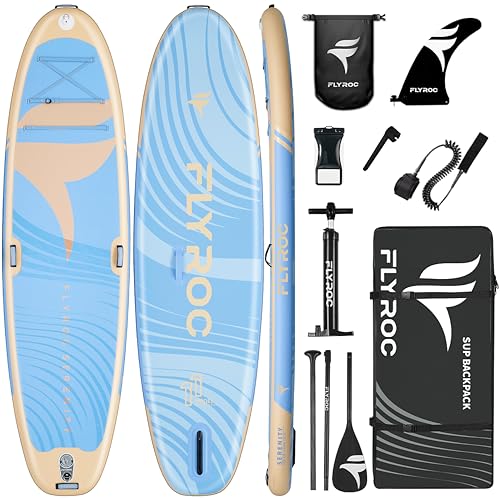
- Size11 ft x 35 in x 6 in
- Capacity430 lb
- Deck100 percent EVA coverage
- Handlesfive, including two side handles
- Bungee6-point adjustable system
- Backpack100 L
- Useyoga, family and pets
Best for: Dogs that wander the whole length of the board
Most boards cover about sixty percent of the deck in EVA and leave bare PVC at the nose and tail. That is where a wet dog slips.
Full coverage removes the question entirely, and it is the same feature that makes a board work for yoga.
Five handles matter with a dog too, because you will be lifting the board while holding a lead.
Strengths
- Full EVA coverage, so there is no slippery PVC anywhere
- Five handles, which makes lifting a loaded board manageable
- Six-point bungee for gear
- Two hundred dollars for full deck coverage
Weaknesses
- Full EVA adds weight
- Marketed for yoga, so the fin setup is not tuned for tracking

- Size11 ft 6 x 35 in x 6 in
- Capacity550 lb
- D-rings14 reinforced
- Bungeefront and rear cords
- Handlesthree built in
- Includedadjustable paddle, pump, bag, leash, removable fins, repair kit and phone pouch
- Watersea, lake and river
Best for: A large dog plus an adult plus gear, or two dogs
Capacity is not just about not sinking. A board loaded near its limit flexes in the middle, and that flex is what makes a dog nervous.
Buying more capacity than you need is the cheapest way to make a board feel rigid with a passenger aboard.
Fourteen D-rings gives you somewhere to clip a short tether, which is worth doing on open water even with a confident swimmer.
Strengths
- Five hundred and fifty pounds is the highest capacity here
- Fourteen D-rings, enough to rig a seat or a dog tether
- Front and rear bungees, so gear does not crowd the dog
- A hundred and sixty six dollars for this capacity is good value
Weaknesses
- High capacity boards feel corky when lightly loaded
- A generic board rather than a dog-specific one

- Size11 ft x 33 in x 6 in
- Weight19 lb
- Capacityover 500 lb
- Finsfour detachable including a larger balance fin
- Mountstwo multifunctional for camera, cup holder or rod
- Includedadjustable paddle and full accessory set
- Guarantee3 year manufacturer, 30 day return
Best for: Two adults or an adult and a child, with the dog aboard too
Nineteen pounds for a board with a five hundred pound capacity is genuinely light, and that matters when you carry the board and manage a dog at the same time.
Thirty three inches is narrower than ideal for a large dog, so treat this as the family board that also takes a small or medium one.
The larger balance fin is the right idea for a loaded board, which otherwise wanders badly.
Strengths
- Over 500 lb capacity in a board that weighs only 19 lb
- Three year guarantee, which is unusual at this price
- Four fins, including a larger one for tracking under load
- Two accessory mounts
Weaknesses
- Thirty three inches is the narrowest board here
- Marketed as a family board rather than a dog board

- Size20.87 x 12.6 in, 53 x 32 cm
- Piecesfour pads with a paw pattern
- MaterialEVA foam, flexible and stretchy
- Fittingtrimmable to shape
- Usepaddle boards, kayaks, skimboards
- Colourblack, also in white
Best for: Adding grip and scratch protection to a board you already own
If you already own a board that is wide enough, this is the cheap fix for the one real problem, which is the bare PVC at the nose and tail.
Clean the area with alcohol, let it dry properly and press the pads down on a warm day. Cold PVC does not bond.
It works equally well on a kayak deck, and on the bare tail of an all-around board that was never sold as pet friendly.
Strengths
- Twenty five dollars to fix the slippery tail on any board
- Trimmable, so it fits round handles and D-rings
- EVA is the same material as a factory deck pad
- Also protects the board from claws
Weaknesses
- Adhesive pads need a clean dry surface and a warm day
- Not a substitute for actual width
How to choose a paddle board for a dog
Thirty five inches wide, minimum: Below that, a dog moving from the middle to the nose will tip you. Thirty four is workable with a small dog and a light paddler; forty two is stable enough that you will barely notice the dog stand up.
Deck pad coverage, not just deck pad: Sixty percent EVA coverage means bare PVC at the nose and tail, which is exactly where a wet dog ends up. Full coverage, or a separate pet pad at the tail, is the feature to look for.
Add both weights and then some: Your weight plus the dog plus the paddle, pump and cooler. Stay well under the stated capacity, because a board near its limit sags in the middle and that flex is what unsettles a dog.
Plan how the dog gets back on: A swimming dog cannot climb a six inch rail, and hauling one aboard from standing is how paddlers end up in the water. A ramp tail, or training the dog to be lifted from a kneeling position, is not optional on open water.
Both of you wear flotation: Dogs tire faster than owners expect, especially in cold water or current. A canine flotation device with a handle also gives you something to lift by, and you should be wearing a buoyancy aid yourself.
Frequently asked questions
Will my dog's claws puncture an inflatable board?
Very unlikely. Drop stitch PVC is several millimetres thick and far tougher than it looks, and the deck pad takes most of the contact. What claws do cause is scratching and eventually wear on bare PVC, which is why a pet pad at the tail is worth having.How do I train a dog to paddle board?
Start on land with the board inflated, feeding the dog on it until standing there is normal. Then kneel and paddle in shallow water for a few minutes at a time. Most dogs are comfortable within three or four short sessions, and rushing that is what creates a dog that will not board at all.Should my dog wear a life jacket?
Yes, on any open water. Even strong swimmers tire, and cold water or current shortens that dramatically. The real reason is the grab handle on the back, which is the only practical way to lift a dog back aboard.What size dog can a paddle board carry?
Any size, within the capacity limit, but the board width matters more than the dog's weight. A 35 inch board handles a labrador comfortably; a 32 inch board will not, no matter what the capacity says. See our all-around board guide for the general shapes.Bottom line
The NACATIN is the pick because it answers the question every other board here ignores, which is how a wet dog gets back on. Thirty six inches of width and a textured ramp tail is the combination that makes paddling with a dog relaxing rather than tense.
Spend less and the BIGFLY at thirty five inches with a scratch resistant pet pad does most of it for two hundred and thirty dollars. If your dog is large or anxious, take the width instead and accept the slow paddling that comes with the forty two inch ZLX.


